
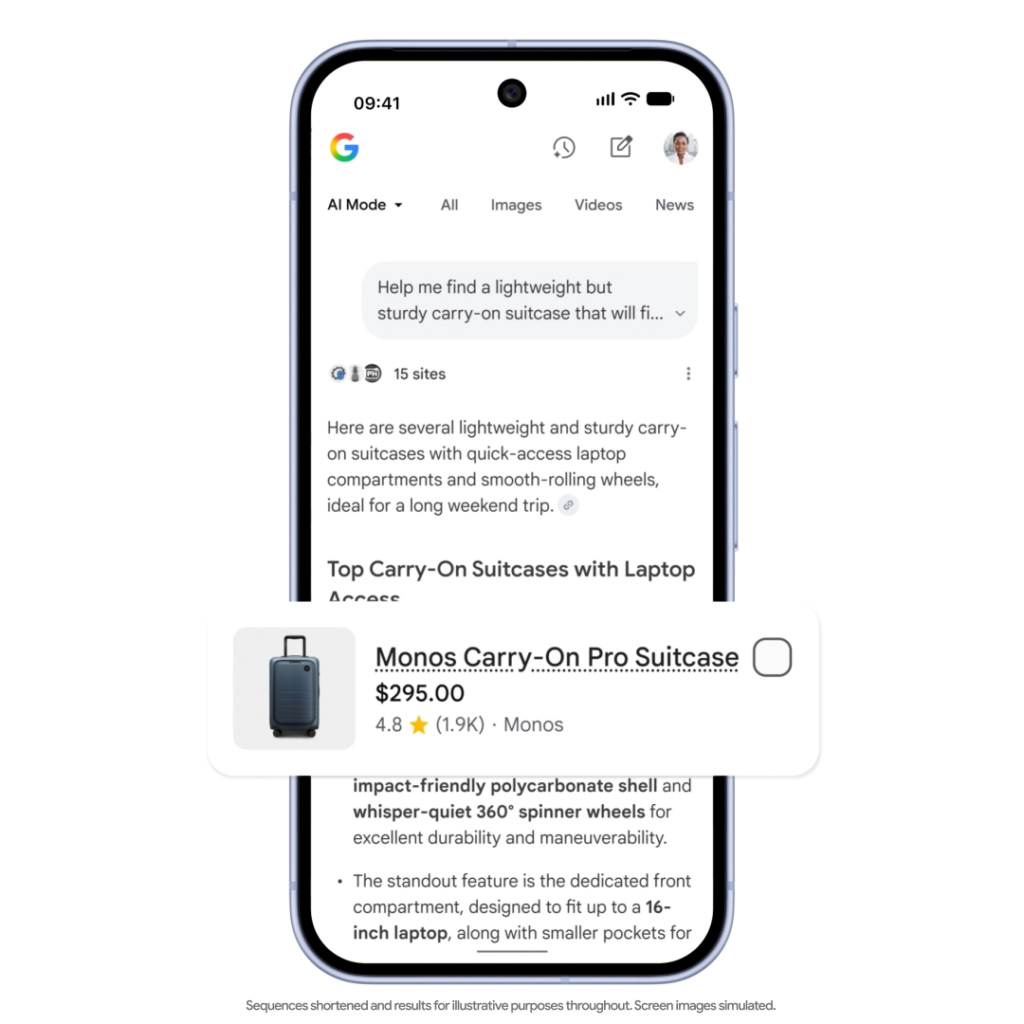
Google’s announcement of the new Universal Commerce Protocol marks a turning point in the way we shop online. This initiative, driven by artificial intelligence and a more open and connected approach to commerce, promises much smoother, more personalized, and more efficient shopping experiences. In this article, we explore in detail what the Universal Commerce Protocol is, how it relates to Google’s new AI-powered commerce tools, and what implications it has for retailers, technology platforms, and consumers.
What the Universal Commerce Protocol is and why it represents a paradigm shift
The Universal Commerce Protocol, driven by Google, is a proposed open standard designed to make it easier for retailers, platforms, and artificial intelligence agents to connect with each other in a simple and secure way. Its goal is to create a universal commerce ecosystem where different AI solutions, marketplaces, online stores, and advertising tools can collaborate without technical friction or excessive dependence on a single provider.
Instead of each company building custom integrations with every platform or assistant, the Universal Commerce Protocol proposes a common language to describe products, prices, availability, shipping conditions, returns, buyer preferences, and other critical elements of the digital shopping experience. This accelerates innovation and allows AI-driven shopping experiences to evolve faster.
Google’s approach with this protocol aligns with the rise of AI commerce agents, also known as shopping agents or conversational agents. These systems use advanced language models and real-time data to help users discover products, compare options, configure complex orders, and complete purchases without leaving the conversation or switching between multiple websites.
In this new scenario, the Universal Commerce Protocol acts as the standardization layer that defines how these agents communicate with product catalogs, shopping carts, payment systems, and logistics solutions. This reduces friction for both brands and consumers, who benefit from more consistent and connected shopping experiences.
How the Universal Commerce Protocol fits into Google’s AI commerce vision
The Universal Commerce Protocol does not emerge in isolation. It is part of a broader Google strategy to drive AI-powered commerce, often referred to as agentic commerce. This vision is based on a simple but powerful idea: instead of people manually searching, comparing, and managing each step of the purchasing process, they will be able to delegate much of this work to AI-powered agents.
Google is developing a set of tools that allow retailers to build their own AI commerce agents, integrated into websites, apps, and even other channels such as search engines, voice assistants, or messaging platforms. These agents will be able to understand user intent, suggest relevant products, provide personalized recommendations, and even answer complex questions about compatibility, usage, or technical specifications.
In this context, the Universal Commerce Protocol acts as a crucial interoperability layer. Instead of building specific integrations for each agent or platform, retailers can expose their catalogs and services through this common protocol, which makes it easier to:
- Allow different AI agents to access the same information consistently
- Enable technology platforms to integrate many retailers without excessive technical costs
- Ensure product data is more consistent across different sales channels
- Maintain a unified shopping experience even when users switch devices or touchpoints
In this way, AI-powered commerce is not limited to a single interface or assistant, but becomes a network of connected experiences orchestrated by standards like the Universal Commerce Protocol that ensure all components can work together.
Benefits of the Universal Commerce Protocol for retailers and platforms
Adopting the Universal Commerce Protocol can bring significant benefits to both retailers and e-commerce, advertising, and data platforms. Although it may require initial technical adaptation, the medium- and long-term advantages are substantial.
Benefits for retailers and brands
For retailers, the Universal Commerce Protocol represents an opportunity to expand reach and improve customer experience without completely reinventing their infrastructure. Key advantages include:
- Interoperability with multiple AI agents: By exposing catalogs and business logic through an open standard, the same dataset can be used by different commerce agents, shopping assistants, and platforms without custom development for each one.
- Lower integration costs: Instead of maintaining multiple custom APIs, retailers can invest in a single robust implementation of the protocol and reuse it across different channels and partnerships.
- Greater data consistency: Product, pricing, and availability data is managed from a single source, reducing errors, outdated information, and discrepancies across channels.
- Access to new shopping experiences: Early adopters can participate in innovative conversational commerce experiences, intelligent recommendations, and multi-device shopping flows.
- Improved conversion rates: By reducing friction in the purchasing process and providing more accurate contextual information, conversion rates can increase significantly.
Benefits for technology platforms and commerce ecosystems
E-commerce platforms, marketplaces, retail software providers, and other intermediaries also benefit from a common language like the Universal Commerce Protocol:
- Faster integrations with new merchants, since the data model and core operations are already standardized.
- Greater scalability when managing large volumes of retailers and products without supporting dozens of different schemas.
- Easier integration of AI agents that can work with the same dataset without complex translations.
- More open ecosystem where new tools and solutions can join without technical barriers, fostering innovation.
Overall, this approach reduces vendor lock-in and enables a more competitive digital commerce landscape, where the best products and experiences can stand out regardless of the underlying platform.
The role of artificial intelligence in the Universal Commerce Protocol
The main reason the Universal Commerce Protocol is so relevant today is the rapid advancement of artificial intelligence applied to commerce. Language models and recommendation systems are no longer limited to simple suggestions; they can act as real shopping assistants capable of understanding complex needs and proposing personalized solutions.
For these agents to work effectively, they need access to granular, structured, and up-to-date information about products, services, prices, promotions, return policies, and more. This is where the protocol plays a key role:
- It standardizes how products and services are described, allowing AI to interpret them more accurately.
- It enables real-time access to inventory and availability data, which is essential to avoid recommending out-of-stock items.
- It allows business rules and constraints to be transmitted, such as purchase limits, incompatible product combinations, or shipping requirements.
- It enables advanced personalization by combining user behavior data with a well-structured catalog.
For example, an AI commerce agent using the Universal Commerce Protocol can help a user configure the purchase of a laptop, including compatible accessories, extended warranty options, and installation services, all within a single conversation. The protocol ensures the agent knows which combinations are valid, what prices apply, and what delivery times are available based on the customer’s location.
Without a standardization layer, each agent would need to manually adapt to each retailer’s internal logic, making it impossible to scale these experiences. With a common protocol, artificial intelligence can focus on understanding and helping the user rather than navigating a complex web of different technical integrations.
Use cases and practical examples of the Universal Commerce Protocol
Although the Universal Commerce Protocol is still in its early stages, several use cases already point to how it could radically transform shopping experiences and operational efficiency in commerce.
AI shopping assistants integrated into websites and apps
A retailer can deploy an AI commerce agent on its website that acts as a 24/7 expert salesperson. Thanks to the protocol, this agent can:
- Access a fully structured product catalog, including size, color, and configuration variations.
- Check real-time stock and delivery times based on user location.
- Apply active promotions and automatically calculate the best available price.
- Guide customers step-by-step through complex purchases, such as appliances with installation or modular furniture.
All of this reduces the need for users to browse dozens of pages or filters, since they can express their needs in natural language and let the agent, powered by the protocol, build the best offer.
Cross-channel shopping experiences
Another interesting scenario is shopping journeys that begin on one channel and end on another. For example, a user could start a conversation with an AI agent in a search engine, discover products from different stores, save some to a list, and complete the purchase later in the retailer’s mobile app.
Thanks to the Universal Commerce Protocol, the information used by the agent to present products, prices, and availability remains consistent across platforms, reducing confusion. In addition, business rules are preserved end-to-end without needing to be reconfigured in each environment.
AI-driven marketing and advertising optimization
Google’s and other platforms’ advertising solutions can also benefit from the protocol. With more structured and standardized product data, AI-powered ads can:
- Generate more relevant creatives with messages aligned with real inventory and active promotions.
- Avoid showing out-of-stock products or items with long delivery times for specific locations.
- Suggest product bundles or cross-sells that respect compatibility rules and business margins.
- Better measure campaign performance with aligned conversion events and catalog data.
The result is more efficient marketing, less wasted ad spend, and an advertising experience that feels more useful and less intrusive for the end user.
Challenges and considerations when adopting the Universal Commerce Protocol
Despite its clear advantages, adopting the Universal Commerce Protocol is not without challenges. Retailers and platforms must carefully evaluate several aspects before implementation.
Technical investment and system adaptation
Adopting a new standard requires reviewing existing product, inventory, pricing, and order management systems. For many companies, this involves:
- Updating or extending data models to align with the protocol schema.
- Reviewing existing integrations with other platforms to avoid duplication or conflicts.
- Training technical and business teams on the new interoperability layer.
However, this investment is usually offset by reduced future integration costs and greater agility when connecting to new channels and AI agents.
Data governance and experience control
By exposing more data through a common standard, retailers must ensure they maintain control over how that data is used and how their brand is represented. This requires clear policies regarding:
- What information is shared through the protocol and at what level of detail.
- Criteria for collaborating with platforms or agents using that data.
- How to ensure the shopping experience reflects brand values and positioning.
The open approach of the Universal Commerce Protocol does not mean losing control, but rather having a structured way to share information under defined and measurable terms.
How to prepare for the future of AI commerce and the Universal Commerce Protocol
For retailers and platforms looking to stay ahead in this new era of AI-driven commerce, several strategic steps are recommended:
- Assess current digital maturity: Review the quality and structure of product, inventory, and customer data. The better organized it is, the easier it will be to integrate into the protocol.
- Define priority use cases: From on-site shopping assistants to advertising integrations, it is best to start with specific projects that deliver visible impact.
- Collaborate with technology providers: Working with partners already exploring or implementing the Universal Commerce Protocol can accelerate adoption.
- Train business and marketing teams: AI commerce and standardization are not just IT projects. Commercial and marketing teams must understand how to leverage these capabilities.
- Monitor and iterate: Measuring improvements in conversion, average order value, customer satisfaction, and operational efficiency will help justify further investment.
The sooner companies begin this journey, the better positioned they will be to integrate into the emerging network of intelligent shopping experiences being built around AI and standards like the Universal Commerce Protocol.
Final reflection on the new era of AI-powered shopping
The launch of the Universal Commerce Protocol by Google is a clear signal of where digital commerce is heading: toward a more open, connected environment powered by AI agents that act as personal shopping assistants. For retailers, it offers an opportunity to participate in these new experiences without relying on costly and fragmented integrations. For users, it promises simpler, more relevant, and smoother shopping, regardless of device or channel.
Now is the time for companies to assess their readiness, improve data quality, and explore how to join this new ecosystem. Those who adopt the Universal Commerce Protocol and AI commerce tools early will be better positioned to lead the next phase of e-commerce.
Source: blog.google/products/ads-commerce/agentic-commerce-ai-tools-protocol-retailers-platforms/

 Sep 11, 2026


