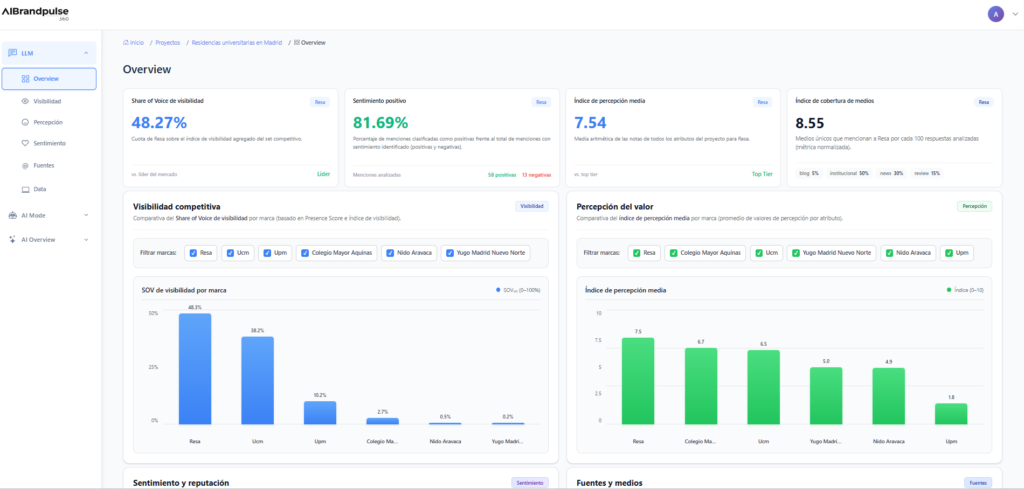
Language models have become a new intermediary between brands and their audiences. Increasingly, systems such as ChatGPT, Google AI Overview, or Google AI Mode explain sectors, compare options, synthesize reputation, and assign value attributes before the user visits a website, checks a ranking, or interacts with an ad.
This shift has created a clear gap in traditional measurement systems. Brands still track traffic, rankings, media mentions, or social sentiment, but they lack visibility into how they are being interpreted within generative environments. They do not know what the AI says about them, in which contexts they appear, with what tone, or against whom they are being compared.
AIBrandpulse360 was created to solve that problem. Not as just another monitoring tool, but as a structured methodology to analyze brand presence, perception, and reputation in AI and LLMs, where a critical part of the decision-making process is already being shaped.
The gap left by traditional monitoring in the AI era
Classic metrics have not disappeared, but they are no longer sufficient. Organic traffic does not reflect how many times a brand is used as a reference by a generative model. Media share of voice does not explain how that noise is synthesized into an AI response. And social listening sentiment does not always match the tone an LLM uses when describing a brand.
The problem is not technical, but conceptual: language models do not function as channels, but as interpretation systems. They reduce complexity, prioritize sources, compare actors, and generate narratives. Measuring that process requires a different approach.
AIBrandpulse360 sits exactly in that intermediate layer, providing observability over an environment that has until now been opaque.
What AIBrandpulse360 actually analyzes
AIBrandpulse360 does not simply detect literal mentions. Its focus is on how AI models represent a brand when generating responses.
Based on systematic analysis of LLM outputs and generative environments, the methodology evaluates dimensions such as:
Actual brand presence in generated responses.
Level of prominence compared to competitors.
Contexts in which it appears (explanatory, comparative, recommendation-based).
Recurring associated attributes.
Role assigned to the brand within the narrative.
Sources and media reinforcing that representation.
This approach makes it possible to move from “my brand appears” to “my brand exists in this specific form within the generated narrative”.
KPIs designed specifically for generative environments
One of AIBrandpulse360’s key contributions is the definition of AI-native metrics, aligned with how generative models work, not how search engines work.
Key indicators include:
The Presence Score, which measures the intensity and recurrence with which a brand appears in generative responses, and the Visibility Score, which evaluates its relative prominence compared to other market players. This distinction is essential to identify brands that appear tangentially versus those that truly structure the discourse.
The AI Visibility Share of Voice helps understand which brands are defining the sector narrative within models, not in media or SERPs, but in the layer where synthesis happens.
To this are added metrics such as number of appearances, responses with explicit mention, percentage of unique appearances, or average position within generated discourse, which help detect patterns of leadership, stability, or marginality.
Reputation and sentiment in AI: a layer different from public reputation
One of the most critical use cases of AIBrandpulse360 is AI reputation monitoring.
The tool analyzes sentiment associated with brand mentions inside generated responses, allowing evaluation of how a brand is described when AI acts as a recommender or explainer.
This is especially relevant because sentiment in AI does not always match sentiment in media or social networks. A brand may enjoy a strong public reputation and yet be described in an ambiguous, incomplete, or even negative way in generative responses due to the quality of available sources or informational inconsistencies.
Detecting these misalignments early is key to preventing them from becoming a structural perception.
Sources and media that shape generative perception
AIBrandpulse360 includes a detailed analysis of sources and media that influence how a brand is represented within language models.
The methodology identifies:
Which types of sources carry more weight (media, institutional, blogs, reviews).
Which specific outlets reinforce the generated narrative.
How influence is distributed by source type.
The relationship between media coverage and AI visibility.
For communication and PR teams, this is especially valuable, as it helps focus efforts on those sources that truly impact generative perception, not just traditional reach.
Monitoring in LLMs, AI Overview, and Google AI Mode
AIBrandpulse360 provides a cross-platform view of brand presence across generative environments. Not all systems work the same way or prioritize the same signals.
The methodology allows analysis of:
Brand representation in conversational LLMs such as ChatGPT.
Appearance and treatment in Google AI Overview.
Presence and framing in Google AI Mode.
This comparative view is key for marketing teams, since a brand may perform well in one environment and be marginal in another. Without this layer of analysis, these differences go unnoticed.
AIBrandpulse360 as a methodology, not just a tool
One of the most distinctive elements of AIBrandpulse360 is that it was not designed as a purely automated or plug-and-play solution.
Its core value lies in a hybrid methodology that combines systematic analysis technology with expert human interpretation of LLM-generated responses. This is a deliberate choice.
Language models are contextual, not deterministic. Two seemingly similar outputs can have very different strategic implications depending on tone, implicit attribution, comparative framing, or semantic nuance. This level of reading cannot be fully automated with reliability.
AIBrandpulse360 prioritizes real understanding of generated discourse over the convenience of an automated dashboard. This places it outside many fully automated SaaS tool categories, but also makes it significantly more reliable for strategic contexts.
It is not designed for those who only want self-updating metrics, but for teams that need judgment, interpretation, and narrative control.
Strategic use cases of AIBrandpulse360
From this methodological perspective, AIBrandpulse360 is used as a strategic intelligence layer across several key areas.
In organic strategy and GEO positioning, it helps identify which concepts models reinforce, which they ignore, and where semantic gaps exist versus competitors, providing actionable insights for content, architecture, and communication.
In reputation management, it allows monitoring how AI describes the brand, detecting emerging biases or risks, and evaluating the consistency of generated discourse over time.
And in communication and PR decision support, it connects sources, messaging, and AI outcomes, enabling prioritization of actions with real impact in generative environments.
In market research, it helps analyze how the sector narrative is structured, which brands lead specific attributes, and how generative perception evolves, offering a view that traditional studies do not capture.
Do you want more information?
Make your brand stop going unnoticed and start positioning itself where it really matters: in the search results.
Boost your organic visibility and grow your brand.