
The financial and banking sector has always operated within a particularly demanding digital framework. Regulation, data sensitivity, the direct impact on economic decision-making, and a constant need for credibility have historically shaped any online visibility strategy. With the rise of generative AI, these demands not only remain but are becoming even more intense.
Language models are beginning to act as informational intermediaries, summarizing financial content, contextualizing risks, and providing explanations that influence user decisions even before they visit a website. In this scenario, traditional SEO evolves into a broader concept: AI positioning or also known as GEO (Generative Engine Optimization), where authority and trustworthiness matter as much as technical optimization.
For financial institutions, insurers, and fintechs, this represents a structural shift. It is no longer enough to be visible. It is necessary to be correctly interpreted by systems that prioritize accuracy and trust.
Why AI SEO is especially critical in finance
AI systems apply a higher level of caution when processing financial information. This caution is not arbitrary: it responds to the classification of this type of content as high-impact for users, which implies stricter standards of quality and reliability.
Organizations such as the European Commission have explicitly highlighted the need to treat financial and economic information with special care in automated systems, as reflected in the framework of the AI Act

In practice, this means that GEO positioning within the financial sector is not based on popularity, but on legitimacy. Brands that consistently appear in generative responses tend to share a key characteristic: their content aligns with regulatory, educational, and transparency criteria.
From a strategic perspective, SEO for AI in banking is not a customer acquisition tactic, but a direct extension of institutional reputation.
How AI interprets financial information
Unlike a traditional search engine, AI does not simply index and retrieve documents. It analyzes patterns, cross-checks sources, and prioritizes those that present higher conceptual coherence and lower risk of misleading the user.
In finance, this translates into a clear preference for content that:
- Explains concepts with technical rigor.
- Includes warnings and regulatory context.
- Clearly distinguishes educational information from commercial messaging.
- Avoids promises or overly persuasive language.
This approach aligns with recommendations from organizations such as the European Securities and Markets Authority (ESMA), which emphasizes the importance of clear and non-misleading communication in financial matters.
From an AI positioning perspective, content that follows these principles is far more likely to be used as a basis for generated responses. In the past, Google already rewarded these same factors through the well-known E-E-A-T framework.
AI SEO and EEAT in the financial sector
In the financial sector, EEAT does not function as an abstract set of quality signals, but as a geographical and regulatory filter. This is a critical difference compared to other industries. In finance, AI does not only evaluate whether content is correct, but whether it is correct within a specific territorial context.
From a geographical positioning perspective, this adds another layer to traditional SEO: it is not enough to be an expert in finance; one must be an expert in finance within a specific legal, fiscal, and regulatory framework.
When generating financial responses, language models tend to implicitly segment by region. They do not “understand laws” like humans do, but they detect patterns of authority linked to specific jurisdictions.
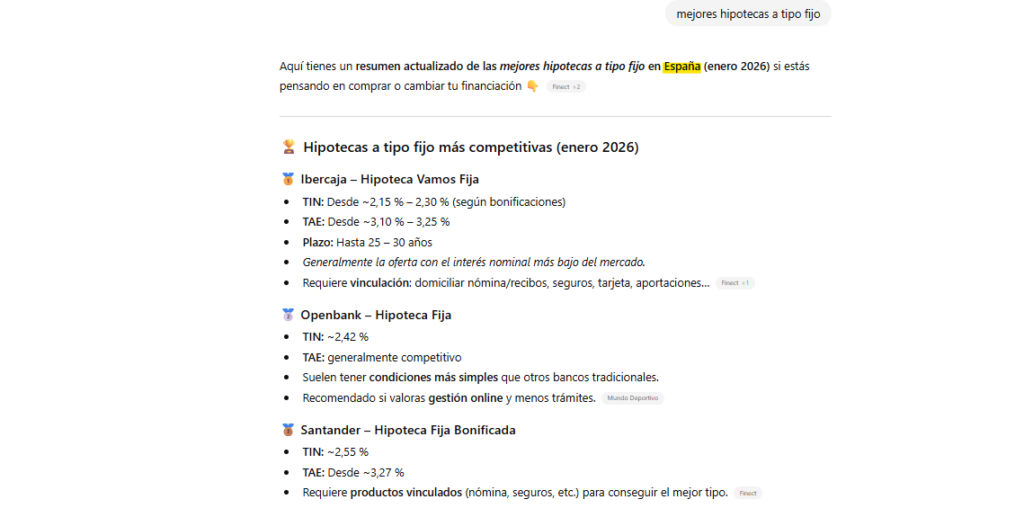
From an AI SEO perspective, these signals are not decorative: they are decisive.
Financial content architecture for AI
Within the context of GEO positioning for the banking and financial sector, content architecture is no longer a matter of navigation or internal linking, but a matter of organizing knowledge in a way that is readable for language models.
LLMs such as ChatGPT do not interpret a website as a collection of independent URLs, but as a set of recurring semantic patterns that define what topics an entity dominates and at what level of depth. OpenAI states in its documentation that models generate responses based on generalized representations of knowledge, where thematic consistency, structured repetition, and conceptual clarity directly influence the quality and reliability of outputs.
From this perspective, an architecture oriented toward GEO in banking and finance must prioritize stable and well-defined content hubs dedicated to major knowledge areas (risk, credit, investment, savings, regulation, payments), rather than fragmented structures focused solely on products or campaigns.
The role of schema and structured data in financial environments
In AI positioning for banks, structured data plays an essential role: reducing ambiguity. In finance, where precision is critical, this becomes even more important.

The consistent use of schema allows content type, responsible entity, expert authorship, and update date to be explicitly declared. This is especially relevant to distinguish between educational information and commercial communication, a line that financial regulators consider fundamental.
Common risks in financial AI SEO
One of the most common mistakes is transferring generic content strategies into a sector that requires extreme precision. Overly simplified, ambiguous, or clearly conversion-oriented texts can be counterproductive in AI environments.
Another frequent risk is the disconnect between marketing, communications, and compliance. When messages are not aligned with regulatory frameworks, the likelihood of AI using that content as a reference decreases significantly.
The absence of clear authorship or the use of generic profiles is another critical factor. In a sector where trust is essential, identifying editorial responsibility provides a signal of credibility that is difficult to replace.
Measuring AI positioning in banking and finance
AI positioning measurement cannot rely solely on traditional metrics. In the financial sector, indicators such as recurrence of appearance in generative explanations, accuracy in describing capabilities, or association with concepts such as security, solvency, or responsible advice become highly relevant.
These indicators should be interpreted alongside traditional metrics, but they provide a strategic view aligned with the evolution of the digital ecosystem.
In this context, specialized tools such as AIBrandpulse 360 de Vipnet360 are positioned as ideal solutions, as they allow quantifying how and how often a financial brand is explicitly or implicitly referenced in multiple generative AI systems, analyzing conceptual associations, and comparing its presence against other market players.

 Sep 11, 2026