
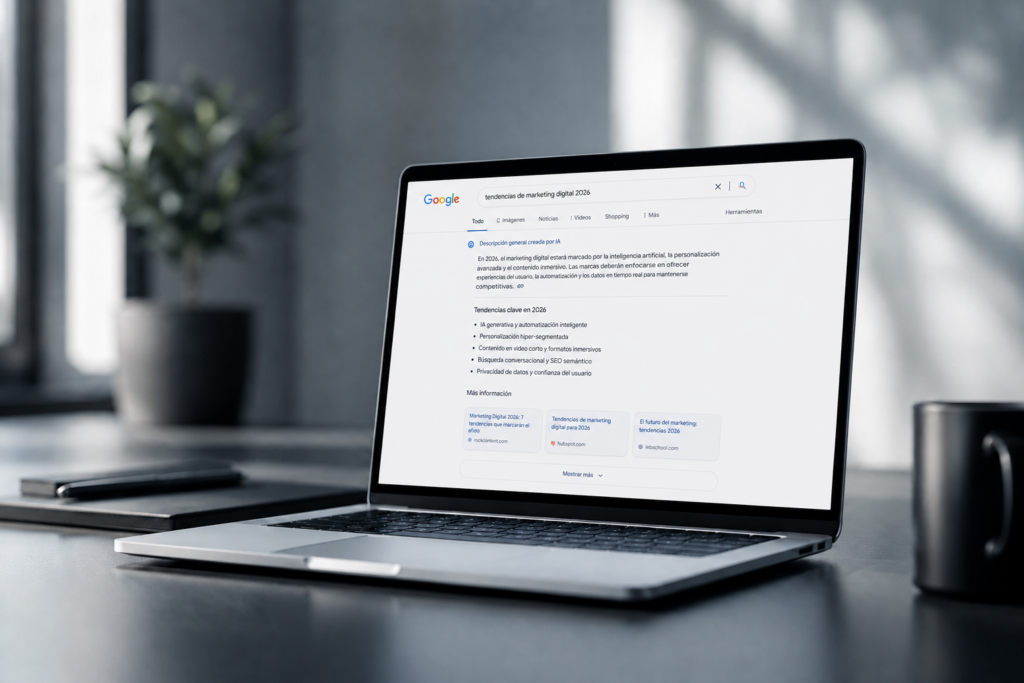
Google is transforming the search experience through Google AI Overviews, AI-generated answers that appear directly at the top of many search results. Instead of simply displaying a list of links, Google synthesizes information from multiple sources and provides users with an immediate, more contextual, and easier-to-understand response.
For brands, this change represents both a new visibility opportunity and a strategic challenge. It is no longer enough to rank a page among the top organic results: it is increasingly important to become a source that Google considers trustworthy, relevant, and authoritative enough to be included in its generative responses.
In this guide, we analyze what Google AI Overviews are, how they work, their impact on visibility and traffic, and the strategies that can help brands stand out in an environment where traditional SEO is increasingly coexisting with disciplines such as GEO and optimization for generative engines.
What Are Google AI Overviews?
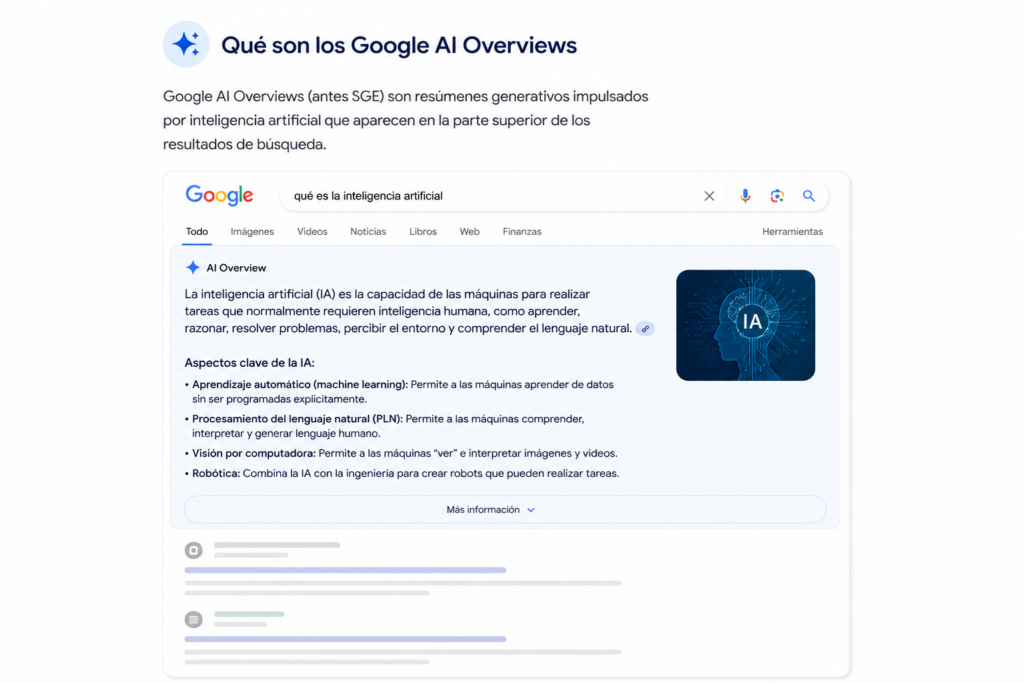
Google AI Overviews are generative responses created by Google’s AI directly within the search results page. Their goal is to help users quickly understand a topic by gathering information from different sources and presenting it in a summarized, structured response accompanied by links for further exploration.
This format emerged from the evolution of Google SGE, the experiment through which Google began testing generative search experiences. The main difference compared to traditional results is that users no longer need to interpret a list of links themselves: Google performs part of that work, connects ideas, and provides an initial answer directly in the SERP.
| Traditional Result | AI Overview |
| List of links | AI-generated answer |
| The user interprets the information | Google synthesizes the information |
| Requires multiple clicks to compare sources | Provides an immediate answer |
| Traditional SEO based on rankings | SEO + GEO based on authority, entities, and semantic relevance |
This does not mean links are no longer important. In fact, AI Overviews can include references to external pages, creating a new visibility channel for brands. The key is understanding that Google no longer simply organizes information: it also interprets it, summarizes it, and decides which sources deserve to be part of that explanation.
How Google Builds a Generative Response
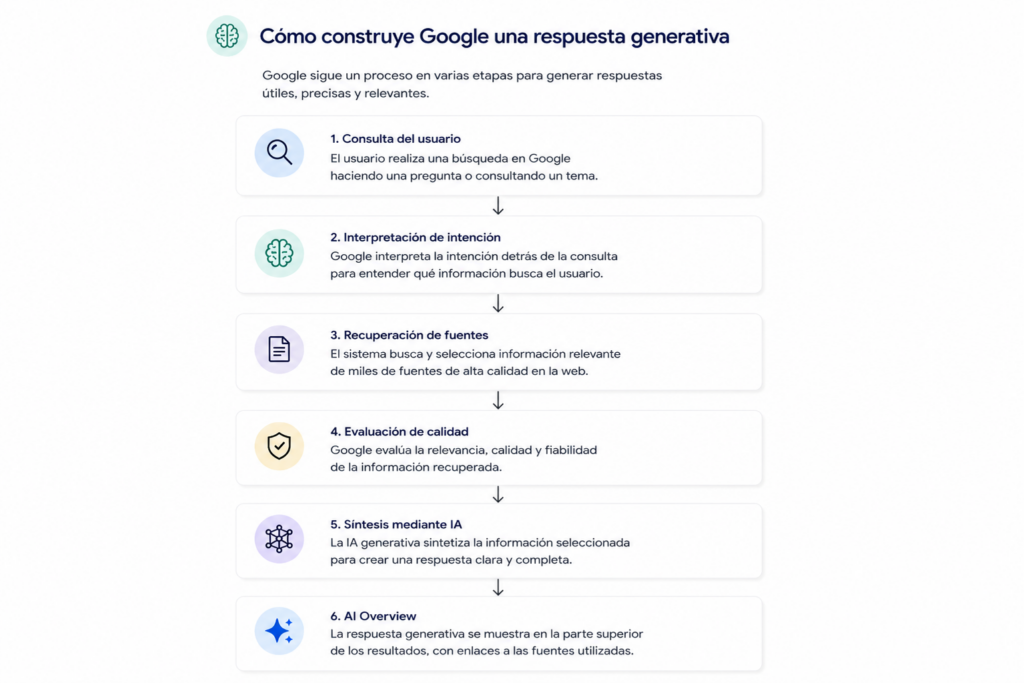
To understand why some brands appear while others do not, it is first necessary to understand how Google generates these responses.
Although Google does not disclose all the details of its systems, it has confirmed that AI Overviews relies on its traditional quality and ranking mechanisms. This means SEO remains important, but it must now be complemented by a more semantic approach focused on topical authority.
In simplified terms, the process typically includes five stages:
- Interpreting the query to understand the user’s true intent.
- Retrieving potentially relevant sources.
- Evaluating quality, authority, and trustworthiness.
- Synthesizing information using generative models.
- Including references or links when useful for expanding the answer.
In this context, semantic search takes on a central role. It is no longer enough to optimize for a specific keyword; content must cover a topic comprehensively, connect related concepts, and demonstrate a genuine understanding of search intent.
What It Means for a Brand to Appear in AI Overviews
Appearing in AI Overviews means that Google considers a brand or page capable of contributing value within a generative response.
For businesses, this can translate into powerful visibility even when users do not immediately click on the result. When Google uses a source to explain a topic, that brand becomes associated with expertise, trust, and authority within its industry.
The main benefits include:
- Greater visibility in informational searches.
- Stronger perceived authority.
- Increased brand awareness.
- Presence in the early stages of the decision-making process.
- Association with helpful and trustworthy answers.
In other words, appearing in AI Overviews is not only about capturing traffic. It also means gaining relevance at the exact moment Google constructs the answer that users will read and remember.

 Sep 11, 2026


