
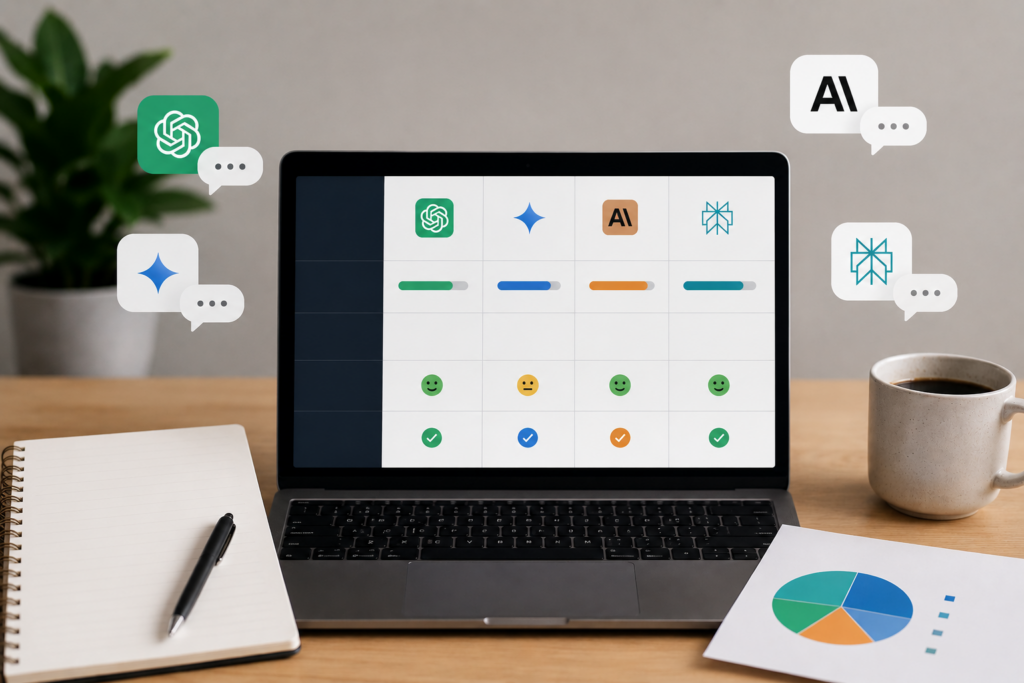
Search habits are evolving.
More and more users are turning to ChatGPT, Gemini, Claude, and Perplexity to discover solutions, research providers, compare alternatives, and ask for recommendations before making a decision.
This has created a new competitive space for brands: AI-generated responses.
The question is no longer just what position your website holds on Google. It also matters how your brand appears when a user asks an AI assistant which are the best companies in an industry, what alternatives exist to a specific solution, or which provider it recommends for a particular need.
Is your brand being mentioned? Does it appear before or after your competitors? Do the models correctly understand your value proposition? Is the perception consistent across platforms?
Answering these questions is essential for understanding brand visibility in the era of generative search.
In this guide, you will learn how to conduct a competitive audit in LLMs, which metrics to analyze, how to interpret the results, and which actions can help improve your positioning in ChatGPT, Gemini, Claude, and Perplexity.
Why Comparing Your Brand in LLMs Matters
Brand perception is no longer shaped solely through search engines, social media, or digital media. It is also being formed within AI assistants.
When users ask about the best tools in a category, the leading companies in a market, or alternatives to a specific solution, models select certain brands and leave others out. That initial selection can directly influence the discovery and consideration stages of the buying journey.
For this reason, analyzing how your brand appears across major AI models helps you understand:
- Whether your company is mentioned in queries relevant to your business.
- Which competitors receive greater visibility.
- How models describe your value proposition.
- Which attributes are associated with each brand.
- Potential reputational risks.
- Opportunities to improve your positioning.
AI brand visibility is no longer just an experimental metric. It can influence how users discover, compare, and remember a brand.
Differences Between ChatGPT, Gemini, Claude, and Perplexity
Not all models generate the same responses.
Each platform uses different sources, update mechanisms, and reasoning approaches, meaning the same query can produce different results depending on the assistant being used.
| Comparison | ChatGPT | Gemini | Claude | Perplexity |
| Natural conversation | Very high | High | Very high | Medium |
| Visible citations | Variable | Limited | Limited | Very frequent |
| Web updates | Depends on version | Yes | Variable | Yes |
| Comparative analysis | High | High | High | High |
| Source transparency | Medium | Medium | Low | High |
These differences mean that a competitive audit should not be limited to a single tool. Analyzing multiple models helps identify patterns, detect inconsistencies, and gain a more accurate understanding of how a brand is perceived in generative environments.
How to Conduct a Competitive Audit in LLMs
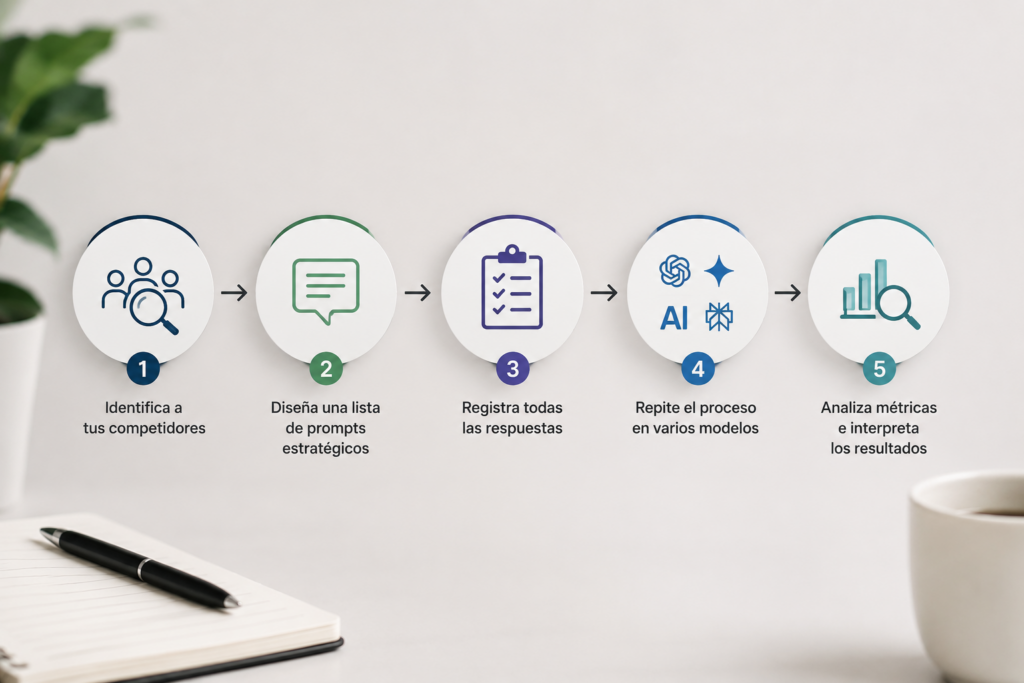
To compare your brand against competitors, it is advisable to use a structured and repeatable methodology.
1. Identify Your Competitors
Include direct competitors, emerging alternatives, and companies that frequently appear in industry comparisons.
It is also recommended to include brands that may not compete directly with you but could be considered relevant by AI models when solving the same user need.
2. Create a List of Strategic Prompts
The questions should reflect real searches performed by potential customers.
Some examples:
- Which are the best companies in [industry]?
- What alternatives exist to [brand]?
- Compare [brand] vs. [competitor].
- What tool would you recommend for [problem]?
- Which companies lead the [category] market?
- What is the best solution for [customer type]?
These types of queries help analyze visibility, positioning, recommendation, and brand perception.
3. Record All Responses
For each prompt, it is advisable to document:
- Brands mentioned.
- Order of appearance.
- Presence or absence of your brand.
- Associated attributes.
- Highlighted competitors.
- Tone used.
- Cited sources.
- Potential errors or outdated information.
This record will become the foundation for all subsequent analysis.
4. Repeat the Process Across Multiple Models
Run the exact same prompts in ChatGPT, Gemini, Claude, and Perplexity.
The goal is not to evaluate a single response, but to identify consistent patterns across multiple queries and platforms.
Which Metrics to Analyze When Comparing Brands in AI
A competitive audit should go beyond simply checking whether a brand appears or does not appear.
The most useful metrics include:
| Metric | What It Measures |
| Mention Frequency | How often the brand appears |
| AI Share of Voice | Market share compared to competitors |
| Position in the Response | Whether it appears at the beginning, middle, or end |
| Associated Sentiment | How the brand is described |
| Topic Coverage | Which categories the brand appears in |
| Consistency | Whether perception is similar across LLMs |
| Cited Sources | Which websites support the response |
AI Share of Voice is one of the most useful metrics because it allows you to compare your brand’s presence against competitors across a set of strategic prompts.
Useful Prompts for Comparing Brands in ChatGPT and Other LLMs
These prompts can serve as a starting point for a brand audit in LLMs.
Discovery Prompts
- “Which companies stand out in [industry]?”
- “What are the most relevant brands in [category]?”
- “What solutions exist for [problem]?”
Comparison Prompts
- “Compare [brand] with [competitor].”
- “What are the differences between [brand A] and [brand B]?”
- “Which is better for [customer type]?”
Recommendation Prompts
- “What tool would you recommend for [need]?”
- “What is the best option for a company that needs [goal]?”
- “Recommend providers for [service].”
Leadership Prompts
- “Who leads the [category] market?”
- “Which companies are considered leaders in [topic]?”
- “Which brands have the most authority in [industry]?”
Alternative Prompts
- “What alternatives exist to [brand]?”
- “Who are [brand]’s competitors?”
- “What options similar to [brand] should I consider?”
How to Interpret the Results Correctly
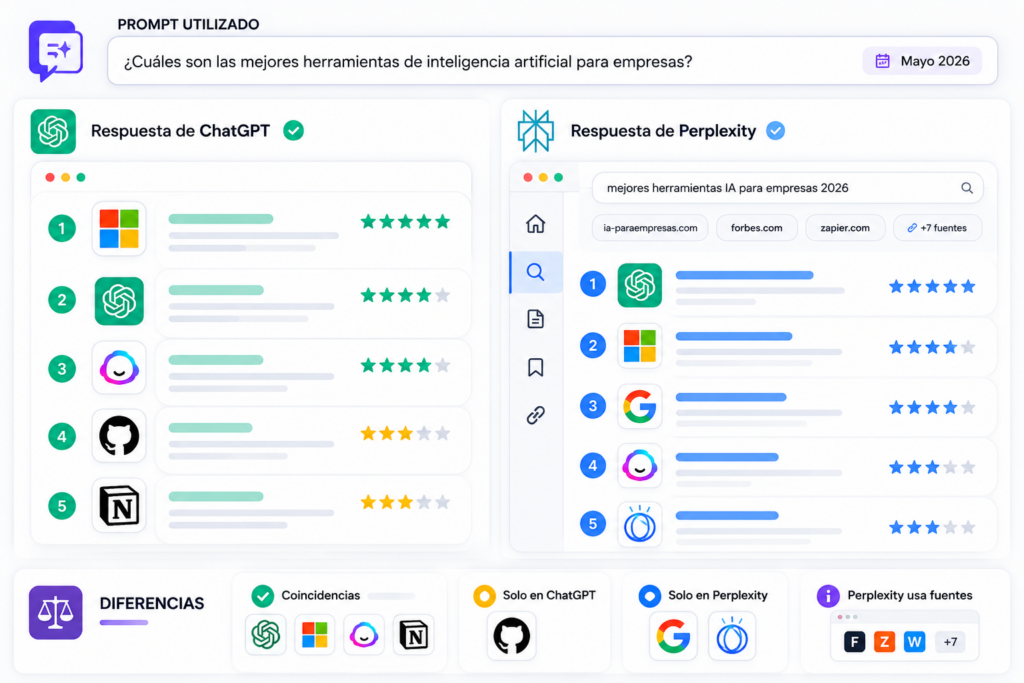
LLM results should be analyzed carefully.
There is no single truth, because each model may respond differently depending on its training data, source access, prompt formulation, and the timing of the analysis.
For this reason, the goal is not to draw conclusions from a single response but to identify patterns:
- Does your brand appear consistently?
- Which competitors dominate the responses?
- Does AI correctly understand your value proposition?
- Are there significant differences between platforms?
- Do errors or incomplete messages recur?
- Do your own sources appear, or only third-party sources?
The real value lies in systematic analysis, not in isolated testing.
To structure this monitoring process, you can rely on AI brand monitoring practices or specialized tools for tracking brands across LLMs.
How to Improve Your Positioning Against Competitors in AI
Once gaps have been identified, the next step is to improve your brand’s presence in generative environments.
Strengthen Your Owned Content
Your website, product pages, documentation, blog, and specialized resources should clearly explain:
- What your company does.
- Which category it competes in.
- Which problems it solves.
- Its key differentiators.
Build External Authority
Mentions in media outlets, comparison articles, industry reports, quality directories, and third-party publications help strengthen a brand’s credibility in the eyes of AI models.
Publish Original Research
Proprietary data, studies, and specialized analyses increase the likelihood that AI systems will consider your company a reference source within its industry.
Maintain a Consistent Narrative
Consistency is essential.
If a brand is described differently across every channel, models will have greater difficulty building a clear and accurate representation of it.
Monitor Competitors Continuously
AI visibility is not static.
Competitors can gain visibility through new mentions, content, research, or brand-awareness campaigns. For this reason, competitive analysis should be part of an ongoing monitoring process.
This is where disciplines such as GEO for brands, AI SEO, and language-model optimization come into play.
How Often Should You Repeat the Analysis?
The frequency will depend on the level of competition and the speed at which the market evolves.
As a general guideline:
- Highly dynamic industries: monthly reviews.
- Stable industries: quarterly reviews.
It is also advisable to conduct additional audits:
- Before major product launches.
- After brand campaigns.
- Following positioning changes.
- When key content is updated.
- If new competitors emerge.
- After a reputational crisis.
The key is to measure progress over time rather than relying on a single snapshot.
Which Teams Should Be Involved?
Although these initiatives often originate within SEO or digital marketing teams, the reality is that AI brand visibility affects multiple areas of an organization.
The teams that can contribute the most value include:
- Marketing.
- Communications.
- Public Relations.
- Corporate Reputation.
- Product.
- Sales.
- Customer Success.
- Strategic Leadership.
Each team brings a different perspective on key messaging, competitive differentiators, sales objections, and market perception.
For this reason, this type of analysis is especially valuable for marketing teams, communications teams, and reputation and public relations teams.
LLMs Have Already Become a New Competitive Channel
ChatGPT, Gemini, Claude, and Perplexity are influencing how users discover information, compare solutions, and form their first impressions of brands.
As a result, understanding how your company appears in these environments is becoming a competitive advantage.
Organizations that monitor their presence in AI will be able to identify opportunities before their competitors, correct narrative inaccuracies, strengthen authority, and increase visibility in AI-generated recommendations.
The strategy is simple:
Measure. Compare. Optimize. Monitor.
Because in the era of generative search, ranking web pages is no longer enough. Brands must also position themselves within the responses generated by artificial intelligence.

 Sep 11, 2026


