

When a brand wanted to increase its online visibility, the strategy was straightforward: appear in search engines for the right queries. However, the way users discover information is changing.
More and more people are turning directly to ChatGPT, Gemini, Claude, Perplexity, or Google AI Overviews to research solutions, compare providers, and make decisions. In this new landscape, it is no longer enough to appear in search results—it is also important to be part of the answers generated by artificial intelligence.
This is where LLMO (Large Language Model Optimization) comes into play, a discipline focused on increasing the likelihood that a brand will be mentioned, recommended, or used as a reference by language models.
In this guide, we will explore what LLMO is, how it works, how it differs from traditional SEO, and which strategies can help improve visibility in generative environments.
What Is LLMO?
LLMO stands for Large Language Model Optimization.
It encompasses the set of strategies aimed at improving how systems such as ChatGPT, Gemini, Claude, Perplexity, or Copilot understand, interpret, and represent a brand in their responses.
While traditional SEO focuses on ranking web pages in search engines, LLMO focuses on ranking knowledge.
Its goal is to ensure that a brand is recognized as a relevant entity within a category and appears when users ask questions related to its products, services, or areas of expertise.
For example, an LLMO strategy can help a company:
- Be mentioned when a user searches for solutions within a specific category.
- Appear in comparisons alongside competitors.
- Become associated with specific strategic attributes.
- Be perceived as a trustworthy source.
- Gain visibility in AI-generated recommendations.
- Maintain a consistent narrative across different models.
The distinction is important because digital visibility is no longer limited to search engine results pages. More and more decisions are starting directly within conversational interfaces.
If you’d like to dive deeper into this shift, you can read this guide on how to appear in ChatGPT and this analysis on what AI visibility is and why it matters.
Why LLMO Is Emerging
LLMO has emerged in response to a profound shift in search behavior.
For years, the process was relatively stable: users performed a Google search, reviewed several results, visited different pages, and built their own understanding.
Today, that process is beginning to change.
Instead of reviewing multiple links, many users prefer to ask a question and receive a synthesized answer from an AI system.
Questions such as:
- What is the best tool to monitor my brand’s visibility in AI?
- Which companies lead this category?
- What solution would you recommend for a B2B company?
- What alternatives exist to this platform?
no longer necessarily end in a list of search results. In many cases, they end with a direct answer.
When this happens, brands are competing for something different from clicks: they are competing to become part of the answer.
That is why concepts such as LLMO, GEO, AI SEO, and SEO for artificial intelligence are gaining prominence. They all attempt to answer the same question: how to optimize brand visibility when users are no longer just searching, but actively conversing with AI systems.
This new context also affects Google. Google AI Overviews demonstrate how traditional search is incorporating generative responses that can reshape the way users discover brands, content, and solutions.
LLMO vs. SEO: Key Differences
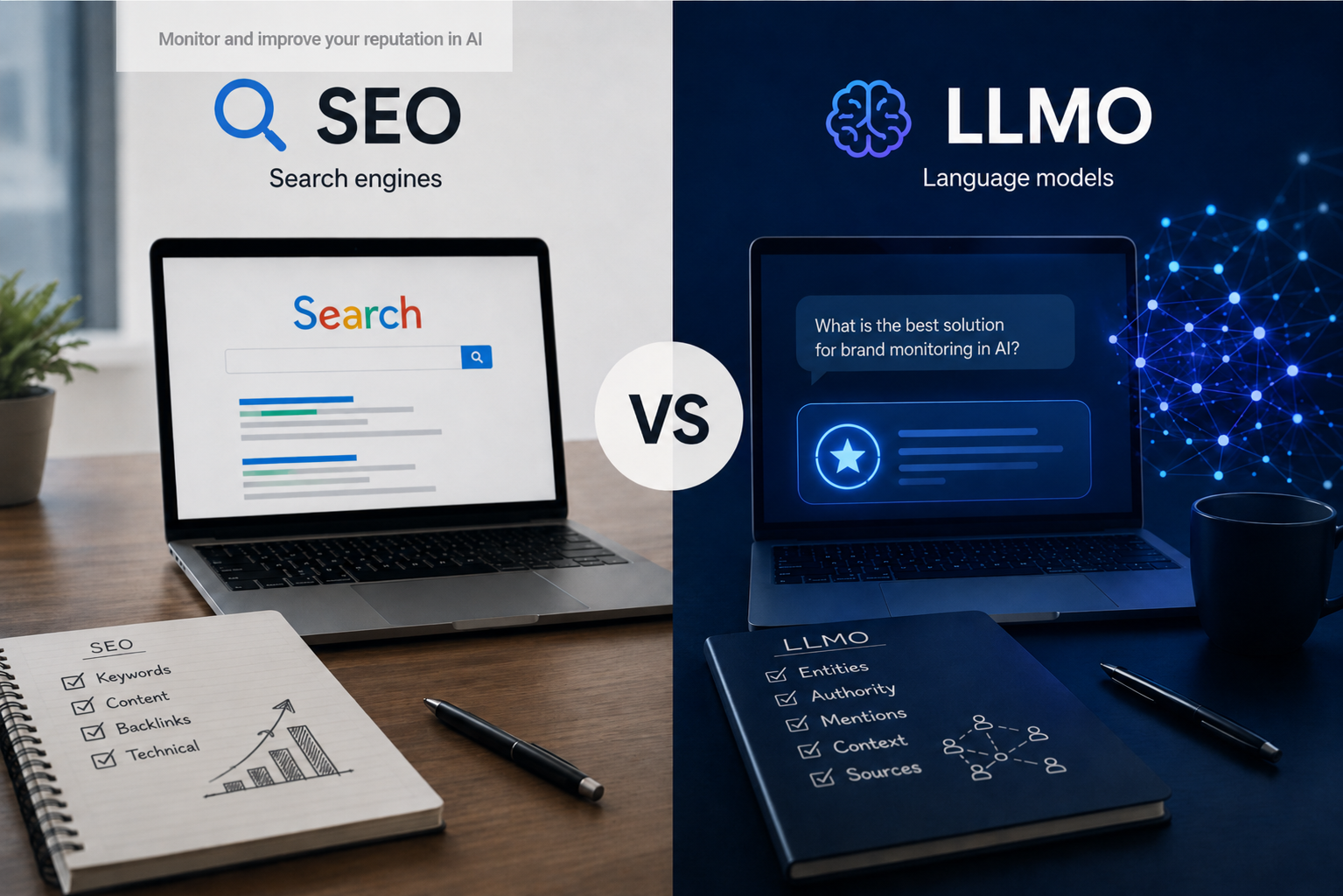
The comparison between LLMO and SEO is one of the most common questions.
Although both disciplines share foundational principles, they pursue different objectives.
| Comparison | Traditional SEO | LLMO |
| Primary Goal | Generate organic traffic | Be mentioned, cited, or recommended by AI |
| Main Channel | Search engines | Language models and conversational assistants |
| Optimization Unit | Web page | Entities, sources, knowledge, and narrative |
| Primary KPI | Rankings, impressions, and clicks | Mentions, AI Share of Voice, and quality of presence |
| Expected Outcome | Website visits | Presence in generative responses |
| Competitive Environment | SERPs | Generative ecosystems |
| Query Type | Keywords and traditional searches | Complex, comparative, and conversational questions |
| Measurement | Rankings, traffic, CTR, conversions | Frequency of appearance, context, sentiment, sources, and competitors |
The key difference lies in the unit of visibility.
In SEO, the focus is typically on optimizing a URL to appear in a SERP.
In LLMO, the focus is on optimizing a brand’s presence as an entity within the knowledge that models use to generate responses.
As a result, a company may achieve excellent Google rankings and still have limited visibility in ChatGPT or Perplexity. Likewise, it may appear in generative responses but be represented with an incomplete description or one based primarily on external sources.
That is why it is important to combine organic search positioning, brand authority, and AI-specific measurement. You can explore this concept further in this guide on AI visibility KPIs.
What SEO and LLMO Have in Common
Although there are clear differences, LLMO does not replace SEO, nor does it start from scratch.
In fact, many of the foundations of LLMO come directly from organic search best practices.
Helpful, High-Quality Content
Language models require clear, accurate, and well-structured information to understand a brand and its areas of expertise.
Topical Authority
Brands that develop deep expertise within a category are more likely to be recognized as authorities by both search engines and AI systems.
Semantic Consistency
Models need clear signals. The more consistently a company describes its products, services, and value proposition, the easier it becomes for AI systems to interpret it correctly.
Trust
External mentions, reputation, trusted sources, and information quality remain essential factors in building credibility.
In other words, LLMO leverages many of the assets brands have built through SEO, adapting them to a new reality driven by artificial intelligence.
SEO, GEO, and LLMO: How Do They Differ?
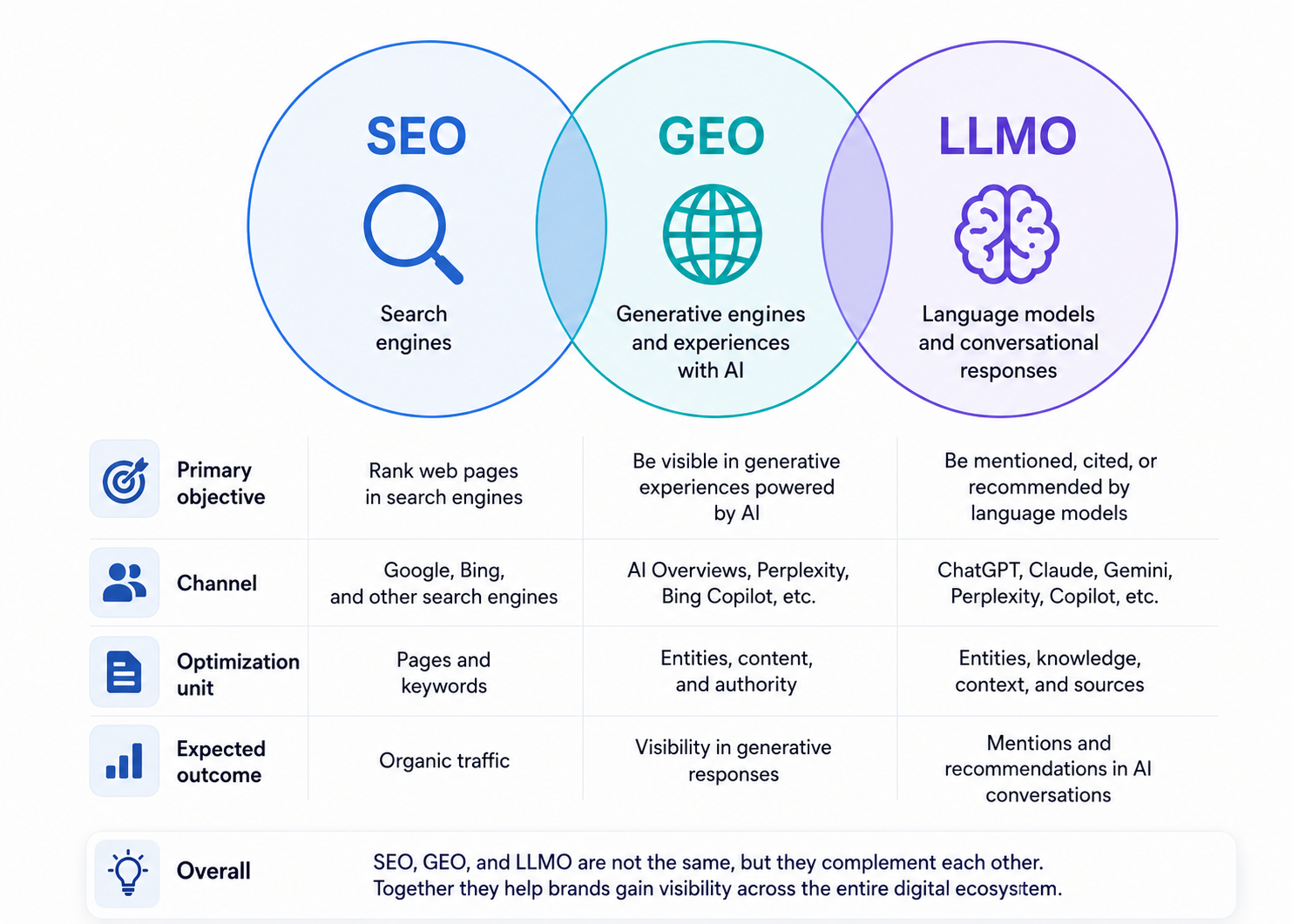
Although they are often mentioned together, SEO, GEO, and LLMO do not mean the same thing.
SEO remains focused on traditional search.
GEO focuses on generative search experiences such as AI Overviews and Perplexity.
LLMO broadens the scope to include how language models understand, represent, and recommend brands, even outside of a traditional search experience.
In practice, these disciplines complement one another and form part of an increasingly integrated digital visibility strategy.
You can think of it as an evolution of SEO toward search engines that no longer simply display links, but provide complete answers. If you’d like to learn more, you can read this guide on the transition from SEO to GEO.
In practice, many strategies overlap. A strong GEO and LLMO positioning strategy should combine content, authority, entities, proprietary sources, external mentions, and continuous measurement.
What Strategies Are Part of LLMO?
LLMO is not about manipulating AI models or artificially repeating keywords. Its purpose is to build a clear, trustworthy, and consistent information ecosystem so that artificial intelligence systems can accurately interpret a brand.
To achieve this, it is recommended to work across several areas in a coordinated way:
Building Topical Authority
Developing specialized content helps demonstrate expertise in the business’s strategic areas. The deeper the content, the easier it becomes for models to associate the brand with a specific topic.
For example, a company seeking to position itself as a leader in AI visibility should publish content on AI SEO, GEO, mention monitoring, LLM Optimization, AI Share of Voice, or reputation within language models.
Creating Original Content
Publishing studies, research, benchmarks, methodologies, or proprietary resources provides unique value to the market. In addition to strengthening topical authority, this type of content increases the chances of the brand being cited as a source.
Entity Optimization
Language models need to clearly understand what a company is, what it offers, and which problems it solves. That is why it is important to maintain a consistent description of the brand and its value proposition across all channels.
Information Structuring
The way content is presented also affects how it is understood. Using clear definitions, comparison tables, direct answers, and a well-organized architecture makes it easier for models to interpret information correctly.
Building External Authority
A brand’s credibility also depends on external signals. Securing mentions in specialized media, reports, directories, or comparison platforms helps reinforce authority and increases the likelihood of being used as a reference.
Monitoring AI Presence
Analyzing how a brand appears in ChatGPT, Gemini, Claude, Perplexity, and other generative environments makes it possible to identify improvement opportunities and correct potential inconsistencies.
This measurement can initially be carried out through manual processes, but brands with greater digital maturity typically rely on dedicated AI brand monitoring tools or solutions designed to monitor brands in LLMs.
How Brands Can Prepare for LLMO
Although LLMO is still an emerging discipline, companies can begin working on it today. The key is to combine content strategy, SEO, public relations, data, and measurement to build a strong presence across AI environments.
Strengthen Owned Assets
The corporate website, blog, product pages, downloadable resources, and educational content should become the primary sources of information about the brand.
To achieve this, it is important to regularly review whether information is up to date, whether the value proposition is clear, and whether pages answer the questions users might ask an AI assistant.
Develop Original Research
Proprietary data can become a competitive advantage. A company that publishes studies, reports, or benchmarks is more likely to be cited as a reference by both media outlets and language models.
In addition, this type of content strengthens topical authority and benefits both SEO and LLMO strategies.
Align SEO and PR
LLMO should not be approached solely from an SEO perspective. It also involves communications, reputation management, public relations, product, and sales.
If a brand message appears one way on the website, another way in media coverage, and differently in external directories, AI models may build a confusing representation of the company.
That is why it is important to align:
- Key messages.
- Brand descriptions.
- Priority categories.
- Use cases.
- Corporate information.
- Differentiating arguments.
- Relevant external sources.
- Narrative positioning against competitors.
This approach can be especially useful for marketing teams, communications teams, and reputation and PR teams.
Monitor Competitors
AI visibility should not be analyzed in isolation. A brand may appear in generative responses while still ranking below competitors or being associated with less valuable attributes.
That is why it is important to compare your brand’s presence against other players in the category.
Some useful questions include:
- Which competitors appear most frequently?
- Which brands does AI recommend?
- Which arguments are repeatedly associated with each company?
- Which sources does the model use when discussing each company?
- Which categories does each competitor dominate?
- What content opportunities exist?
This analysis helps identify gaps and prioritize optimization efforts.
Evaluate Presence in LLMs
Before defining an advanced strategy, it is essential to understand your starting point.
To do so, you can create a panel of strategic prompts and analyze them regularly across different models:
- Brand-related queries.
- Category-related queries.
- Comparative queries.
- Recommendation queries.
- Problem-solution queries.
- Industry-specific queries.
- Purchase-decision-oriented queries.
You can also use an AI visibility tool to centralize measurement, identify patterns, and compare your brand’s presence against competitors.
Will Traditional SEO Disappear?
The answer is no. SEO remains essential for generating organic traffic, building topical authority, and creating trustworthy sources of information.
What is changing is not the importance of SEO, but the context in which it operates. Digital visibility no longer depends solely on rankings and clicks, but also on how artificial intelligence systems interpret and represent a brand.
For that reason, the future is not about choosing between SEO and LLMO. The real opportunity lies in combining both disciplines within a broader digital visibility strategy.
So, Should You Start Working on LLMO?
In most cases, yes—especially if your industry relies on research, comparison, or recommendation processes before a purchase is made.
Not every company will require the same level of maturity from the outset. Some can begin by analyzing how they appear in ChatGPT or Perplexity, while others may develop more advanced strategies based on content, authority, monitoring, and language model optimization.
The important thing is to understand that visibility no longer happens exclusively in traditional search engines. More and more decisions are influenced by AI-generated responses, and in that context, a brand can either become a trusted reference or fall behind competitors with greater authority.
As conversations replace part of traditional search behavior, the question is no longer who ranks first on Google. The real question is who becomes part of the answer.

 Sep 11, 2026


