The way users find information is changing at high speed. No longer does everything start and end with a list of ten organic results. Today, many searches are resolved directly in answers generated by artificial intelligence, conversational assistants, automated summaries, and engines capable of synthesizing different sources into a single explanation.
Google AI Overviews, ChatGPT Search, Perplexity, and other AI-powered search engines are transforming digital visibility. In this new environment, ranking in the first position is still important, but it no longer tells the whole story. A brand may not occupy the top organic result and still be present in a generative answer. Or it may have good SEO positions and not be mentioned by any AI system.
This is where a new strategic metric emerges: AI Share of Voice. This indicator measures how frequently a brand is cited, recommended, or referenced within responses generated by artificial intelligence compared to its competitors.
In this guide, we explain what AI Share of Voice is, how it is measured, why traditional ranking is losing prominence, and what actions help improve visibility in ChatGPT, Google AI Overviews, Perplexity, and other generative search environments.
What Is Share of Voice in AI
The AI Share of Voice is a metric that measures the percentage of presence a brand has within the responses generated by artificial intelligence systems compared to other brands, competitors, or sources in the same sector.
Put simply: if a user asks ChatGPT, Perplexity, or Google AI Overviews for the best solutions, companies, tools, or brands within a category, the AI Share of Voice indicates how much your brand appears within those answers.
Unlike traditional SEO ranking, AI Share of Voice does not measure a specific position on a SERP. It does not answer the question “where do I rank?” but rather a broader question: “Am I part of the answer the user receives?”.
This metric can analyze different types of presence:
- Direct brand mentions.
- Citations as a source.
- Inclusion in comparative lists.
- Explicit recommendations.
- Appearance in informational responses.
- Presence in brand, category, or commercial intent queries.
Therefore, when we talk about visibility in AI, we are not talking solely about traffic or clicks. We are talking about presence, authority, and prominence within the new spaces where users make decisions.
Why Traditional Ranking Is No Longer Enough
For a long time, SEO relied on a clear logic: the higher a page appeared on Google, the more visibility and traffic it could capture. Average position, impressions, CTR, and organic sessions were sufficient indicators to evaluate performance.
But generative search changes that model.
Now users can receive a summarized response without needing to click on multiple results. They can ask a conversational assistant for recommendations. They can compare providers within a single response. And they can resolve complex doubts without browsing through ten different pages.
This has several implications for SEO:
- Less dependence on the click
In many informational searches, the user gets a direct answer. This can reduce the need to visit a website, especially for simple or definition-based queries. - Greater importance of being a cited source
If the AI synthesizes information from various sources, being part of those sources becomes just as relevant as holding a high organic position. - More weight on topical authority
Models tend to rely on content that is clear, complete, consistent, and recognizable within a specific topic. - Emergence of new SEO metrics for AI
In addition to rankings and traffic, teams must measure mentions, presence in responses, topical coverage, and share of visibility against competitors.
This does not mean traditional SEO disappears. It means it evolves. Organic optimization remains the foundation, but it must expand into an SEO for artificial intelligence strategy capable of competing in environments where the final answer is not always a list of links.
Share of Voice vs Traditional SEO Ranking
Traditional SEO ranking and Share of Voice in artificial intelligence do not measure the same thing. The former analyzes the position of a URL for a specific keyword. The latter measures the presence of a brand in AI-generated responses across a set of prompts, questions, or search intents.
| Comparison | Traditional Ranking | AI Share of Voice |
| What it measures | Organic position | Presence in AI-generated answers |
| Unit of analysis | Keyword | Conversations, prompts, and intents |
| Objective | Get clicks | Be mentioned, cited, or recommended |
| Channel | Classic SERP | Generative AI, AI Overviews, ChatGPT, Perplexity |
| Competition | Top 10 results | All sources considered by the AI |
| Main KPI | Average position | Share of mentions |
| Strategic reading | “Where do I appear” | “How much prominence do I have” |
This difference is key. In traditional SEO, a brand can be in position 3 for a keyword. In AI, that same brand may be mentioned, may not appear at all, or may be outperformed by competitors that have greater topical authority, more external mentions, or better semantic coverage.
Therefore, measuring only rankings can provide an incomplete picture. The new landscape requires combining classic metrics with AI visibility KPIs that allow understanding which brands are gaining presence within generative responses.
How to Measure Share of Voice in AI
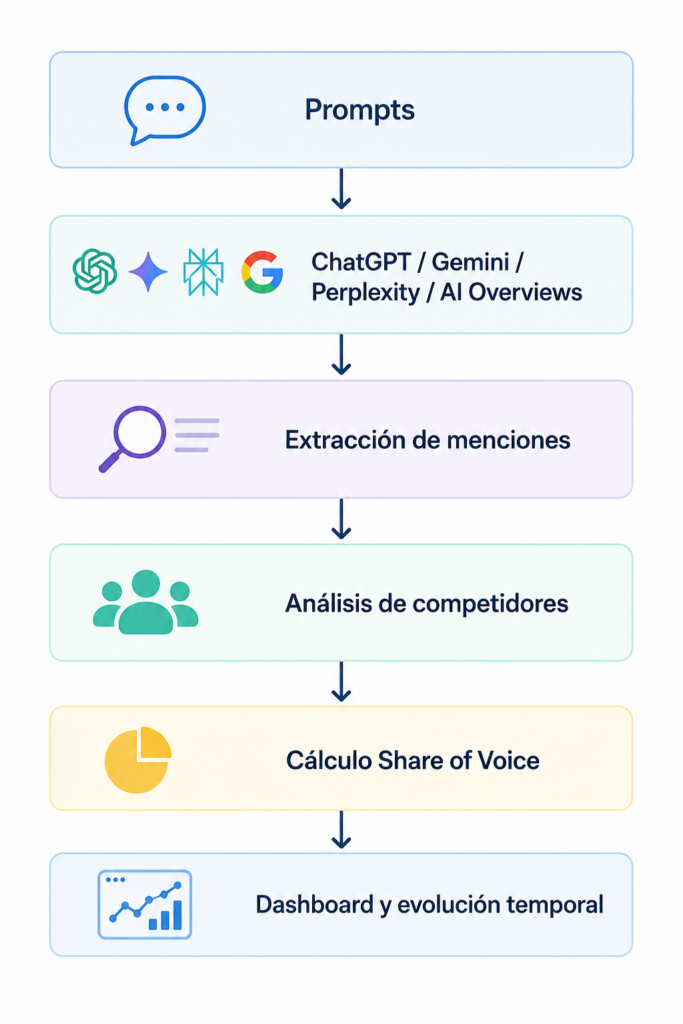
Measuring AI Share of Voice requires moving from a logic based on isolated keywords to a logic based on prompts, intents, and decision scenarios.
A practical methodology can include the following steps.
1. Define a Set of Strategic Prompts
The first step is to create a sample of questions relevant to the business. These questions should represent different phases of the user journey:
- Informational queries.
- Comparative questions.
- Provider searches.
- Tool recommendations.
- Doubts about specific problems.
- Transactional or decision-making queries.
For example, a software brand might analyze prompts such as:
- “Best tools to monitor brands in AI”.
- “How to measure a brand’s visibility in ChatGPT”.
- “What platform works to analyze mentions in AI Overviews”.
- “Alternatives to measure Share of Voice in artificial intelligence”.
2. Run Prompts Across Different Engines
Next, those prompts must be analyzed on platforms like ChatGPT, Perplexity, Google AI Overviews, Gemini, or other relevant engines for the sector.
It is not enough to do a single test. Generative responses can vary depending on the moment, context, location, prompt phrasing, or available sources. Therefore, the measurement must be repeated periodically.
3. Record Brand and Competitor Mentions
The next step is to identify which brands appear in each response. Here it is useful to distinguish between different levels of presence:
- Brand mentioned.
- Brand recommended.
- Brand cited as a source.
- Brand included in a comparison.
- Brand highlighted as the main option.
- Brand absent.
With this data, you can calculate the percentage of responses in which each brand appears.
4. Calculate the Share of Mentions
A simple formula for AI Share of Voice would be:
AI Share of Voice = brand mentions / total mentions of competing brands x 100
For example, if in 100 AI-generated responses there are 200 mentions of brands in the sector and your brand appears 40 times, your AI Share of Voice would be 20%.
5. Analyze the Quality of the Appearance
Not all mentions carry the same value. Appearing at the end of a list is not equivalent to being the primary recommendation. Therefore, in addition to measuring frequency, it is useful to analyze:
- Position within the response.
- Sentiment or context of the mention.
- Depth of description.
- Association with strategic categories.
- Presence against direct competitors.
- Appearance in high commercial intent prompts.
6. Measure Timeline Evolution
AI Share of Voice must be analyzed as an evolving metric. The important thing is not just knowing if a brand appears today, but whether it gains or loses presence over time.
To do this, it is helpful to have an AI brand monitoring tool that allows automating prompts, comparing competitors, and detecting changes in generative responses.
Factors Influencing Appearance in AI-Generated Responses
There is no single formula to guarantee that a brand appears in AI Overviews, ChatGPT, or Perplexity. However, there are factors that can increase the likelihood of being cited, mentioned, or recommended.
Domain Authority
Sources with authority, history, inbound links, and trust signals are more likely to be considered in information retrieval processes. Technical SEO and off-page authority remain relevant.
Content Quality and Depth
Thin or superficial content is less likely to be useful to an AI. In contrast, pages that explain concepts clearly, answer specific questions, and cover a topic in depth can be more interpretable and leverageable.
Semantic Clarity
Models need to understand entities, relationships, and contexts. Therefore, it is important to work on content with a clear structure, explicit definitions, and precise language.
A good semantic search strategy for LLMs helps the AI better understand what a brand offers, in which category it competes, and with which concepts it should be associated.
Structured Data
Schema markup, FAQs, product listings, organization data, and other structured elements can facilitate the interpretation of content by search engines and automated systems.
Brand Consistency
A brand must present itself consistently across its website, external profiles, press releases, directories, media, comparisons, and proprietary content. If information is inconsistent, the AI may have more difficulty identifying it correctly.
Topical Coverage
It is not enough to have a single optimized page. Brands with greater coverage over a topic tend to build more authority. This involves working on content clusters connected to each other and oriented toward resolving different search intents.
Presence in Reliable Sources
External mentions in media, studies, rankings, industry directories, comparisons, and reference pages can also influence how models perceive an entity.
This is why reputation in AI and LLMs becomes an essential part of the strategy: it doesn’t just matter what a brand says about itself, but how it is represented across the digital ecosystem.
How to Increase Your AI Share of Voice
Improving Share of Voice in artificial intelligence requires an ongoing strategy. It is not about “optimizing a page” and expecting immediate results. It is about building signals of authority, relevance, and clarity across the brand’s entire digital ecosystem.
Create Comprehensive Content
AI models tend to rely on content that thoroughly answers specific questions. Therefore, it is advisable to create pages that explain concepts, compare options, resolve frequently asked questions, and cover topics deeply.
Good content for AI should:
- Answer real questions.
- Include clear definitions.
- Provide examples.
- Compare alternatives.
- Explain processes step-by-step.
- Incorporate data, tables, and structures that are easy to interpret.
Build Topical Authority
Authority is not built with a single piece of content. It is necessary to develop comprehensive clusters around the brand’s strategic themes.
For example, a company that wants to dominate the conversation on AI visibility should work on content about:
- What is visibility in AI.
- How to measure mentions in LLMs.
- How to appear in ChatGPT.
- How to appear in AI Overviews.
- How to monitor competitors.
- What KPIs to use in generative SEO.
- How model reasoning works.
This type of architecture reinforces the association between brand and category.
Optimize for Entities
In generative search, entities matter. An entity can be a brand, a person, a product, a category, a sector, or a solution.
To improve understanding of the brand, it is ideal to optimize key pages such as:
- Corporate page.
- Product pages.
- Use case pages.
- Author biographies.
- Industry pages.
- Glossaries.
- FAQs.
- Comparisons.
It is also important for the brand to be described consistently across external sources.
Improve Content Structure
Well-structured content is easier to interpret. To achieve this, it is recommended to use:
- Descriptive H2s and H3s.
- Short paragraphs.
- Ordered lists.
- Comparative tables.
- FAQs.
- Executive summaries.
- Highlighted definitions.
- Structured data where applicable.
A well-organized page can increase the chances of being interpreted correctly by search engines and generative models.
Monitor Competitors
AI Share of Voice must always be analyzed within a competitive context. It is not enough to know if your brand appears. You need to know who appears more, in what prompts, with what messages, and on which platforms.
The monitoring of brands in AI allows detecting:
- Which competitors dominate the responses.
- Which prompts trigger brand mentions.
- What topics the AI associates with each company.
- What sources each engine uses.
- What content opportunities exist.
- What messages repeat across generative responses.
This information helps turn GEO into a measurable strategy, rather than an intuition.
GEO: The Evolution of SEO Toward Generative Search
The concept of GEO, or Generative Engine Optimization, refers to the optimization of a brand, content, or entity to appear within responses generated by artificial intelligence engines.
The common question is: GEO vs SEO, are they the same thing? The short answer is no. But they are not opposing strategies either.
Traditional SEO focuses on improving organic visibility on search engines. GEO expands that focus to optimize presence in generative responses, conversational assistants, AI engines, and systems that synthesize information.
GEO works on aspects such as:
- Optimization for responses.
- Topical authority.
- Clarity of entities.
- Brand consistency.
- Content easily interpretable by AI.
- Monitoring mentions in LLMs.
- Presence in decision-making prompts.
In this sense, the shift from SEO to GEO does not imply abandoning the foundations of organic positioning. It means adapting them to a context where the user no longer always searches for links, but for answers.
For brands wanting to move forward in this field, GEO and LLMO positioning is becoming a key discipline to gain visibility in generative environments.
Tools to Monitor Share of Voice in AI
Manually measuring visibility in ChatGPT, Google AI Overviews, or Perplexity can be useful at an initial stage, but it is not enough for a serious strategy. Responses change, prompts multiply, and competitors evolve.
Therefore, brands need tools capable of:
- Creating panels of strategic prompts.
- Running queries on a recurring basis.
- Detecting brand mentions.
- Comparing competitors.
- Analyzing evolution over time.
- Measuring presence by platform.
- Identifying content opportunities.
- Evaluating reputation and sentiment in AI responses.
A brand monitoring solution in LLMs allows moving from isolated checks to a continuous measurement of performance in generative environments.
Furthermore, for marketing teams, having an AI visibility tool helps integrate these metrics within the broader strategy of positioning, reputation, and demand.
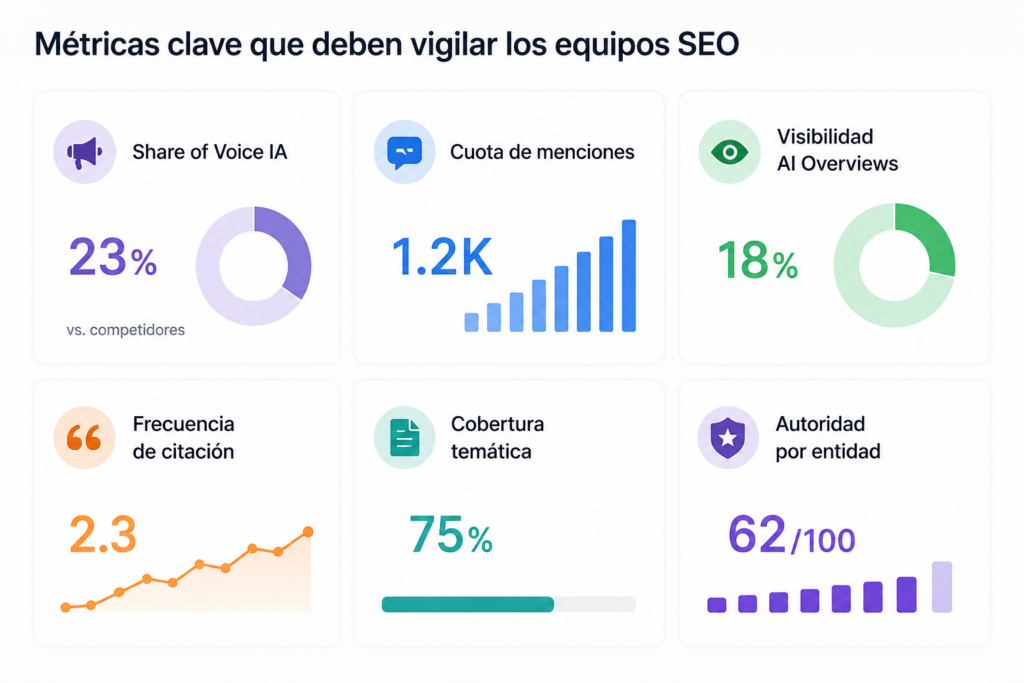
What Metrics SEO Teams Should Watch Now