

Artificial intelligence is already changing the way people search for information, compare options and make decisions. But the next big leap could be even more profound: the arrival of AI agents capable of researching products, analysing alternatives and recommending brands based on each user’s specific needs.
This means that companies will no longer need to convince only human consumers. They will also need to be visible, understandable and trustworthy for the artificial intelligence systems involved in the purchase process.
The key question is clear: is your brand ready to compete in an environment where AI agents increasingly influence purchase decisions?
What are AI agents?
AI agents are systems designed to achieve specific goals. Unlike a traditional chatbot, which usually answers questions or holds a conversation, an agent can interpret a task, search for information, analyse alternatives, apply criteria and move towards a decision or action.
In a purchase context, this means that an agent could help a user find products, compare prices, review ratings, analyse features, check availability or recommend the most suitable option based on their preferences.
For example, a user could ask:
“Find me the best travel insurance for a family travelling to Japan in August.”
Or also:
“Compare three CRM tools for an SME with a limited budget.”
Instead of simply showing links, an AI agent could analyse options, summarise advantages and disadvantages, discard less relevant alternatives and suggest a decision.
This capability makes agents a key evolution in the future of AI-assisted shopping.
AI agents vs chatbots: what is the difference?
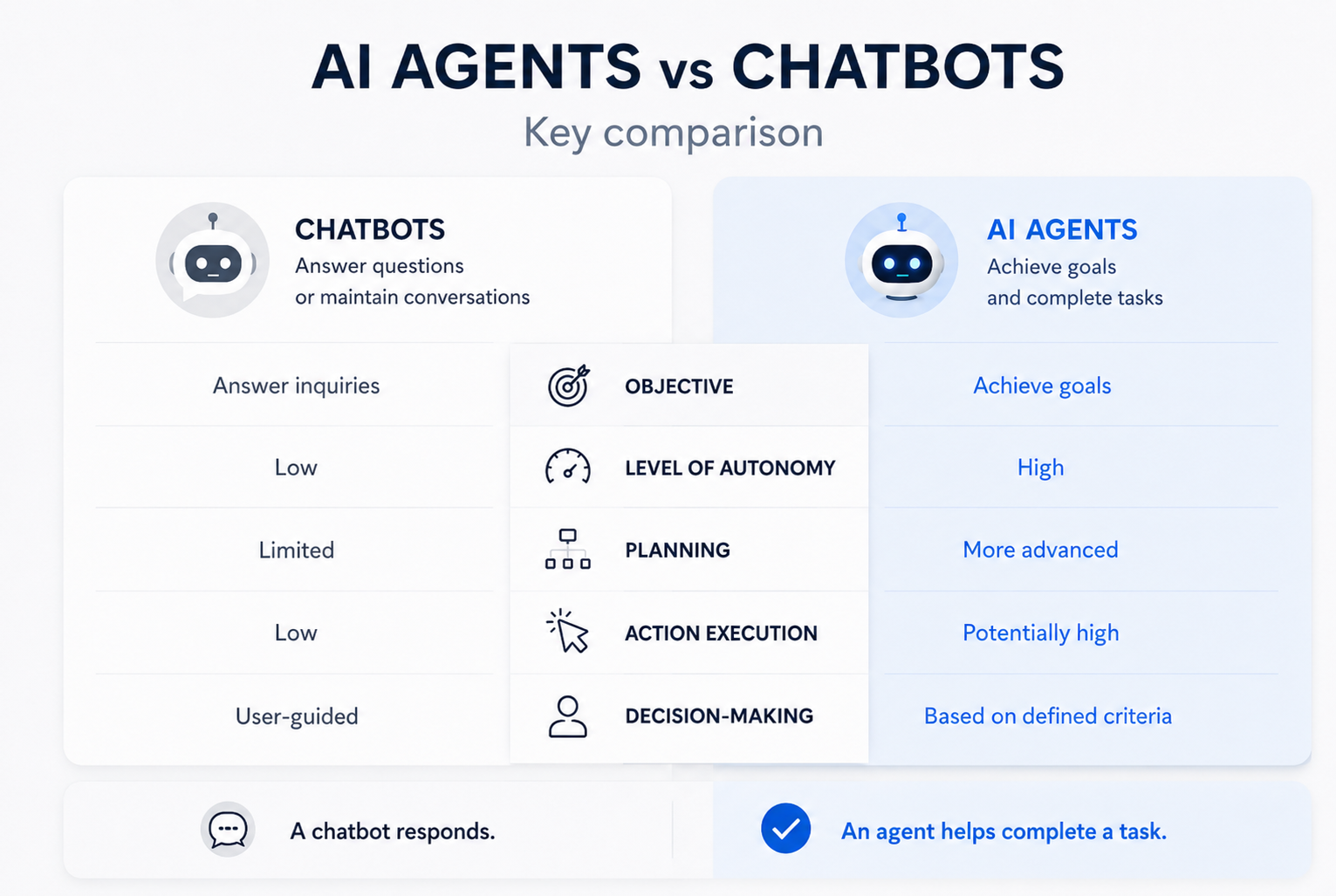
The main difference between a chatbot and an AI agent lies in the level of autonomy.
| Comparison | Traditional chatbots | AI agents |
| Goal | Answer queries | Achieve goals |
| Level of autonomy | Low | Higher |
| Planning | Limited | More advanced |
| Action execution | Limited | Potentially high |
| Decisions | Guided by the user | Based on defined criteria |
A chatbot responds. An agent helps complete a task.
This difference may seem small, but it has important implications for brands. If the user delegates part of the search and comparison process to AI, the brand will need to ensure that its products, services and competitive advantages are easy to identify, interpret and compare.
How purchase decisions will change
AI agents can become new intermediaries between consumers and companies. Instead of visiting several websites, reading dozens of reviews and manually comparing product sheets, users will be able to ask an agent to do part of that work.
This shift can change purchasing behaviour in several ways:
- Users will consider fewer brands before making a decision.
- Comparisons will become more automatic and less manual.
- Clear, structured and verifiable information will carry more weight.
- Recommendations will become more personalised.
- Digital reputation and external mentions will have greater influence.
- Decisions may be made more quickly.
In this new scenario, brand visibility in AI will be a strategic factor. Having an attractive website or a complete product page will no longer be enough. The brand must be understandable to the systems that collect, interpret and synthesise information.
If AI does not clearly understand what a company offers, who it helps, how it is different or why it should be recommended, that brand may be left out of the consideration process before the user even sees it.
The new AI-powered customer journey
Artificial intelligence can play a role at every stage of the customer journey.
In the discovery stage, agents can identify which brands, products or services match a specific need.
In the consideration stage, they can compare attributes, prices, ratings, availability, reputation, terms and differentiating advantages.
In the decision stage, they can narrow down the list of options or recommend a specific alternative.
In the loyalty stage, they can remember renewals, suggest recurring purchases, detect better alternatives or recommend changes based on the user’s new needs.
This turns AI into a new touchpoint within the commercial process. For many companies, the difference between appearing or not appearing in an AI-generated recommendation can have a direct impact on customer acquisition.
How agents will choose which brands to recommend
Although each system will work differently, AI agents are likely to assess a combination of internal and external signals before recommending a brand.
Some of the most relevant factors may include:
- The quality and clarity of the available information.
- The authority of the sources that mention the brand.
- Digital reputation.
- Third-party opinions and reviews.
- Consistency of information across channels.
- The accuracy of product or service data.
- Price, availability and conditions.
- Presence in media, comparison sites, directories or specialised sources.
- Relevance to the user’s specific need.
That is why preparing for this new environment does not depend only on commercial content. It also requires working on brand authority, reputation, presence in reliable sources and the quality of the data that AI systems can find and interpret.
If you want to explore this topic further, you can review this guide on AI visibility and why it should be measured.
Risks for brands that fail to adapt
Companies that do not prepare for the arrival of AI agents may be at a disadvantage compared to competitors that are more visible, better structured or easier to recommend.
Some of the main risks are:
- Losing presence in AI-assisted purchase processes.
- Being left out of the first suggested options.
- Being compared based on incomplete or outdated information.
- Depending too heavily on marketplaces, aggregators or external comparison sites.
- Losing differentiation against competitors with stronger positioning in generative environments.
- Having less influence in the initial consideration stage.
- Not controlling how the brand is described in AI-generated responses.
The risk is not only selling less. The real risk is no longer being part of the initial set of brands that AI considers relevant to solve a specific need.
How to prepare your brand for AI agents
Preparing for AI agents does not mean changing the company’s entire digital strategy. It means strengthening the assets that make a brand easy to find, understand, compare and recommend.
1. Improve owned content
The website, blog, product pages, success stories and corporate resources should clearly explain what the brand offers, who it is useful for, what problem it solves and how it differs from other options.
Generic or non-specific content will be less useful in an environment where AI needs to extract precise information to answer specific queries.
2. Build topical authority
Brands should develop useful content around the topics, categories and problems they want to be recognised for. This helps AI models associate the brand with specific areas of expertise.
It is not just about publishing more content, but about building consistent signals of knowledge, experience and relevance.
3. Ensure information consistency
Key messages, brand descriptions, product data, prices, availability, terms and differentiating advantages must be consistent across all channels.
When there are contradictions between the website, external listings, marketplaces, social profiles or third-party media, AI systems may interpret the brand incorrectly or incompletely.
4. Optimise product or service data
In ecommerce and comparison-driven sectors, agents will need clear and structured data: features, prices, availability, ratings, return policies, guarantees, integrations, limitations and differentiating attributes.
The easier this information is to interpret and compare, the more likely the brand is to be correctly included in a recommendation.
5. Develop a GEO and LLMO strategy
SEO remains important, but it must be complemented with strategies focused on generative environments. GEO and LLMO positioning helps improve a brand’s presence in AI-generated responses and language models.
It is also advisable to understand how SEO for AI is evolving and how it affects the way brands appear in new search experiences.
6. Monitor brand presence in AI
It is not enough to know whether your brand appears. You also need to analyse which competitors AI recommends, with what arguments and for what types of queries.
For this, it can be useful to work on brand monitoring in AI and measure how presence evolves compared to other companies in the sector.
Sectors where the impact may be greater
AI agents can affect many markets, but their impact will be especially relevant in sectors where users compare before buying.
Some examples include:
- Ecommerce.
- Travel.
- Technology.
- Finance.
- Insurance.
- Healthcare.
- Education.
- Telecommunications.
- Software.
- Professional services.
In these sectors, AI agents can act as a filter between the user’s intent and the chosen brand. If a company does not appear in that initial filter, it can lose opportunities before the user even visits its website.
What is the relationship between SEO, GEO, LLMO and AI agents?
SEO will remain key to building organic visibility, authority and qualified traffic.
GEO helps improve a brand’s presence in generative search engines and AI-powered responses.
LLMO is focused on helping language models better understand a brand, its products, its advantages and its relationship with specific search needs.
These disciplines do not compete with each other. They complement one another:
- SEO helps a brand be found.
- GEO helps it appear in generative responses.
- LLMO helps language models understand and represent it correctly.
Together, they can improve the likelihood of a brand being visible to the systems that will influence future purchase decisions.
So, should brands be concerned about AI agents?
Yes, although not from a place of alarm. The arrival of AI agents does not mean that all purchases will become automated or that human judgement will disappear.
What matters is understanding the direction of change. Artificial intelligence will play an increasingly important role in the discovery, comparison and recommendation of products and services.
Brands that start preparing now will be better positioned to compete in an environment where AI actively participates in the decision-making process.
Being prepared means offering clear information, building authority, taking care of digital reputation, optimising product data and measuring brand visibility in artificial intelligence.
In a market where agents can reduce the number of options users consider, being visible, trustworthy and easy to recommend can become a decisive competitive advantage.

 Sep 11, 2026


