

For years, digital positioning was measured with a clear logic: keywords, rankings, and organic traffic. Google was the playing field, and the battle was to appear on the first page.
Today, the playing field has changed.
More and more users no longer search — they ask. And they ask directly to artificial intelligence models. ChatGPT, Gemini, conversational assistants integrated into search engines… The experience is no longer a list of links, it is a synthesized answer.
This shift has a direct consequence:
brand perception no longer depends only on your SEO. It depends on how AI describes you.
And this is where a new discipline emerges: AI brand monitoring.
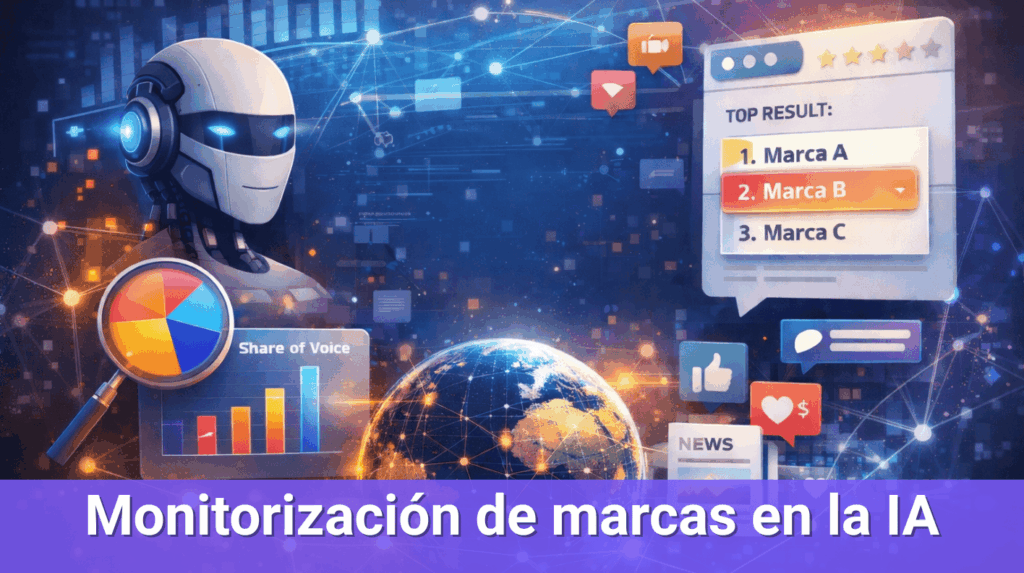
What does it mean to monitor a brand in LLM environments?
It is not simply about knowing whether you appear in a generated answer.
It is about understanding:
- How much space you occupy compared to your competitors.
- What position you appear in within the response.
- What attributes your brand is associated with.
- What tone or sentiment it projects.
- Which sources are influencing that narrative.
It is a layer different from traditional SEO: more contextual, more strategic, and closer to reputation and branding than to “ranking positions”.
If you want to translate this into metrics, this guide on AI visibility KPIs can help.
From visibility to conversational leadership
One of the first concepts to understand is AI Share of Voice.
In an environment where AI synthesizes information and mentions multiple brands, the question is not only “am I mentioned?”. It is: how much prominence do I have within the answer?
If your brand occupies only a small part of the generated discourse, you are giving up what we could call conversational leadership. And that, even if it does not appear in Google Analytics, impacts real decisions: which brand is remembered, which one is compared, and which one becomes the “reference”.
Monitoring helps turn something seemingly intangible into a comparable (and actionable) indicator.
Position and intensity: two details that change everything
There is a factor that often goes unnoticed: order.
Although models do not show a classic ranking, they still organize information. And it matters: being the first brand mentioned is not the same as being the fourth.
That is why measuring average position and presence intensity helps answer an important question:
Are you the main option… or just another alternative?
That nuance completely changes the strategy.
Perception: the new battlefield
Visibility is only one part. Perception is the other.
When AI talks about a brand, it associates it with certain attributes: innovation, prestige, international presence, profitability, quality, experience.
If the generated narrative does not match the positioning the brand wants to project, there is a strategic misalignment.
Measuring perception allows you to detect those gaps and address them through content, communication, and topical authority.
If you are interested in the “why” behind these responses, this article explains very well how ChatGPT reasons (and why that affects how it mentions brands).
The influence of sources
An especially relevant aspect is the origin of information.
Language models do not invent narratives in a vacuum. They rely on content, media, mentions, and prior context.
Analyzing which types of media, press, blogs, institutional sources, or reviews influence the generated narrative helps connect monitoring with PR and content strategy.
Suddenly, the conversation stops being abstract. It becomes actionable.
Why this discipline will keep growing
AI is already entering the brand discovery and consideration process. This is not a trend — it is a natural evolution of digital positioning.
Brands that understand this early will gain an advantage. Those that ignore it will depend on a narrative they do not control… and worse, are not even measuring.
If your goal is for your brand to appear (and appear well), this complements it perfectly: how to appear in ChatGPT
The role of AIBrandPulse360
In this context, AIBrandPulse360 emerges as a platform specialized in measuring this new layer of visibility and perception.
It is not just about analyzing generated responses. It is about structuring comparable metrics that allow you to:
- Measure share of visibility against competitors.
- Analyze intensity and position of presence.
- Evaluate perception through strategic attributes.
- Track sentiment evolution.
- Understand media coverage and influence.
In other words, turning AI-generated conversation into strategic data.
The question that defines the coming years
When someone asks an AI about your industry, does your brand lead the answer or merely accompany it?
That difference is becoming decisive.
And what is not measured cannot be managed.

 Sep 11, 2026


