

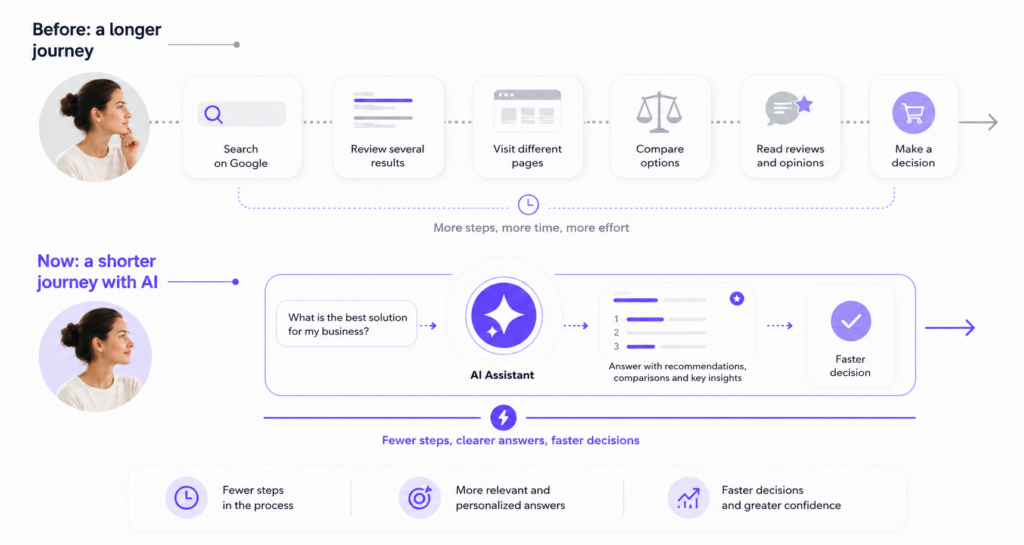
For years, a large part of the customer journey began with a Google search. Users entered a query, reviewed several results, visited different websites, and compared options before making a decision.
Artificial intelligence is changing this journey.
Tools such as ChatGPT, Gemini, Copilot, Claude, and Perplexity allow users to receive recommendations, comparisons, and complete answers without visiting multiple websites. This reduces the number of steps, consolidates information, and changes the way brands are discovered.
Understanding how ChatGPT, Gemini, and Perplexity influence brand visibility is becoming increasingly important for any company that wants to remain part of its customers’ decision-making process.
From Traditional Search to Direct Answers
In a traditional search, users receive a list of links and decide which sources to consult.
In AI environments, the model analyzes multiple signals and generates a single response. It can summarize information, compare alternatives, recommend brands, and explain which option best fits a specific need.
Search is no longer simply a gateway to different websites. In many cases, the response itself becomes the place where users discover, compare, and select options.
This shift is also closely linked to semantic search, as models do not merely identify keywords—they aim to understand concepts, relationships, context, and user intent.
How AI Is Changing the Customer Journey
Discovery
Users no longer need to know a brand or perform a branded search.
They can ask questions such as:
- Which companies offer this service?
- Which are the best brands in this industry?
- Which solution is best suited for an SME?
- Which product would you recommend for this need?
Based on these questions, AI decides which companies, products, or services to include in its response. Brands that do not appear may be excluded from the decision-making process from the very beginning, even if they have strong visibility in traditional search engines.
For this reason, learning how to appear in AI-generated responses is becoming a priority for marketing and communications teams.
Consideration
During the consideration stage, users can request direct comparisons between products, providers, or services.
AI summarizes differences, identifies strengths and weaknesses, and associates specific attributes with each brand. Factors such as price, innovation, specialization, quality, customer service, and reputation can influence how each alternative is presented.
Brands are no longer competing solely for a position in Google. They are also competing to be included, accurately described, and well represented within AI-generated responses.
In this context, a brand’s reputation in AI becomes essential, as models may rely on reviews, media coverage, directories, corporate content, and other external sources to shape their perception.
Decision
In the final stages of the journey, users may ask for a specific recommendation.
For example:
- Which one would you choose?
- Which brand has the best reviews?
- Which option offers the best value for money?
- Which one is the most reliable?
These responses can directly influence the decision, even before users visit the company’s website.
For brands, it is no longer enough to simply appear in an answer. It is also essential to understand how to determine whether a brand is being recommended by AI and the contexts in which those recommendations occur.
A Shorter and Less Visible Customer Journey
AI can reduce the number of steps required to reach a decision.
Previously, a user might perform several searches, visit comparison websites, read articles, and consult reviews. Now, they can concentrate much of that process into a conversation with an assistant.
This makes some interactions more difficult to measure using traditional tools.
A brand can influence a decision without receiving a click. Likewise, it can miss an opportunity without knowing that it was not included in a recommendation.
For this reason, metrics such as organic traffic, impressions, and SEO rankings remain important, but they no longer provide visibility into the entire journey. The transition from SEO to GEO highlights the need to broaden measurement and also analyze brand presence in generative responses.
What Brands Need to Measure Now
To understand their presence in this new customer journey, companies should analyze:
- Which questions they appear in.
- How frequently they are mentioned.
- How they rank against their competitors.
- Which attributes are associated with them.
- In which situations they are recommended.
- Which sources AI uses to construct the response.
- How their visibility evolves over time.
- Which models or platforms deliver the best results.
One of the most relevant metrics is Share of Voice in artificial intelligence, which shows the percentage of visibility a brand achieves compared with its competitors across a set of queries.
It is also important to analyze each stage of the journey separately. A brand may have strong visibility in general discovery questions but disappear when users request comparisons, opinions, or final recommendations.
To gain a complete view, companies should define and regularly monitor different AI visibility KPIs, rather than limiting the analysis to a single metric.
How to Adapt to the New Search Landscape
Brands need to create information that is clear, consistent, and easy to interpret.
This means working on their website, content, media coverage, reviews, directories, and other sources that may influence AI-generated responses.
Some relevant actions include:
- Answering real user questions.
- Creating comparative and specialized content.
- Clearly explaining products and services.
- Keeping corporate information up to date.
- Strengthening reputation across external sources.
- Securing coverage in relevant media outlets.
- Using structured data and a clear website architecture.
- Analyzing which sources models are citing or using.
- Regularly measuring visibility across different LLMs.
- Developing a GEO positioning strategy that complements traditional SEO.
The goal should not be to create content exclusively for AI models, but to provide useful, reliable, and consistent information that can be understood, verified, and used in their responses.
How AIBrandpulse360 Helps
AIBrandpulse360 makes it possible to analyze how a brand appears throughout the new customer journey shaped by artificial intelligence.
The solution measures brand presence, Share of Voice, mentioned competitors, associated attributes, and the sources influencing responses. It also enables regular brand monitoring in AI to identify changes and trends over time.
This allows companies to identify which stages of the journey they are visible in, where they are losing opportunities, and which actions they should prioritize to improve their positioning.
They can also determine whether a strategy is generating results, compare their progress with that of competitors, and understand which content or sources are strengthening their presence.
Search no longer begins only on Google. An increasing number of decisions start and progress within an AI-generated response.
Understanding this new journey is essential to ensure that a brand not only appears, but is also accurately interpreted, considered, and recommended.

 Sep 11, 2026


