

For years, discovering a brand online was a fairly predictable process. Users searched on Google, opened several results, compared options, read reviews, and after several interactions, eventually visited a website or contacted a company. For marketing teams, that journey was relatively easy to measure through impressions, clicks, sessions, forms, assisted conversions, or branded searches.
That journey has not disappeared, but it is no longer the only one. Tools such as ChatGPT, Gemini, and Perplexity are creating a new stage before the website visit: the conversation with artificial intelligence. Before clicking on a result, many users ask which brands they should consider, which solution best fits their case, or which companies seem most reliable within a category.
This completely changes how brands gain visibility. It is no longer enough to appear when someone searches on Google. Now it also matters to appear when an AI summarizes the market, compares alternatives, and recommends options before the user reaches a website.
What AI Brand Discovery Is
AI brand discovery is the process through which a user learns about, compares, or dismisses a company through responses generated by tools such as ChatGPT, Gemini, or Perplexity. Instead of browsing ten different pages, the user can request a direct recommendation and receive a summarized answer with several brands, advantages, limitations, and decision criteria.
The difference compared to traditional SEO is important. In Google, visibility usually depends on rankings, snippets, and clicks. In generative search, a brand can influence the user’s decision even without receiving an immediate visit. It may appear within a response, be mentioned as an alternative, or be excluded from the conversation without that loss appearing in Analytics.
That is why it increasingly makes sense to talk about AI visibility, a discipline that expands classic SEO and focuses on understanding how generative models interpret, mention, and recommend brands.
Why ChatGPT Changes the Way Brands Are Searched

ChatGPT has popularized a search experience that is closer to asking for advice than consulting a list of results. Users can explain their situation, add nuances, request comparisons, and adapt the response to their needs.
For example, users no longer ask only “best marketing automation tools.” Now they can ask something much more specific: “Which automation tool would you recommend for a B2B company with a long sales cycle, a small sales team, and a need to improve lead tracking?”
This difference forces brands to compete in much more specific scenarios. AI does not only analyze whether a company exists within a category, but whether it seems suitable for the specific context described by the user.
To appear in these types of responses, a brand needs to work on several aspects:
- Clearly explain what problem it solves.
- Define the type of customer for which it is most relevant.
- Publish useful content about use cases, comparisons, and decision criteria.
- Maintain a consistent presence on its website and external sources.
- Review how crawlers and AI user agents access content.
In this context, understanding how to appear in ChatGPT has become a priority for any company that depends on digital acquisition and wants to remain present in the early stages of decision-making.
How Gemini Affects Visibility Within Google
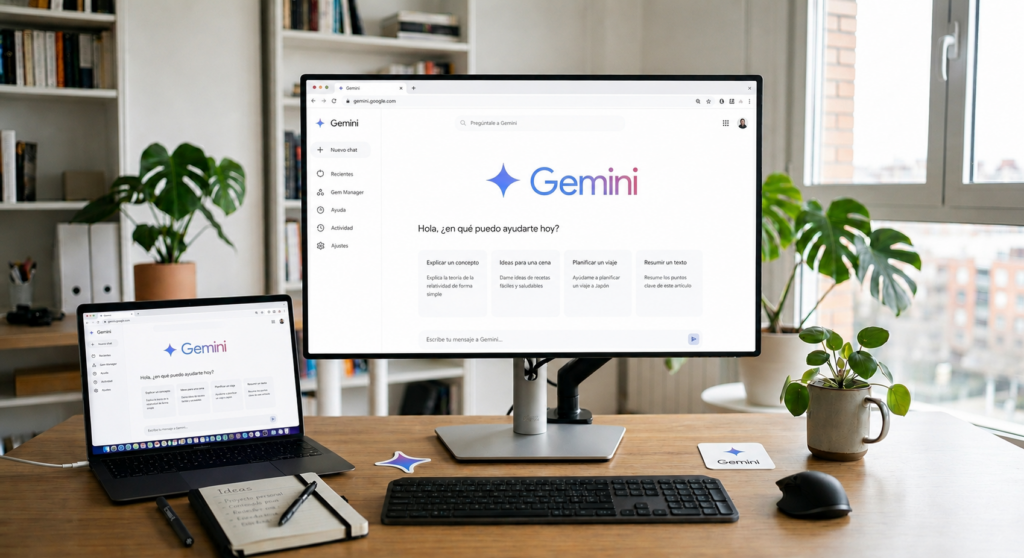
Gemini is especially relevant because it connects artificial intelligence with Google’s search ecosystem. This means users can receive AI-generated answers before interacting with traditional organic search results.
When this happens, attention shifts. Users no longer see only a list of links, but a summarized explanation that may include brands, concepts, recommendations, and sources. If that response sufficiently answers their question, they may not need to visit as many pages as before.
For companies, this change implies that SEO must evolve. It is no longer just about optimizing a page for a keyword, but about building content that helps models understand the relationship between the brand, the category, the user’s problem, and the decision stage.
That is why SEO for AI in 2026 should be approached as a natural extension of traditional SEO, especially in sectors where purchasing decisions require comparison, trust, and context.
How Perplexity Changes the Role of Sources

Perplexity introduces another important change because it combines conversational answers with visible sources. Users receive a quick synthesis, but they can also review the links that support that response.
This makes mentions and citations a key part of visibility. A brand can gain presence if it appears as a source, if it is cited in relevant content, or if it is clearly and consistently associated with a category.
The opportunity is clear: appearing inside a useful answer can influence users long before an organic click. The risk is also clear: if a brand does not appear in the initial synthesis, it may be excluded from the consideration process even if it has strong website content.
That is why it is important to appear and measure presence in AI, not only to know whether a brand is mentioned, but also to understand in which contexts it appears and against which competitors.
Why Companies Want to Appear in AI Answers
Companies want to appear in ChatGPT, Gemini, and Perplexity because these tools influence the consideration phase. When a user asks which brands to evaluate, which provider makes sense, or which solution best fits their case, AI can shape the initial shortlist of options.
This is especially important in complex purchases, B2B software, professional services, technology, banking, telecom, and any sector where users need to reduce uncertainty before contacting a company.
Appearing in an AI response can bring three main advantages:
- Greater presence in the early stages of the buying process.
- Stronger authority compared to direct competitors.
- Higher chances of entering the user’s shortlist before the click.
The problem is that many of these interactions are not visible in traditional analytics tools. That is why AI brand monitoring is becoming essential to understand how a company appears, disappears, or changes position within generative responses.
From SEO to GEO: The New Optimization for Generative Engines
Traditional SEO is still important, but it no longer covers the full user journey. The rise of generative engines has led to the concept of GEO, or Generative Engine Optimization, which focuses on optimizing a brand’s presence for AI-generated answers.
The evolution from SEO to GEO does not mean abandoning Google or stopping organic content efforts. It means adding a new strategic layer: making the brand easy for AI systems to understand, cite, and recommend.
To achieve this, companies need to manage both their own content and external signals. A brand with clear messaging, consistent mentions, and strong topical authority is more likely to be correctly interpreted by models.
What Helps a Brand Appear in ChatGPT, Gemini, and Perplexity
There is no single formula for appearing in AI responses, but there are clear patterns that help. Generative models tend to favor clear, coherent, useful information that is strongly connected to a specific category or problem.
The most important factors are:
- Clarity of brand positioning.
- In-depth content about problems, solutions, and use cases.
- Consistent and relevant external mentions.
- Comparisons, guides, and decision-support content.
- Topical authority within a specific category.
It is also important to understand how ChatGPT reasons, because models do not “know” a brand like a human does. They build associations from information patterns, mentions, context, and repeated language across sources.
What Content a Website Needs to Be Visible in AI
A website prepared for AI brand discovery cannot rely only on generic commercial pages. It needs content that clearly explains what the company does, who it is useful for, in which cases it fits, and how it differs from alternatives.
The most useful content types are those that help users make decisions, not just learn. For example, comparison guides, use-case pages, industry-specific content, FAQs, trend analysis, and articles that explain evaluation criteria.
It is also useful to build pages tailored to different teams or profiles when the solution targets multiple departments. For example, an AI visibility tool may have different value propositions for marketing teams, communications teams, PR and reputation teams, product teams, or sales teams.
The more specific the content, the easier it is for AI to understand in which context a brand should be recommended.
How to Measure AI Brand Visibility
Measuring AI visibility requires going beyond organic traffic. A company may be influencing generative responses without receiving immediate clicks, or it may be losing opportunities because competitors appear more frequently in decision-related queries.
Some important indicators are:
- Which questions the brand appears in.
- Which competitors appear alongside it.
- How the brand is described in responses.
- What positive or negative attributes are associated with it.
- In which models it appears and in which it does not.
- Whether it appears in informational, commercial, or comparison queries.
These new AI visibility KPIs help understand whether a brand is gaining relevance in generative answers or whether it needs to strengthen its content, authority, or positioning.
Tools like AIBrandPulse allow you to analyze how a brand appears across different AI engines, which competitors dominate a category, and what opportunities exist to improve conversational presence.
Brand Reputation Is Also Built in LLMs
AI visibility is not only about appearing. It also matters how a brand appears. A model may describe a company as a leader, an emerging alternative, a specialized provider, or a lesser-known solution. Each nuance affects user perception.
That is why AI and LLM reputation will become increasingly important. Brands need to review how they are represented by models, what information is repeated about them, and whether that representation matches their real positioning.
In addition, this cannot be a one-time review. As generative answers evolve, it will also be necessary to continuously monitor brands in LLMs to detect perception shifts, new competitor associations, or mentions that could influence user decisions.
This is especially relevant in industries where trust is a decisive factor. In banking, insurance, telecom, enterprise software, or professional services, misrepresentation can directly affect user consideration.
Industries Where AI Visibility Will Be Especially Important
The impact of ChatGPT, Gemini, and Perplexity will not be the same across all industries. It will be stronger in markets where users need to compare multiple options before deciding and where trust plays a major role.
For example, GEO positioning in the banking and financial sector will be important because users usually research, compare providers, and evaluate reputation before choosing financial products.
It will also be important in GEO positioning for the telecom sector, where decisions depend on coverage, price, perceived quality, service, and comparisons.
In both cases, AI can become a recommendation layer that influences users before they reach a corporate website.
The Future of Brand Discovery Will Be Conversational
Brand discovery will become increasingly non-linear. A user may start by seeing a recommendation on social media, search for information on Google, ask ChatGPT for a comparison, validate sources on Perplexity, and end up visiting only two websites before making a decision.
In that journey, brands need to be visible, consistent, and easy to interpret. SEO will remain important, but it will coexist with new GEO and LLMO strategies focused on improving presence within generative engines and large language models.
ChatGPT, Gemini, and Perplexity are changing how users discover brands because they reduce the distance between searching for information and receiving a recommendation. Companies that understand this shift will be able to optimize their presence not only to attract traffic, but also to enter the conversation while users are still deciding which options are worth considering.
The key question will no longer be only how many visits a website receives, but how often a brand appears, is understood, and is recommended within the AI systems that influence purchasing decisions.

 Sep 11, 2026


