

When Visibility No Longer Depends on Google
What It Means to Position in ChatGPT
Positioning in ChatGPT means that your brand appears, is cited, or is recommended when a user asks a question related to your sector, product, service, or category. This presence can happen in several ways:- As a brand mention, when ChatGPT names you within an explanation or a list.
- As a recommendation, when it suggests you as a relevant option to resolve a need.
- As a semantic association, when your brand is recurringly linked to a specific topic, problem, or category.
Why ChatGPT Changes the Rules of Traditional SEO
Google organizes results. ChatGPT generates answers. In a classic search engine, the user receives a list of links, compares options, and decides where to click. In ChatGPT, on the other hand, they receive a synthesized answer that usually includes only a few brands, sources, or solutions. This changes the logic of digital visibility. You are no longer solely competing to be in Google’s top 10, but rather to be part of the small group of entities that the AI considers relevant to a specific query. SEO remains important, but now it needs to be complemented with GEO positioning strategies, which are aimed at improving a brand’s presence in answers generated by artificial intelligence. This shift implies three key ideas:1. Authority Outweighs Isolated Optimization
A well-optimized page is not enough if the brand lacks external signals that reinforce its authority. To appear in AI answers, mentions, third-party content, case studies, comparisons, industry reports, and distributed reputation all matter.2. Semantic Clarity Is Decisive
Language models work with relationships between entities, concepts, and contexts. If your brand consistently appears alongside a specific topic, it is more likely to be understood as relevant within that territory. For example, saying “we are a digital agency” is not the same as building a clear association like “we are specialists in brand visibility in generative AI.” The clearer the category, the easier it will be for ChatGPT to link your brand to a specific search intent.3. Measurement Goes Beyond Traffic
In many cases, the user gets an answer without ever clicking. Because of this, measuring only organic sessions, rankings, or CTR leaves out a major part of the new digital visibility. Now it is also necessary to measure whether the brand appears in ChatGPT, how it appears, which competitors it shares the response with, and whether the AI describes it correctly.How ChatGPT Works When Generating Answers
ChatGPT does not work like a traditional search engine with a fixed ranking of pages. It generates responses based on language patterns, semantic relationships, learned knowledge, and, depending on the version or configuration, it can also rely on external tools or sources available in real time. This has an important consequence: ChatGPT does not just interpret isolated web pages. It interprets relationships between brands, concepts, problems, solutions, and contexts. Therefore, to increase your chances of appearing, your brand must be understandable as an entity. Your digital ecosystem should make clear:- What you do.
- Who you do it for.
- What problem you solve.
- What category you compete in.
- What sets you apart.
- What external sources back up your authority.
How ChatGPT Decides Which Brands to Mention
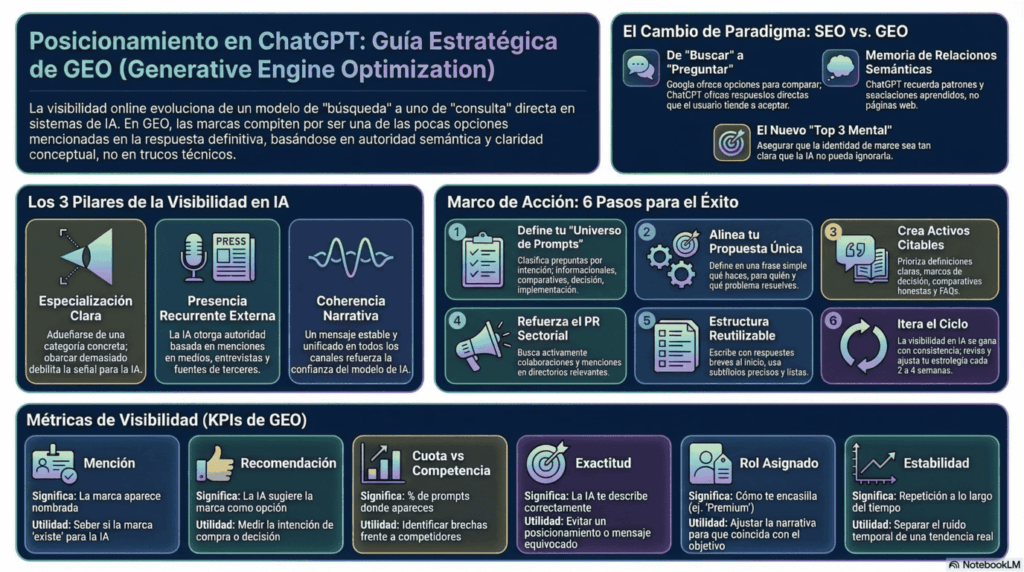
There is no public algorithm that explains exactly why ChatGPT mentions one brand and not another. Furthermore, responses can vary depending on the model, language, context, conversation history, and prompt phrasing. Even so, several patterns usually repeat in generative responses.Clear Specialization
Brands that try to cover too many topics dilute their signal. In contrast, those that consistently associate themselves with a specific category have a higher chance of appearing. A strong proposal should answer three questions in a single sentence: what you do, for whom, and what problem you solve. Weak example: We help businesses with digital marketing and artificial intelligence. Clearer example: We help businesses measure and improve their brand visibility in AI-generated answers. The clearer the category, the easier it will be for the AI to connect the brand with a specific search intent.Recurring Presence Outside Your Own Website
Your website matters, but it is not enough. To reinforce brand authority in AI, mentions in the media, interviews, directories, comparisons, industry studies, podcasts, third-party articles, and case studies also play a role. AI tends to trust entities that appear repeatedly in relevant and coherent contexts. Because of this, working on reputation in AI is not just about publishing more content, but about building a distributed and consistent presence.Narrative Consistency
If you define yourself one way on your website, another way on social media, and a completely different way in the press, the signal weakens. Narrative consistency means keeping the core elements of your brand stable:- Category.
- Value proposition.
- Target audience.
- Problems you solve.
- Case studies.
- Differentiators.
- Key terminology.
Useful and Reusable Content
Generative systems usually rely better on content that is clear, structured, and easy to synthesize. This is why the following work exceptionally well:- Precise definitions.
- Step-by-step guides.
- Honest comparisons.
- Criteria tables.
- Frequently asked questions (FAQs).
- Case studies.
- Glossaries.
- Original studies.
- Proprietary data.
How to Appear in ChatGPT Answers: An Action Framework
Appearing in ChatGPT does not depend on a single action. It is the result of a cumulative strategy that combines content, authority, consistency, and measurement.
1. Define Your Prompt Universe
Do not optimize blindly. Before creating or modifying content, identify what questions your audience might ask in ChatGPT.
Group those prompts by intent:
Informational Prompts
Questions aimed at learning:
- What is positioning in ChatGPT.
- What is GEO in digital marketing.
- How visibility works in generative AI.
- What is the difference between SEO and GEO.
Comparative Prompts
Questions where the user evaluates options:
- Best tools to measure visibility in ChatGPT.
- Alternatives for monitoring a brand in AI.
- ChatGPT vs Gemini vs Perplexity for brand visibility.
- Best GEO solutions for businesses.
Decision Prompts
Questions close to conversion:
- Which tool to choose for measuring visibility in AI.
- How much it costs to monitor a brand in ChatGPT.
- How to know if my brand appears in AI answers.
- What GEO solution a B2B company needs.
Implementation Prompts
Questions oriented around execution:
- How to create a GEO audit.
- How to measure brand mentions in ChatGPT.
- Template for analyzing prompts.
- Checklist for appearing in AI answers.
This classification helps you understand where your brand appears, where it doesn’t, and what content you need to create to fill those gaps.
2. Reinforce Your Semantic Positioning
Your brand must be easy to understand for users, search engines, and AI models.
To achieve this, review whether your core pages clearly answer these questions:
- What you do.
- Who you do it for.
- What problem you solve.
- What category you want to position yourself in.
- What sets you apart from other alternatives.
If the answer is ambiguous, the AI will have a harder time associating you with a specific intent.
3. Create Citable Assets
A common mistake is to publish only generic articles. To improve visibility in AI, it is beneficial to create assets that can be reused, cited, or synthesized.
Some recommended formats are:
- Proprietary definitions.
- Decision frameworks.
- Honest comparisons.
- Practical guides.
- FAQs geared toward real intent.
- Studies with proprietary data.
- Case studies.
- Specialized glossaries.
For example, if you want to position yourself around brand visibility in AI, it is not enough to talk about artificial intelligence in general. You need to explain what AI visibility is, how it is measured, what metrics matter, and how it compares against competitors.
4. Work on External Mentions and Distributed Authority
Authority is not built solely within your website. For a brand to gain a presence in generative responses, it is ideal to reinforce its appearance across relevant external sources.
Recommended actions:
- Publishing proprietary studies.
- Securing mentions in industry media.
- Participating in interviews and podcasts.
- Appearing in relevant comparisons.
- Creating verifiable success stories.
- Collaborating with industry experts.
- Maintaining consistent profiles in directories and professional networks.
The goal is not to generate noise, but to reinforce a clear signal: your brand belongs to a specific category and has authority within it.
5. Optimize Content for Human Reading and AI Synthesis
Writing for AI does not mean writing artificially. It means writing with clarity.
Best practices:
- Answering the primary intent early on.
- Using descriptive headings.
- Avoiding excessively long paragraphs.
- Adding concrete examples.
- Including tables when they help compare.
- Defining important concepts.
- Avoiding vague claims.
- Maintaining terminological consistency.
Editorial clarity improves user experience and makes it easier for generative systems to understand, summarize, and reuse content.
6. Repeat the Cycle Periodically
Visibility in ChatGPT is not earned through an isolated action. It requires iteration.
A recommended cycle would be:
- Measuring a fixed library of prompts.
- Detecting gaps, errors, and opportunities.
- Creating or improving content.
- Reinforcing external signals.
- Reviewing changes in responses.
- Comparing against competitors.
- Adjusting narrative and priorities.
This process turns GEO into a measurable strategy, rather than an intuition.
How to Measure Your Visibility in ChatGPT
One of the greatest challenges of positioning in ChatGPT is measurement. There is no official tool equivalent to Google Search Console that displays every time a brand appears in generative answers.
Because of this, you need to build your own analysis system.
The key is to measure two dimensions:
- Whether you appear.
- How you appear.
Because being mentioned as a footnote is not the same as appearing as a top recommendation in a query with high commercial intent.
To dive deeper into this point, you can consult the guide on AI Visibility KPIs, which explains the core metrics for analyzing presence in generative answers.
Manual Method for Analyzing Presence in ChatGPT
If you are just getting started, you can build a basic measurement system using a spreadsheet and a fixed library of prompts.
1. Create a List of Relevant Questions
Select between 30 and 100 prompts related to your category. Include informational, comparative, transactional, and implementation questions.
2. Define Your Competitors
Include direct competitors, indirect alternatives, and brands that already appear in AI answers.
3. Run the Prompts Using Consistent Criteria
Control for variables such as:
- Language.
- Country or market.
- Exact prompt.
- Model used.
- Measurement date.
- Whether the answer includes browsing or sources.
- User type or prompt context.
4. Log the Results
Create a table with fields such as:
- Prompt.
- Date.
- Model.
- Appears / Does not appear.
- Position.
- Competitors mentioned.
- Type of appearance.
- Brand description.
- Accuracy.
- Sentiment.
- Notes.
5. Repeat the Measurement
A single snapshot is not enough. Answers can vary over time. What is truly useful is observing trends.
At a minimum, it is advisable to review performance every month. In highly competitive sectors, it can make sense to track weekly across prompt clusters.
Limitations of Manual Measurement
Manual measurement is useful for getting started, but it falls short when AI visibility transitions from a curiosity into a strategic priority.
Its main limitations include:
Scale
Measuring dozens or hundreds of prompts across multiple markets, languages, models, and competitors is highly time-consuming.
Consistency
Slight changes to a prompt can alter the response. Without a controlled methodology, it is easy to compare data points that are not equivalent.
Depth
It is not enough to know if you appear. You also need to understand why you appear, next to whom, with what narrative, and within which search intent.
Historical Tracking
Without continuous tracking, it is difficult to know if an action succeeded or if a shift in the response is merely noise.
Because of this, once measurement begins to guide marketing, reputation, or sales decisions, it is best to rely on an AI visibility tool that allows you to scale your analysis.
When to Use a Specialized AI Visibility Tool
A GEO tool makes sense when you need to transition from periodic reviews to a continuous monitoring system.
Especially if you want to:
- Measure hundreds or thousands of prompts.
- Benchmark your brand against competitors.
- Analyze multiple AI models.
- View historical evolution.
- Detect shifts in brand perception.
- Identify content opportunities.
- Prioritize SEO, PR, and branding actions.
- Turn AI answers into actionable data.
Solutions like AI BrandPulse 360 help monitor presence, representation, competitors, narrative, gaps, and evolution across generative environments. This allows you to stop relying on isolated screenshots and work on AI visibility with a sturdier methodology.
If your goal is to understand how you appear across different models and what opportunities you have against competitors, you can start by monitoring brands in LLMs.
Errors That Make You Invisible in ChatGPT
Using Messages That Are Too Generic
If your value proposition could apply to any company in your industry, it is too weak. The AI needs clear signals to associate you with a specific category.
Relying Solely on Your Corporate Blog
Owned content is important, but not enough. You also need external mentions, distributed authority, and a presence within relevant contexts.
Not Measuring Real Prompts
Optimizing without knowing what the user is asking leads to creating content disconnected from actual demand.
Ignoring Competitors
In generative AI, many answers are comparative. If you do not know who is appearing alongside you, you do not know your real position.
Constantly Changing Your Narrative
A lack of consistency makes it difficult for models to link your brand to a particular solution, problem, or category.
Creating Superficial Content
Generic content provides a very weak signal. To earn visibility, you need definitions, criteria, examples, data, comparisons, and useful breakdowns.
Checklist to Improve Your Positioning in ChatGPT
Before launching a GEO strategy, review these points:
- Your value proposition is clear.
- Your primary category is well-defined.
- Your content answers real prompts.
- Your brand appears in relevant external sources.
- You have comparisons against competitors.
- Your narrative is consistent across all channels.
- You have defined GEO metrics.
- You have a historical log of your evolution.
This checklist does not replace a comprehensive audit, but it helps detect initial weak points in visibility.
Conclusion
Digital visibility no longer depends solely on appearing in Google. It also depends on how AI systems interpret, describe, and recommend your brand.
To appear in ChatGPT, you need more than optimized content: you need semantic clarity, distributed authority, narrative consistency, and constant measurement.
Companies that begin measuring their presence in generative answers can spot opportunities before their competitors and turn GEO into a strategic advantage.
In the new era of positioning, the winner is not whoever repeats a keyword the most. The winner is whoever explains best, demonstrates authority, and gets the AI to recognize them as a trusted source.

 Sep 11, 2026


