

Digital visibility no longer depends only on appearing on Google. Today, a brand can also be discovered, compared or recommended within responses generated by ChatGPT, Gemini, Claude, Perplexity or Google’s AI Overviews.
This changes the way companies should analyse their online presence. A company may have strong SEO rankings and still be invisible in generative responses. It may also appear, but with an incomplete, outdated description or one based on external sources it does not control.
That is why, before designing a GEO positioning or LLMO strategy, it is advisable to carry out an AI visibility audit.
The objective is clear: understand the starting point, identify improvement opportunities and anticipate potential reputational risks.
What is an AI visibility audit?
An AI visibility audit is the process of assessing how a brand appears within responses generated by artificial intelligence-based tools.
It can also be called an LLM audit, GEO audit, LLMO audit or LLM presence analysis.
This type of analysis combines several areas:
- SEO.
- Online reputation.
- Competitive intelligence.
- Brand analysis.
- Mention monitoring.
- Source evaluation.
Its purpose is not only to know whether a brand appears or does not appear. It also aims to understand how it appears, who it competes against and what narrative AI models are building around it.
In this context, AI visibility becomes a key dimension of digital strategy. It is no longer enough to be present in traditional search engines; it is also necessary to measure brand presence in generative responses.
Why your company should carry out this type of audit
A GEO audit or AI visibility audit helps you make decisions based on data, not assumptions.
It helps detect:
- Whether your brand appears in relevant queries.
- Which competitors have greater visibility.
- Which attributes AI associates with your company.
- Whether there are errors or outdated messages.
- Which sources influence the responses.
- What content or authority opportunities exist.
- Which risks may affect brand reputation.
The message is simple: you cannot optimise what you are not measuring.
Before improving your AI presence, you need to know your starting point and how models respond when asked about your market, your products, your competitors or your brand.
Checklist: how to carry out an AI visibility audit
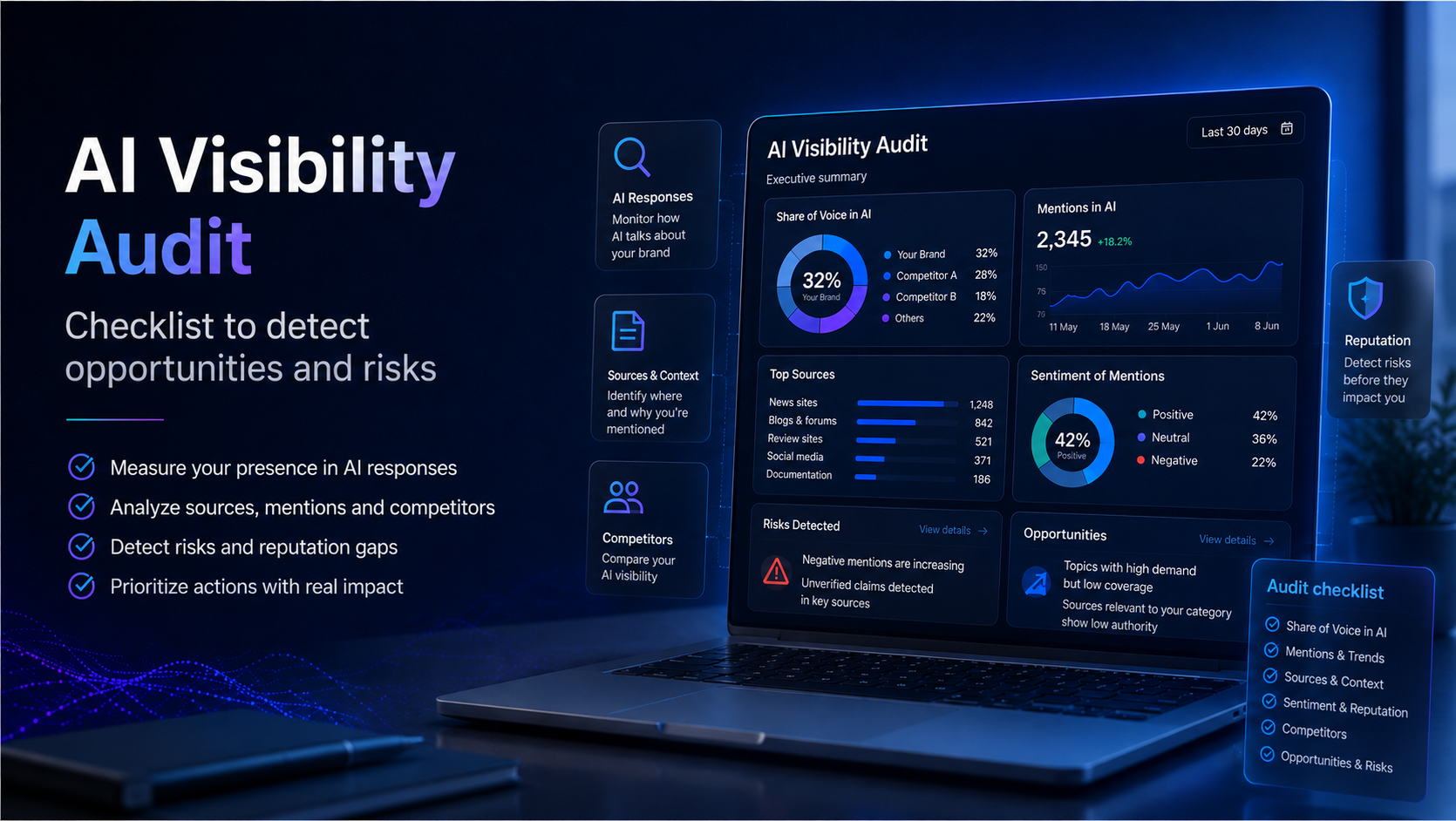
This checklist can be used as a basis for assessing a brand’s presence in ChatGPT, Gemini, Claude, Perplexity and AI Overviews.
1. Check whether your brand appears in relevant queries
Start with questions that a real user might ask before making a decision.
Examples:
- “Which companies do you recommend for [category]?”
- “What are the best solutions for [problem]?”
- “Which brands stand out in [sector]?”
- “What alternatives are there to [competitor]?”
- “Compare [brand] with [competitor].”
The objective is to check whether your brand appears in brand, category, comparison and recommendation queries.
2. Analyse how your brand is described
Appearing is not enough. Context also matters.
Evaluate:
- Which attributes are associated with the brand.
- Which strengths are mentioned.
- Which limitations appear.
- Whether the description matches your positioning.
- Whether there is incomplete or incorrect information.
- Whether AI properly understands your value proposition.
This part is key in a brand audit in ChatGPT and other LLMs.
3. Identify which sources influence the responses
When the tool shows sources or references, review whether the most common ones are:
- Owned content.
- Specialised media.
- Directories.
- Third-party reviews.
- Comparisons.
- Outdated pages.
- Competitor sources.
If AI talks about your brand mainly using external sources, there may be a risk of losing control over the narrative.
At this point, it is useful to analyse how models interpret the available information and how they connect concepts, entities and sources. Semantic search plays an important role, because LLMs do not simply read keywords: they also interpret relationships, context and topical authority.
4. Compare your presence against competitors
An AI visibility audit should include competitive benchmarking.
Analyse:
- Which brands appear most frequently.
- In what order they are mentioned.
- Which competitors receive better descriptions.
- Which companies are recommended.
- Which arguments are repeated about each brand.
- Which sources support each competitor.
This makes it possible to identify visibility gaps and opportunities to strengthen your positioning.
5. Evaluate Share of Voice in AI
Share of Voice in AI measures what percentage of mentions belongs to your brand compared to your competitors within a set of prompts.
For example, if you analyse 50 responses and your brand appears in 10, while a competitor appears in 30, there is a clear difference in generative visibility.
This metric helps turn the audit into a comparable and measurable analysis. That is why Share of Voice in AI is becoming a key metric for understanding which brands dominate the conversation within generative environments.
6. Detect reputational risks
An AI reputation audit can reveal issues that do not always appear in a traditional SEO analysis.
Check whether the models show:
- Outdated data.
- Contradictory messages.
- Negative associations.
- Unfavourable comparisons.
- Errors about products or services.
- Dependence on negative reviews.
- Lack of differentiation from competitors.
Detecting these risks early makes it possible to act before they affect brand perception.
Reputation in AI does not depend only on what a company says about itself. It also depends on how models aggregate, interpret and reformulate information from different sources.
7. Analyse consistency across platforms
Not all models respond in the same way.
Compare results across:
- ChatGPT.
- Gemini.
- Claude.
- Perplexity.
- Google AI Overviews.
Your brand may appear well positioned on one platform but be invisible on another. Tone, cited sources and highlighted competitors may also vary.
When analysing how ChatGPT, Gemini and Perplexity influence visibility, it is important not to rely on a single answer or a single tool.
8. Prioritise improvement opportunities
Once the audit is complete, classify the findings according to three criteria:
- Business impact.
- Ease of implementation.
- Reputational urgency.
This makes it possible to turn the analysis into an actionable roadmap.
Which metrics should you monitor?
| Metric | What it measures |
| Mention frequency | How many times the brand appears |
| Share of Voice in AI | Presence compared to competitors |
| Position in the response | Whether it appears at the beginning, middle or end |
| Narrative quality | How the company is described |
| Source diversity | Who contributes to the conversation |
| Consistency | Similarity across platforms |
| Reputational risk | Presence of problematic messages |
| Thematic coverage | Which categories the brand appears in |
It is also advisable to define AI visibility KPIs to measure progress over time and verify whether the actions implemented are genuinely improving the brand’s presence in generative responses.
Risks an AI audit can reveal
An LLM audit can reveal risks that the brand had not previously detected.
The most common ones are:
- Invisibility in strategic categories.
- Competitors dominating recommendations.
- Outdated information about the company.
- Poorly differentiated descriptions.
- Excessive dependence on external sources.
- Major differences between platforms.
- Low presence in comparative queries.
- Lack of topical authority.
- Negative or unfavourable mentions.
The main risk is not only failing to appear. It is appearing in an incorrect, weak or irrelevant way.
A brand may be mentioned, but not recommended. It may be present, but without differentiation. Or it may appear linked to attributes that are not part of its current positioning.
What to do after the audit
An audit only has value if it becomes concrete actions.
Strengthen strategic content
Update key pages, improve product or service content and create resources that answer your users’ real questions.
Improve topical authority
Develop content clusters around the topics for which you want AI to recognise your brand.
Update corporate information
Make sure company information is clear, consistent and up to date across owned and external channels.
Drive high-quality mentions
Work on PR, specialised media, relevant directories, studies, collaborations and external sources that strengthen your authority.
Develop a GEO and LLMO strategy
The audit should serve as the starting point for a broader optimisation strategy across generative environments and language models.
How often should this analysis be repeated?
The frequency depends on the sector, competition and the brand’s level of exposure.
As a reference, it may make sense to repeat the audit:
- Monthly in highly competitive sectors.
- Quarterly for most companies.
- After major campaigns.
- After product launches.
- After positioning changes.
- In the event of a reputational crisis.
AI visibility changes over time, so it is important to measure evolution and not only capture a one-off snapshot.
In addition, models, sources and response formats are constantly evolving. What appears in a response today may not appear in the same way a few weeks from now.
So, should your company carry out an AI visibility audit?
Yes, especially if your organisation depends on digital awareness, online reputation, demand generation or comparison against competitors.
An AI visibility audit allows you to understand how your brand appears in ChatGPT, Gemini, Claude, Perplexity and AI Overviews, which competitors have greater presence and which risks may affect your positioning.
To do this in a more structured way, an AI visibility tool can help measure mentions, compare competitors, analyse prompts and transform the results into actionable metrics.
Understanding how generative systems perceive you is the first step towards influencing that perception.
Before optimising for AI, you need to measure. And before designing a GEO or LLMO strategy, you need to know where your brand stands today.

 Sep 11, 2026


