

The conversation about a brand no longer happens only on Google, social media, or digital media outlets. More and more users are directly asking language models such as ChatGPT, Gemini, Perplexity, or Google’s AI Overviews to compare companies, find recommendations, understand products, or validate purchasing decisions.
This changes a key question for any marketing, SEO, communications, or digital reputation team: what sources do LLMs use when talking about a brand?
In many cases, AI-generated responses are not based solely on a company’s website, official blog, or proprietary reports. They may also rely on industry publications, directories, reviews, comparison sites, forums, rankings, third-party content, or even outdated webpages.
The challenge is no longer simply appearing in an AI response. The real challenge is understanding who is shaping the narrative about your brand: your strategic sources or the external sources talking about you.
In this guide, we analyze how LLMs obtain information, the difference between owned and third-party sources, the reputational risks of losing narrative control, and how you can strengthen your brand visibility in LLMs through a stronger SEO and GEO strategy.
How LLMs Gather Information About Brands
To understand brand visibility in LLMs, you first need to understand how LLMs obtain information and what sources artificial intelligence uses to build its responses.
Although each model works differently, several mechanisms are generally involved:
- Data used during model training.
- Publicly available web content.
- Information retrieval systems.
- Real-time search capabilities, when available.
- Databases, directories, and indexed documents.
- Signals of authority, relevance, consistency, and freshness.
In other words, models do not create brand perceptions from scratch. They build responses from the information they consider most useful and reliable for answering a specific query.
As a result, when a user asks what a company does, what alternatives exist in a category, or which brands AI recommends, the model may combine signals from multiple sources.
This creates a new challenge: a company may have done an excellent job managing its owned assets, but if other sources have greater authority, stronger mentions, or a more accessible structure, LLMs may turn to them first.
If you’d like to explore this topic further, you can review this guide on how to appear in ChatGPT and this analysis of how ChatGPT reasons.
What Strategic Sources and Third-Party Sources Are
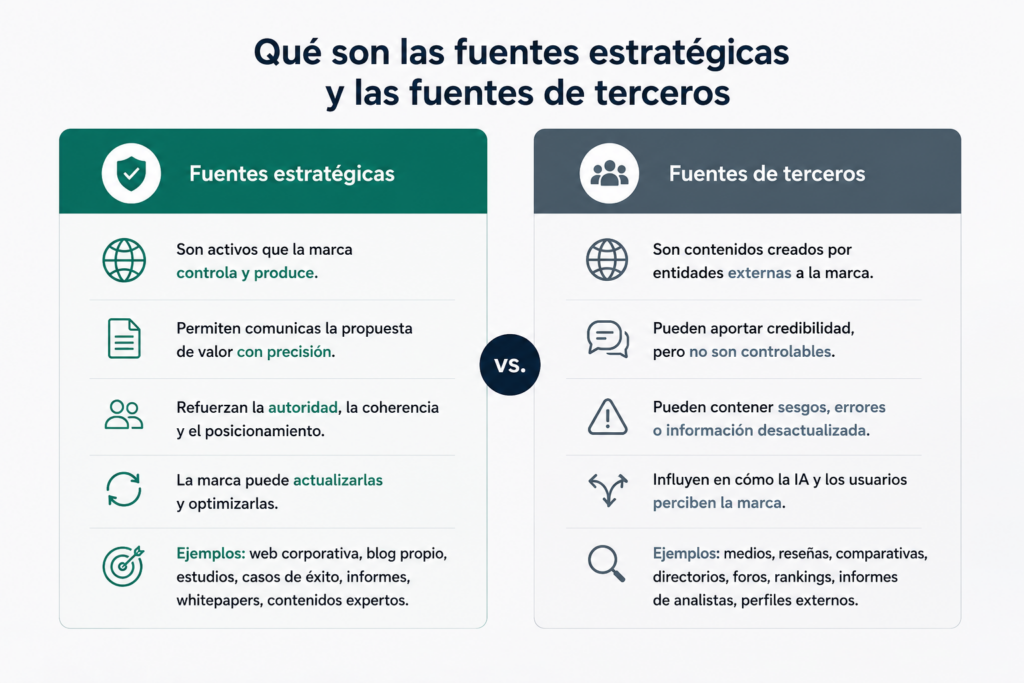
To evaluate the sources LLMs use when talking about a brand, it is useful to distinguish between two major categories: strategic sources and third-party sources.
Strategic Sources
Strategic sources are information assets that the brand itself controls, produces, or directly promotes. Their role is not only to attract traffic but also to build authority, clarity, and narrative consistency.
Examples include:
- Corporate website.
- Company blog.
- Original research studies.
- Research reports.
- Case studies.
- White papers.
- Product or service pages.
- Resource center.
- Industry glossaries.
- Official press releases.
- Technical documentation.
- Content authored by company experts.
These sources allow a brand to explain who it is, what it does, what differentiates it, who it serves, and which problems it solves.
In an advanced AI SEO strategy, these pages also function as authority signals for generative models. The goal is no longer just ranking in search engines, but building clear, useful, and recognizable sources that can contribute to AI-generated responses.
Third-Party Sources
Third-party sources are pieces of content created by entities outside the brand. They can add credibility, but they may also introduce bias, errors, or narratives the company cannot control.
Examples include:
- Digital media outlets.
- Business directories.
- User reviews.
- Comparison websites.
- Rankings.
- Forums.
- Industry publications.
- Marketplaces.
- Analyst reports.
- Competitor-generated content.
- Profiles on external platforms.
These sources can be beneficial when they reinforce a brand’s authority. However, they can also become problematic if they contain outdated information, incomplete messaging, uncontextualized criticism, or comparisons that fail to reflect the brand’s true value proposition.
The goal is not to avoid external sources. In fact, a strong digital reputation strategy requires third-party validation. The problem arises when those external sources carry more weight than owned sources in the way AI describes your brand.

 Sep 11, 2026


