

More and more users are turning to ChatGPT to discover tools, compare providers, and ask for recommendations. For businesses, appearing in these responses can influence brand awareness, reputation, and purchase consideration.
There is no formula that guarantees ChatGPT will mention a brand. Its presence can vary depending on the prompt, the model, the user, their location, and the sources consulted. However, companies can work on several factors that increase the likelihood of their brand being correctly identified and considered relevant.
What Does It Mean to Appear in ChatGPT?
A brand can appear in several ways:
- As a relevant company within a category.
- In a list of tools or providers.
- As a recommendation for a specific need.
- Through a citation or link to its website.
- Via information sourced from media outlets, reviews, or comparison websites.
Not every appearance carries the same value. A brand may be mentioned without being recommended, or it may appear with inaccurate or outdated information.
That is why AI visibility should measure not only how often a brand is mentioned, but also the context, prominence, accuracy, and sentiment of those mentions.
Where Does ChatGPT Get Its Information?
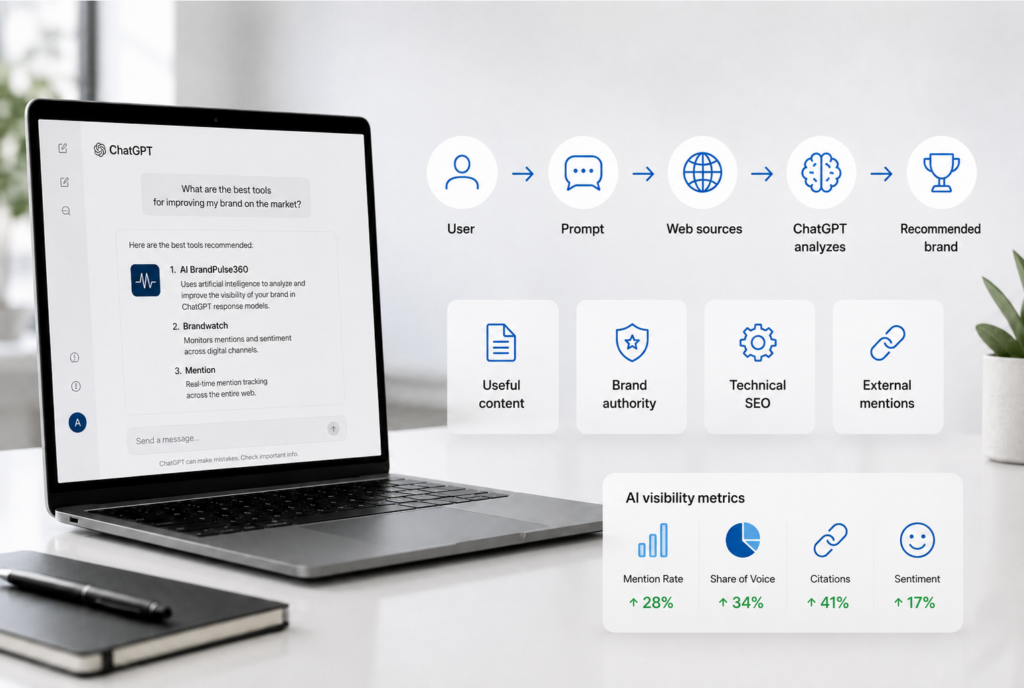
ChatGPT can generate responses based on the knowledge learned during its training or by performing web searches to retrieve up-to-date information.
For responses that use web search, the following factors may influence the results:
- Page indexing.
- Accessibility for web crawlers.
- The relevance of the content to the query.
- The authority of the source.
- External mentions of the company.
- The clarity and freshness of the information.
This means that appearing in ChatGPT does not depend on a single algorithm. It combines search, source selection, and content interpretation processes. Understanding how ChatGPT reasons helps you build a more realistic visibility strategy.
Factors That Can Influence Whether Your Brand Appears in ChatGPT
1. A Clearly Defined Brand
AI systems should be able to easily identify:
- What the company is.
- Which products or services it offers.
- Which category it belongs to.
- Who its target audience is.
- Which markets it operates in.
- What differentiates it from its competitors.
This information should be consistent across the company’s website, social media profiles, directories, media coverage, and other external sources.
Contradictory information, poorly documented name changes, or outdated descriptions can make it more difficult for ChatGPT to interpret the brand correctly.
2. Relevance to Users’ Questions
A brand appears in relation to a specific query.
Competing for a broad prompt such as “best marketing tools” is very different from competing for a more specific query like “platforms for measuring a brand’s visibility in ChatGPT.”
It is important to identify prompts related to:
- The product category.
- The problems it solves.
- Its use cases.
- Product comparisons.
- Alternatives to competitors.
- Recommendations by industry or country.
This research makes it possible to create content based on real conversations rather than focusing solely on keywords.
3. Clear and Easy-to-Understand Content
Your pages should answer specific questions such as:
- What problem does the product solve?
- Who is it designed for?
- How does it work?
- How is it different?
- What results does it deliver?
- What are its limitations?
Descriptive headings, definitions, lists, examples, and tables make content easier to understand and extract information from.
There is no required length for each section. What matters is that every section is clear, specific, and understandable on its own.
4. Original and Verifiable Information
Content that simply repeats what has already been published elsewhere is unlikely to become a trusted source.
A brand can provide greater value by publishing:
- Original data.
- Industry research.
- Real-world case studies.
- Transparent methodologies.
- Comparisons based on clearly defined criteria.
- Expert opinions.
- Experiments and in-depth analysis.
Case studies can help demonstrate expertise and generate original insights that other publications are more likely to reference or link to.
It is also important to support commercial claims with data, reliable sources, dates, and verifiable examples.
5. Mentions in External Sources
Information published by third parties helps validate a company’s activity, category, and reputation.
Some of the most valuable sources include:
- Industry publications.
- Comparison websites.
- Industry directories.
- Professional associations.
- Customer reviews.
- Research reports.
- Professional communities.
A contextual mention in a reputable publication usually provides more value than dozens of low-quality directory listings or profiles.
It is equally important to monitor your AI brand reputation, since a company may appear frequently while still being associated with negative attributes or unfavorable information.
6. Crawling, Indexing, and Technical SEO
If a page cannot be crawled or indexed, it is less likely to be used in AI responses based on web search.
It is recommended to review:
- The robots.txt file.
- The noindex directives.
- The XML sitemap.
- Canonical tags.
- Internal linking.
- HTTP response codes.
- Content rendering.
- Server or firewall restrictions.
It is also advisable to ensure that OAI-SearchBot is not blocked if you want your content to be eligible for ChatGPT’s web search capabilities.
Verifying your domain in Bing Webmaster Tools and using IndexNow may help new or updated content be discovered more quickly, although neither guarantees that it will appear in ChatGPT.
7. Structured Data
Schema.org markup can help AI systems understand entities such as organizations, authors, articles, products, and software applications.
Some useful schema types include:
- Organization.
- Article.
- Person.
- Product.
- SoftwareApplication.
- BreadcrumbList.
Structured data should always reflect real, visible information on the page. While it improves technical understanding, it does not guarantee that ChatGPT will cite or recommend the content.
8. Up-to-Date Content
Pricing, product features, company information, and statistics should always be kept up to date.
A meaningful content update should include reviewing:
- Data and sources.
- Links.
- Examples.
- Features and functionality.
- Screenshots.
- Referenced products.
- Review dates.
Simply changing the publication date does not improve the quality of the content.
Practices That Do Not Guarantee Results
Some actions can be valuable as part of a broader strategy, but on their own they do not guarantee that a brand will appear in ChatGPT:
- Publishing large amounts of AI-generated content.
- Repeatedly mentioning the company name.
- Adding a FAQ section without providing any new information.
- Implementing structured data without improving the content itself.
- Creating artificial profiles or mentions.
- Optimizing exclusively for a single AI assistant.
ChatGPT, Gemini, Perplexity, and Google AI Overviews do not use exactly the same systems. That is why it is important to understand how ChatGPT, Gemini, and Perplexity influence brand visibility.
How to Improve Your Brand’s Presence
| Action | Description |
| Identify Priority Prompts | Build a representative set of prompts covering your category, products, use cases, and competitors. Do not focus only on queries that include your company name. The goal is to determine whether your brand appears when users are not yet familiar with it. |
| Establish a Baseline | For each prompt, record whether the brand appears, its position in the response, how it is described, which competitors are mentioned, which sources are cited, whether the information is accurate, and the overall sentiment. A single response is not representative, so results should be evaluated across multiple prompts and over time. |
| Analyze Competitors | Identify the brands that appear most frequently and examine the content they publish, the sources that mention them, the attributes associated with them, the pages that are cited, and the questions they answer best. The objective is not to copy competitors, but to identify topics and sources that are not yet well covered by your own brand. |
| Optimize Strategic Pages | Prioritize your homepage, product pages, comparison pages, case studies, original research, and company information pages. Every page should clearly explain what the company offers, who it serves, and what differentiates it from competitors. |
| Measure Regularly | AI visibility changes over time. Models are updated, new sources emerge, and competitors publish new content. An AI brand monitoring strategy helps identify these changes consistently. |
How to Measure Visibility in ChatGPT
Traffic coming from ChatGPT is useful, but it does not capture every brand mention. An AI-generated response can influence a user’s decision even if it does not generate a click.
Some of the most important AI visibility KPIs include:
| KPI | Description |
| Mention Frequency | The percentage of AI-generated responses in which the brand is mentioned. |
| AI Share of Voice | The proportion of the company’s presence compared with its competitors. It helps identify which brands dominate a conversation, even though AI responses do not have fixed rankings like traditional search results. |
| Prominence | The level of visibility and importance the brand receives within the response. Being the first recommendation carries more value than appearing at the end of a list without any explanation. |
| Citation Rate | The percentage of responses in which the company’s domain is cited as a source. |
| Accuracy | The extent to which the information presented about the brand is accurate and up to date. |
| Sentiment | The positive, neutral, or negative perception associated with the company. |
ChatGPT and Google AI Overviews
ChatGPT and Google AI Overviews are both part of the shift toward generative search, but they do not rely on the same underlying systems.
To increase the likelihood of appearing in AI Overviews, a page should be properly crawlable, indexed, and eligible to appear in Google Search.
Many best practices are beneficial for both environments:
- Original content.
- Technical SEO.
- Clear and up-to-date information.
- Topical authority.
- External mentions.
- Verifiable data.
- Strong internal linking.
Brands can specifically optimize how to appear in Google AI Overviews and compare those results with their visibility across other AI assistants.
This evolution from SEO to GEO does not replace traditional search optimization. Instead, it expands the focus to include AI-generated answers, brand mentions, and recommendations.
How AIBrandPulse360 Can Help
AIBrandPulse360 enables companies to measure how their brand appears in ChatGPT and other AI environments. The platform monitors relevant prompts, analyzes brand mentions, and compares a company’s visibility with that of its competitors.
With AIBrandPulse360, you can:
- Measure how frequently your brand appears.
- Compare your Share of Voice.
- Analyze brand prominence and sentiment.
- Identify the sources cited by AI.
- Detect inaccurate or outdated information.
- Discover the prompts in which competitors are mentioned.
- Evaluate changes after publishing new content or executing communication initiatives.
As an AI visibility platform, AIBrandPulse360 helps organizations understand not only whether they appear in AI responses, but also how they are represented, why they are being mentioned, and which opportunities exist to strengthen their visibility.
Frequently Asked Questions
Why does the response change when I repeat the same prompt?
Generative AI models may select different wording, sources, and recommendations each time a prompt is executed. The conversation context, user location, and ongoing system updates can also influence the response.
For this reason, visibility should be measured across multiple executions rather than relying on a single response.
Should I always use the same prompts?
It is best to combine a stable set of prompts with a selection of variable ones.
Fixed prompts make it possible to compare your brand’s performance over time, while variable prompts help identify new search behaviors and emerging conversations.
Does a positive mention always generate traffic?
Not necessarily. Many users receive the information directly within the AI response and never visit the cited website.
That is why traffic should be analyzed alongside mentions, prominence, sentiment, and Share of Voice.
Which departments should be involved?
An effective AI visibility strategy may involve SEO, content, communications, public relations, reputation management, product, and analytics teams.
Collaboration across these departments helps maintain consistent information and take action on the factors that influence brand visibility.

 Sep 11, 2026


