
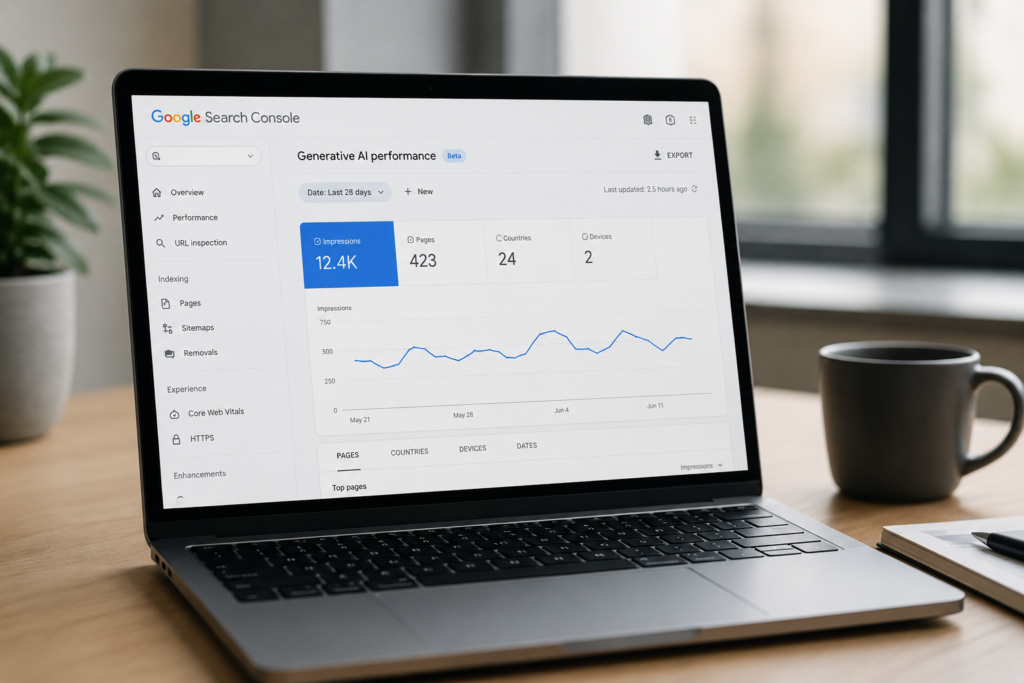
Google Search Console is beginning to offer a clearer view of something that until now has been difficult to measure: a website’s presence within Google’s generative AI experiences.
The new report makes it possible to analyze impressions generated in environments such as AI Overviews and Google AI Mode, separating part of that visibility from traditional organic search results.
For SEO and marketing teams, this represents an important step forward: it is no longer enough to measure rankings, clicks, or traffic. It is also becoming necessary to understand when a website appears within generative answers and which content is gaining greater visibility in AI.
What data the new generative AI report provides
The report makes it possible to identify which pages are appearing within Google’s generative experiences and how that presence evolves over time.
This becomes especially relevant as Google AI Overviews and Google AI Mode change the way users consume information.
| Available data | What it allows you to analyze |
| Impressions | How many times site links appear in generative experiences |
| Pages | Which URLs achieve greater visibility |
| Countries | Which markets generate the impressions |
| Devices | Differences between mobile, desktop, and tablet |
| Dates | How visibility evolves over time |
A high number of impressions means that Google is displaying content from a page within its AI experiences, but it does not necessarily mean that the user clicked on it.
That is why these impressions should primarily be interpreted as an AI visibility metric rather than solely as a source of traffic.
What Search Console still does not show
The new report provides relevant information, but it still does not offer a complete view of AI performance.
| Search Console allows you to see | Information that is still missing |
| AI impressions | Specific queries that triggered the appearance |
| Visible URLs | AI-specific CTR |
| Country and device | Position within the answer |
| Performance over time | Competitors mentioned |
| Presence on Google | Visibility in ChatGPT, Gemini, or Perplexity |
This means the data should be interpreted with some caution.
For example, a page may increase its generative impressions while losing organic clicks. This does not automatically mean that AI is causing the decline, but it may indicate a change in how users find information.
Which pages perform best in AI
One of the most interesting analyses is identifying which URLs generate the highest number of impressions.
If certain pages stand out, it is worth reviewing what they have in common:
- clear answers;
- well-structured headings;
- first-party data;
- comparisons;
- specialized content;
- up-to-date information;
- strong topical coverage.
These patterns can serve as a reference for the rest of the strategy.
A strong SEO for AI strategy is not only about optimizing keywords, but also about making it easier for Google and other models to understand what information each page provides and when it is relevant.
Combining traditional SEO and GEO
The report also reinforces the need to analyze SEO and GEO together.
Traditional SEO continues to measure rankings, impressions, clicks, and conversions. GEO broadens that perspective to include presence within generative answers.
In this context, it is useful to understand the shift from SEO to GEO as an evolution rather than a replacement.
New AI visibility KPIs are also becoming increasingly important, such as:
- Mention Rate;
- Citation Rate;
- Share of Voice;
- sentiment;
- associated attributes;
- sources used by the models.
These metrics provide additional context for the impressions reported in Search Console.
AIBrandpulse360: an additional layer for understanding AI visibility
The new Search Console report helps explain what is happening with a website within Google, but it does not show the full picture.
AIBrandpulse360 expands this analysis by making it possible to study how a brand appears across different generative engines, which competitors are gaining presence, and which attributes, sources, and topics are associated with each company.
This makes it possible to analyze:
- presence compared with competitors;
- AI Share of Voice;
- sentiment;
- associated attributes;
- sources used;
- queries where the brand appears or disappears;
- content and authority opportunities.
An AI visibility tool makes it possible to combine these signals with Search Console data and obtain a more complete view.
Search Console helps identify which pages are gaining impressions within Google. AIBrandpulse360 adds a second layer: how the brand is positioned within the generative ecosystem and which competitors it is competing against.
How to interpret the data correctly
The real value of the report lies not in looking at an isolated figure, but in analyzing how it evolves over time.
It is useful to compare generative impressions with:
- organic traffic;
- CTR;
- pages gaining or losing visibility;
- content updates;
- technical changes;
- conversions.
It is also worth comparing trends before and after updating a page or strengthening a topic area.
The goal is to move from a traffic measurement mindset to a broader approach focused on measuring influence and visibility.
From measuring rankings to measuring AI presence
The new generative AI report in Search Console confirms an important shift in how organic performance should be understood.
Rankings remain relevant, but they no longer tell the whole story.
A brand also needs to know whether its content appears within generative answers, which pages perform best as sources, and how that presence evolves over time.
Combining Search Console, SEO, GEO, and platforms such as AIBrandpulse360 makes it possible to build a much more complete measurement system.
Because in AI-powered search, it is no longer only about how many people reach a website. It also matters how much that website and brand influence the answers users receive before they click.

 Sep 11, 2026


