
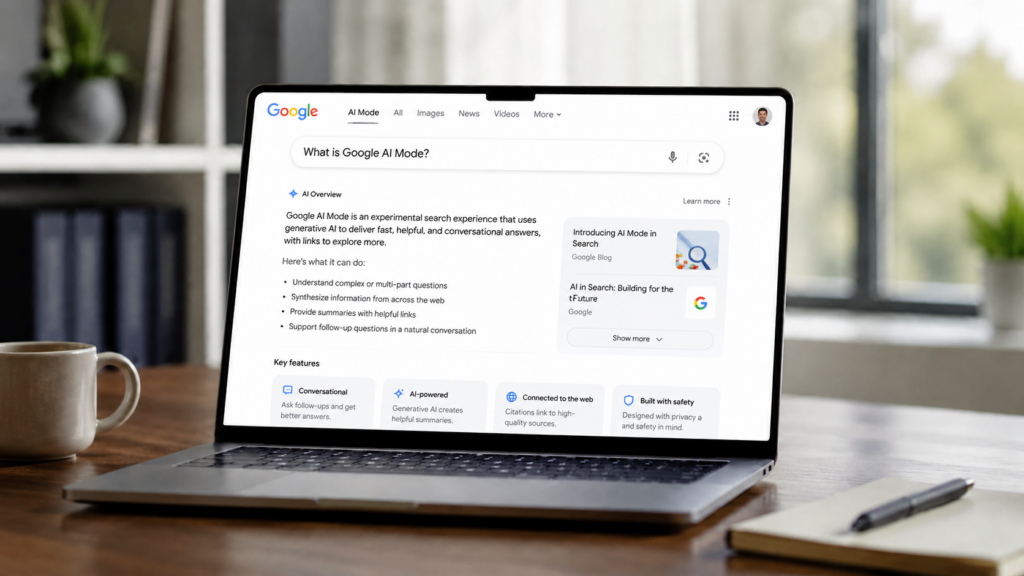
Google is evolving from a search engine primarily based on results into an experience capable of generating complete answers.
Google AI Mode represents one of the most important changes within this transformation. Instead of simply displaying a list of links, it allows users to make complex queries, maintain a conversation, and receive synthesized answers based on different sources.
For users, this means a new way of searching. For brands, it means reconsidering what it really means to have visibility on Google.
What is Google AI Mode
Google AI Mode is an AI-powered search experience that allows users to interact with Google using natural language.
Users can make a query, add new conditions, explore specific aspects in greater depth, and continue the conversation without having to start a new search from scratch.
It can also combine different formats such as text, voice, or images.
This brings it closer to the experience already offered by other generative engines and represents another step forward from Google AI Overviews.
| Traditional search | Google AI Mode |
| Relatively specific keywords | Natural language questions |
| List of results | Synthesized answer |
| Each query starts from scratch | Maintains context |
| The user compares several websites | AI summarizes different sources |
| Mainly text | Text, voice, and images |
The fundamental difference is that Google is no longer acting solely as an intermediary between a question and different web pages. It now also interprets information and builds an answer.
From keywords to conversations
One of the most relevant changes in AI Mode lies in how it interprets queries.
A search such as “best laptop” can become a much more specific request:
“I need a lightweight laptop for traveling, video editing, and around eight hours of use without charging. Which options should I compare?”
Google can break that need down into different parts, search for related information, and build an answer by combining several sources.
This approach is closely related to semantic search: understanding concepts, relationships, and intent is becoming more important than responding solely to an exact keyword match.
For SEO, this means working on complete topic areas rather than isolated pages built around a single keyword.
How SEO changes with Google AI Mode
SEO does not disappear with AI Mode. But the way we understand success does change.
Until now, much of the strategy focused on achieving a specific ranking and generating a click.
In a generative interface, part of the user’s need may be resolved before they reach a web page.
| Traditional SEO | SEO in a generative environment |
| Gain rankings | Gain presence in the answer |
| Optimize keywords | Cover intents and topics |
| Maximize CTR | Earn mentions and citations |
| Rank a URL | Build topical authority |
| Measure rankings | Measure brand visibility |
That is why SEO, content, digital PR, and reputation are becoming even more closely connected.
What this means for measurement
One of the main consequences of generative search is that marketing teams need to broaden the metrics they use.
It is no longer enough to know:
- rankings;
- impressions;
- clicks;
- CTR;
- organic traffic.
It is also important to analyze whether a brand appears in the answers, which competitors it appears alongside, which attributes are associated with it, and which sources support that presence.
The AI visibility approach broadens the traditional SEO perspective and helps explain a company’s presence within this new search journey.
A brand may maintain strong organic rankings while still having limited presence in the most relevant generative answers within its category.
How AIBrandpulse360 fits into Google AI Mode
This new scenario presents a clear challenge: brands need to understand what is happening inside the answers, not only in traditional rankings.
AIBrandpulse360 makes it possible to analyze how a brand appears across different generative engines, which competitors are gaining visibility, and which attributes, sources, and topics are associated with each company.
This helps monitor aspects such as:
- frequency of appearance;
- Share of Voice compared with competitors;
- attributes associated with the brand;
- sentiment;
- sources used;
- queries where the brand appears or disappears;
- content and authority opportunities.
An AI visibility tool makes it possible to turn these signals into comparable data and identify where there is room to improve a brand’s presence.
The goal is not simply to check whether a company appears in Google AI Mode or other generative engines, but to understand why it appears, how it is positioned compared with competitors, and which actions can strengthen its visibility.
How to prepare for Google AI Mode
There is no single formula for “optimizing for AI Mode.”
The foundation remains a technically accessible website and high-quality content, but some priorities become more important:
- answer real needs clearly;
- structure headings and content correctly;
- develop topic clusters;
- provide original information;
- keep content up to date;
- build authority beyond the website;
- strengthen the relationship between the brand and its areas of expertise.
It will also be necessary to monitor how that presence evolves.
The AI brand monitoring process helps detect changes in the queries, competitors, attributes, and sources that influence generative answers.
This makes it possible to connect SEO and GEO with real data instead of simply assuming which content may be working.
Google AI Mode changes the concept of visibility
Google AI Mode does not mean the end of SEO.
It represents an evolution in what we consider a search and, as a consequence, in what we understand by visibility.
Rankings remain important, but they will share prominence with mentions, citations, topical authority, and a brand’s ability to become part of an answer.
The most important change may be this: the goal is no longer only to get Google to display a page, but to get Google to understand when that page or brand deserves to be part of the answer.
In an environment where the search engine interprets, compares, and synthesizes information for the user, building authority will be just as important as achieving rankings.

 Sep 11, 2026


