

ChatGPT, Gemini, Copilot, Claude, and Perplexity are already part of the search and decision-making process for many users. These tools recommend companies, compare products, and shape brand perception without users having to visit the company’s website.
This shift requires companies to broaden the way they analyze their digital presence. It is no longer enough to track Google rankings, organic traffic, or the number of mentions on social media. Companies also need to know whether their brand appears in AI-generated responses, how it is described, and which competitors achieve greater visibility.
The monitoring of brands in AI makes it possible to observe this new visibility environment and understand how a company’s presence evolves within generative models.
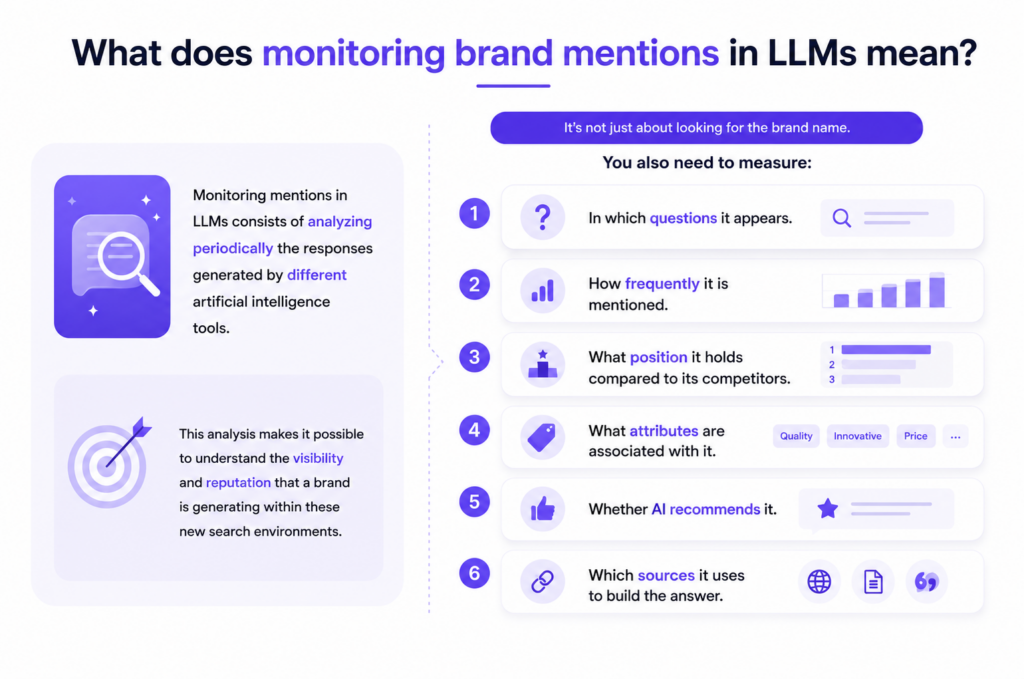
What Does Monitoring Brand Mentions in LLMs Mean?
Monitoring mentions in LLMs involves periodically analyzing the responses generated by different artificial intelligence tools.
It is not simply a matter of searching for the brand name. It is also necessary to measure:
- Which questions it appears in.
- How frequently it is mentioned.
- What position it holds compared to its competitors.
- Which attributes are associated with it.
- Whether the AI recommends it.
- Which sources it uses to build the response.
This analysis provides a better understanding of a brand’s visibility in AI and the reputation it is building within new search environments.
It also helps identify differences between platforms. A company may appear frequently in ChatGPT, have limited visibility in Gemini, and not be mentioned in Perplexity for the same queries.
Why Should It Be Carried Out Continuously?
LLM responses are not static. They may change as a result of:
- Model updates.
- New versions of the tools.
- Changes to information retrieval systems.
- The publication of new content.
- Changes to the sources consulted.
- New reviews, news articles, or external mentions.
- Variations in how questions are phrased.
- Changes in the context of the conversation.
A one-off measurement provides only a snapshot of a specific moment. It may show how a brand appears today, but it does not make it possible to determine whether its visibility is improving, declining, or remaining stable.
Continuous monitoring makes it possible to detect trends, compare periods, and assess whether optimization efforts are producing a real impact.
It also makes it easier to identify important changes at an early stage, such as the emergence of a new competitor, the loss of a prominent position, or the association of the brand with incorrect or outdated information.
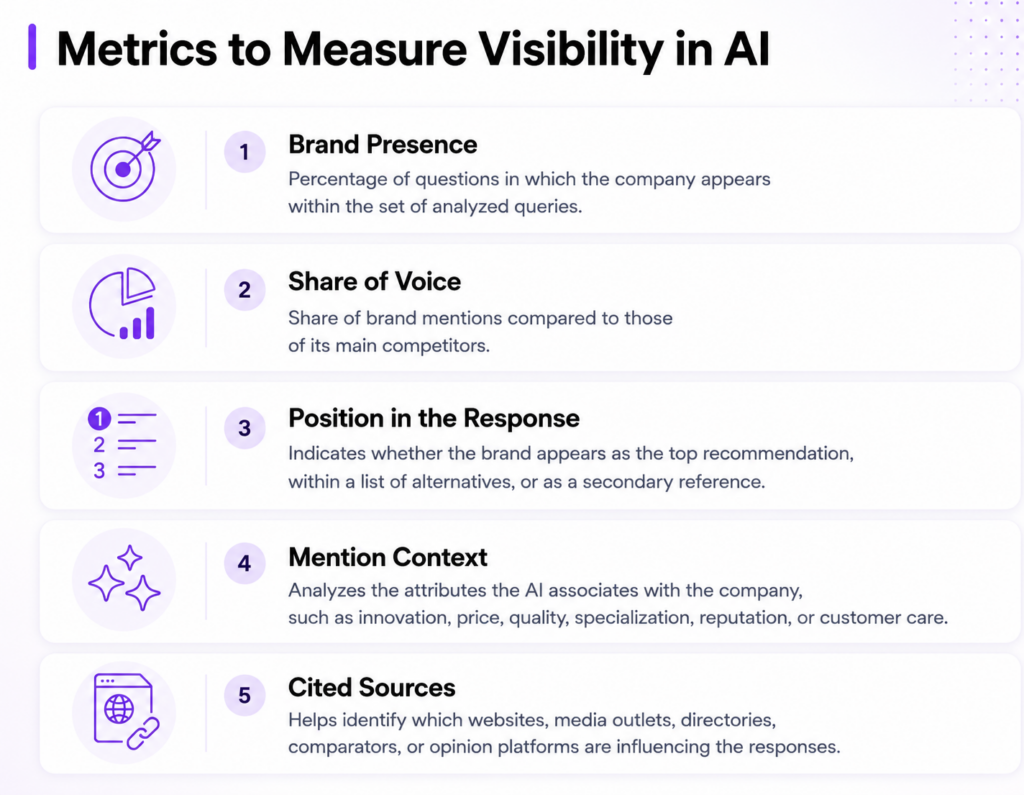
Metrics for Measuring Visibility in AI
Brand Presence
Percentage of questions in which the company appears within the set of analyzed queries.
For example, if 100 relevant questions are run for a particular industry and the brand appears in 35 responses, its presence rate would be 35%.
This metric provides an overview of the brand’s overall coverage, although it should be analyzed alongside other indicators. Appearing frequently does not necessarily mean holding a favorable position.
Share of Voice
Share of Voice measures the proportion of brand mentions compared to those of its main competitors.
It helps answer questions such as:
- Which company is mentioned most frequently?
- Which competitor dominates a specific category?
- How is each brand’s share of presence evolving?
- Which companies are gaining visibility?
The Share of Voice in AI works, to some extent, as a competitive benchmark equivalent to the rankings traditionally analyzed in search engines.
Position in the Response
Not all mentions have the same value.
A brand may appear as the top recommendation, be included in a list of alternatives, or be mentioned only as a secondary reference. It may also appear in a comparison while receiving a less favorable assessment than its competitors.
For this reason, it is important to analyze:
- The order in which it appears.
- The relevance of the mention.
- The length of the description.
- The level of recommendation.
- Its relevance to the needs expressed by the user.
Mention Context
This metric analyzes the attributes and concepts that AI associates with the company.
The most common include:
- Innovation.
- Price.
- Quality.
- Specialization.
- Reliability.
- Reputation.
- Customer service.
- Ease of use.
- Geographic coverage.
- Value for money.
Context provides insight not only into how often a brand appears, but also into how it is being interpreted. This analysis is especially important for managing a company’s reputation in AI.
Recommendation Level
A mention does not always imply a recommendation.
The model may cite a brand as an example, include it in a neutral list, or present it as the most suitable option for a specific need. It is therefore important to distinguish between presence, consideration, and recommendation.
Analyzing whether a brand appears and is recommended in AI responses helps determine which stage of the decision-making process it is influencing.
Cited Sources
When a tool displays the sources used in its response, it is possible to identify which websites, media outlets, directories, comparison sites, or review platforms are influencing it.
These sources may include:
- The corporate website.
- Media outlets.
- Specialist articles.
- Business directories.
- Comparison websites.
- Forums and communities.
- Review platforms.
- Industry studies and reports.
This analysis makes it possible to identify which domains are strengthening the brand’s presence and which are favoring its competitors.
Performance over time compares the results obtained across different periods.
This makes it possible to determine whether a brand:
- Is appearing in more questions.
- Has improved its average position.
- Is gaining or losing Share of Voice.
- Is beginning to be associated with new attributes.
- Is receiving more recommendations.
- Is appearing in new categories or use cases.
To obtain a complete overview, it is advisable to define several AI visibility KPIs and avoid relying on a single indicator.
How to Carry Out Continuous Monitoring
1. Create a Consistent Set of Questions
The first step is to create a consistent set of questions related to the category, customer needs, and the different stages of the decision-making process.
For example:
- Which are the best companies in the industry?
- Which brand offers the most reliable solution?
- What alternatives are there to a particular company?
- Which provider would you recommend for this type of customer?
These questions should be run periodically across different models while maintaining a consistent methodology.
The results must then be recorded, the brand’s presence compared with that of its competitors, and relevant changes identified, such as a loss of visibility, the emergence of new competitors, or negative associations.
2. Analyze Different Models
The same questions should be run across different LLMs, as each tool may produce different results.
The way ChatGPT selects and presents a brand may differ from Gemini, Claude, Copilot, or Perplexity. These differences may be due to their sources, retrieval systems, internal instructions, or the way they interpret each query.
Understanding how ChatGPT, Gemini, and Perplexity influence visibility makes it possible to identify the platforms on which a brand has the strongest presence and where it needs to improve.
3. Maintain a Consistent Methodology
To compare results effectively, the methodology should remain as consistent as possible.
This means keeping:
- The same questions.
- The same language.
- The same markets or locations.
- The same models analyzed.
- A defined measurement frequency.
- The same classification criteria.
- A standardized system for evaluating mentions and recommendations.
It is also important to record the date, the model version when available, and any variable that may affect the response.
4. Record and Structure the Results
Responses must be converted into measurable information.
It is not enough to store them as text. They must be classified in order to identify:
- The brands mentioned.
- The order in which they appear.
- The associated attributes.
- The tone of the response.
- The level of recommendation.
- The competitors included.
- The sources used.
- The related products or services.
This structure makes it easier to compare queries, models, and periods.
5. Identify Relevant Changes
Once the data has been collected, variations that may affect the brand’s positioning should be identified.
For example:
- A decrease in presence.
- The loss of the top position.
- The emergence of new competitors.
- An increase in negative mentions.
- The disappearance of a relevant category.
- The use of outdated information.
- A change in the cited sources.
- An improvement in visibility following a specific action.
Monitoring should help distinguish a temporary variation from a sustained trend.
Monitoring should support decision-making.
The results may highlight the need to:
- Create content about topics in which the brand does not appear.
- Improve product or service pages.
- Provide clearer answers to users’ questions.
- Strengthen the brand’s presence in relevant media outlets.
- Increase reviews and other reputation signals.
- Correct inaccurate or outdated information.
- Develop comparison content.
- Explain use cases and differentiating factors more clearly.
- Structure website information in a clearer and more accessible way.
- Develop a GEO positioning strategy.
For example, if a brand does not appear when users ask about the best solutions for SMEs, it may be necessary to create specific content for that audience, improve the description of its offering, or secure mentions in sources that are relevant to that category.
After implementing these actions, the same questions should be repeated to determine whether any changes have occurred. In this way, monitoring becomes a continuous cycle of analysis, optimization, and measurement.
How AIBrandpulse360 Helps
AIBrandpulse360 makes it possible to continuously analyze how a brand appears across different artificial intelligence models.
The solution measures brand presence, Share of Voice, mentioned competitors, associated attributes, and the sources influencing the responses. This makes it possible to understand not only whether a company appears, but also how it is described, in which contexts it is recommended, and what position it holds compared to other alternatives.
As an AI brand monitoring tool, AIBrandpulse360 facilitates the ongoing tracking of key metrics and makes it possible to identify relevant changes over time.
It also combines automated analysis with expert guidance to interpret the results and turn them into an optimization plan. This enables marketing, communications, reputation, and product teams to identify opportunities, prioritize actions, and measure their impact.
In an environment where an increasing number of decisions begin within an AI-generated response, monitoring brand visibility is the first step toward improving it.
What cannot be measured cannot be optimized. And in the new generative search environment, not appearing is also a result that brands need to understand.

 Sep 11, 2026


