SEO rankings, organic traffic, impressions, and media mentions have long been the main benchmarks for measuring brand visibility. However, the arrival of ChatGPT, Gemini, Claude, Perplexity, and Google AI Overviews has opened up a new scenario: many search, comparison, and purchase decisions no longer necessarily start or end on a traditional search engine results page.
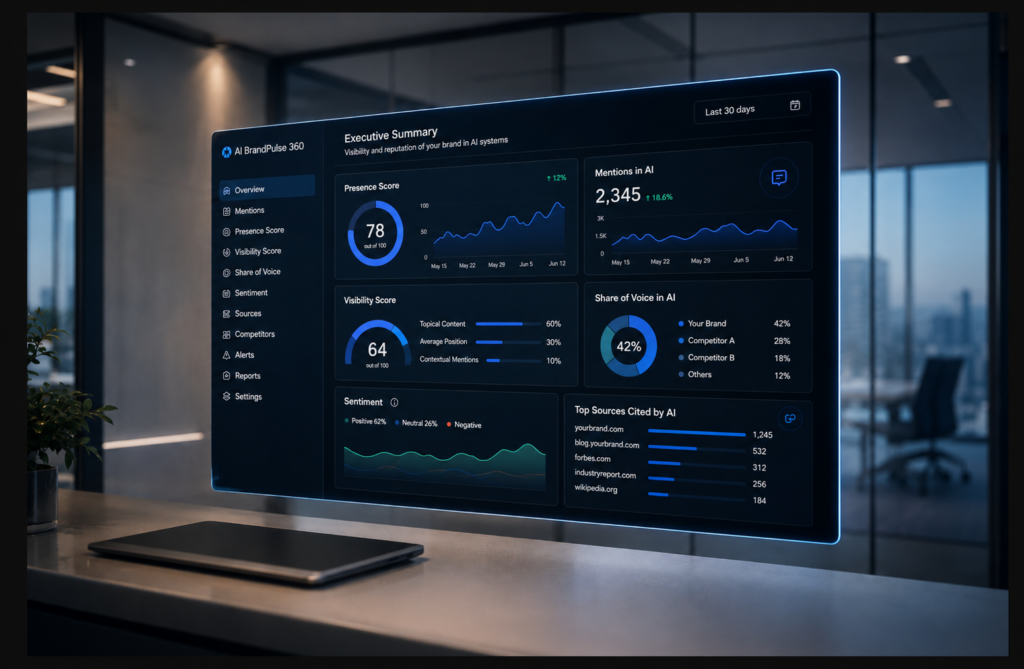
In this context, AIBrandpulse360 allows analyzing how artificial intelligence systems interpret and represent a brand within their answers. The platform goes beyond identifying whether a company appears or not: it measures its visibility, the prominence it receives, the associated perception and sentiment, its presence against competitors, and the sources influencing the image that AI builds around it.
What is AIBrandpulse360
AIBrandpulse360 is a platform designed to monitor how artificial intelligence models represent a brand when answering user queries. Its goal is to help companies understand where they stand within generative environments such as ChatGPT, Gemini, Claude, Perplexity, Google AI Overviews, or Google AI Mode.
Unlike a traditional SEO tool, it does not focus solely on positions, clicks, or traffic. Its analysis goes a step further because it observes how AI understands the brand, in what contexts it mentions it, what attributes it associates with it, and which competitors appear alongside it.
This turns brand monitoring in AI into a new layer of analysis for marketing, SEO, communication, and digital reputation teams. It is no longer enough to know how a website ranks on Google; it is also necessary to understand how the brand appears when someone asks an AI system directly for a recommendation.
Why Measuring Traditional SEO is No Longer Enough
Traditional SEO remains essential, but search behavior is changing. Previously, users saw a list of results, visited several pages, and compared information on their own. Now, for many queries, artificial intelligence summarizes content, selects sources, ranks alternatives, and provides a direct answer.
This means a brand can rank well on Google and still have little presence in ChatGPT, Gemini, or AI Overviews. It can also happen that a competitor is more highly recommended by AI even if they do not have the best organic position in a traditional search.
This is where the difference between SEO and GEO comes into play. While SEO works on search engine visibility, GEO, or Generative Engine Optimization, aims to improve a brand’s presence within AI-generated responses. Simply put, SEO helps a brand be found, while GEO helps AI understand, mention, and recommend it in the right contexts.
That’s why it makes more and more sense to combine both strategies and work on GEO positioning for LLMs as a natural extension of SEO.
Mentions: The First Sign of AI Presence
The first metric that AIBrandpulse360 analyzes is very straightforward: whether AI mentions a brand when it should. Although it may seem like a basic question, it holds enormous strategic value because it detects whether or not a company is part of the relevant answers within its category.
AIBrandpulse360 analyzes the number of appearances, mention frequency, queries where the brand appears, the timeline evolution of that presence, and the contexts in which it gains or loses visibility. In this way, a company can know if it is present in key conversations or if the models are prioritizing other competitors.
For example, a tech company might have good SEO content and organic traffic, but not show up when someone asks ChatGPT for “the best tools to automate commercial processes.” In that case, the problem isn’t just on Google, but in the brand’s AI presence.
The key is not just to appear in any answer, but to appear in the answers that actually influence the user’s decision.
Presence Score: How Much a Brand Actually Appears
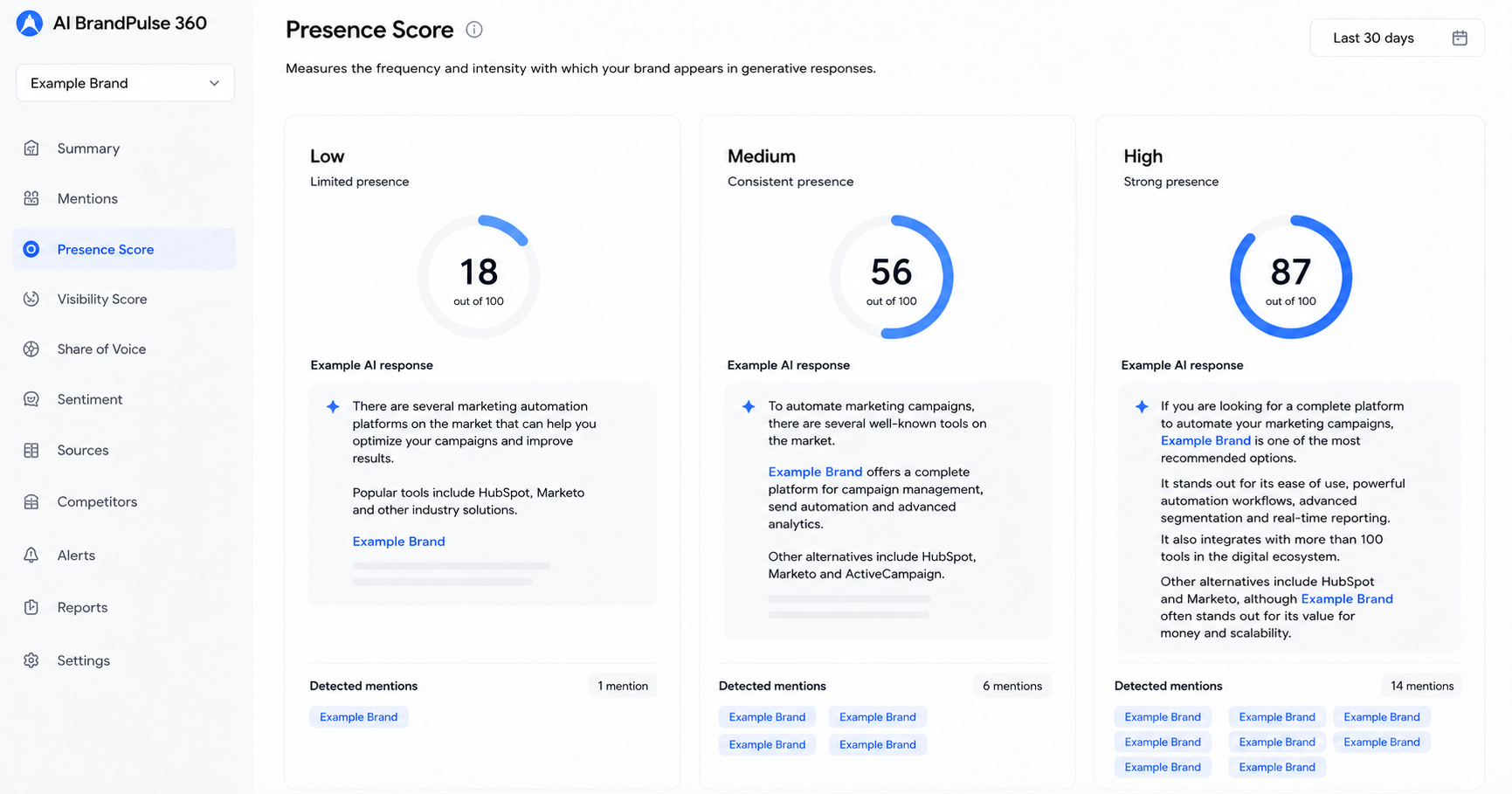
The Presence Score measures the intensity and recurrence with which a brand appears in generative responses. It is not just about counting isolated mentions, but about understanding whether the brand appears occasionally, maintains a stable presence, or is starting to be recognized as a benchmark within its category.
Presence Score Level
What It Means
Low
The brand appears sporadically or only in very specific queries.
Medium
The brand has a consistent presence in relevant topics, although it does not yet dominate the conversation.
High
The brand appears frequently, and models recognize it as an important entity within its category.
A low Presence Score may indicate that the brand is not yet sufficiently associated with its market in AI models. A medium level shows that there is a foundation of presence to continue building on, while a high level indicates that the brand appears recurrently and is starting to achieve clear recognition in generative responses.
This metric helps answer a question that traditional SEO cannot always resolve: whether the brand is truly present in the conversation generated by artificial intelligence.
Visibility Score: Appearing is Not the Same as Standing Out
Appearing in a response does not always mean having real visibility. One brand might be mentioned at the bottom of a list, without context, or as a secondary alternative, while another might occupy a prominent position and be presented as one of the best options.
The Visibility Score measures precisely that level of prominence. AIBrandpulse360 analyzes where the brand appears within the response, how much space it receives, whether it is presented as a primary or secondary option, if it is recommended over other competitors, and if the accompanying explanation reinforces its value proposition.
This difference is important because not all mentions carry the same weight. It is not the same for AI to say that a brand “also exists” as it is to describe it as “one of the most recommended options” to solve a specific need.
From a commercial standpoint, this difference can directly influence purchase consideration.
Share of Voice in AI: Who Dominates the Conversation
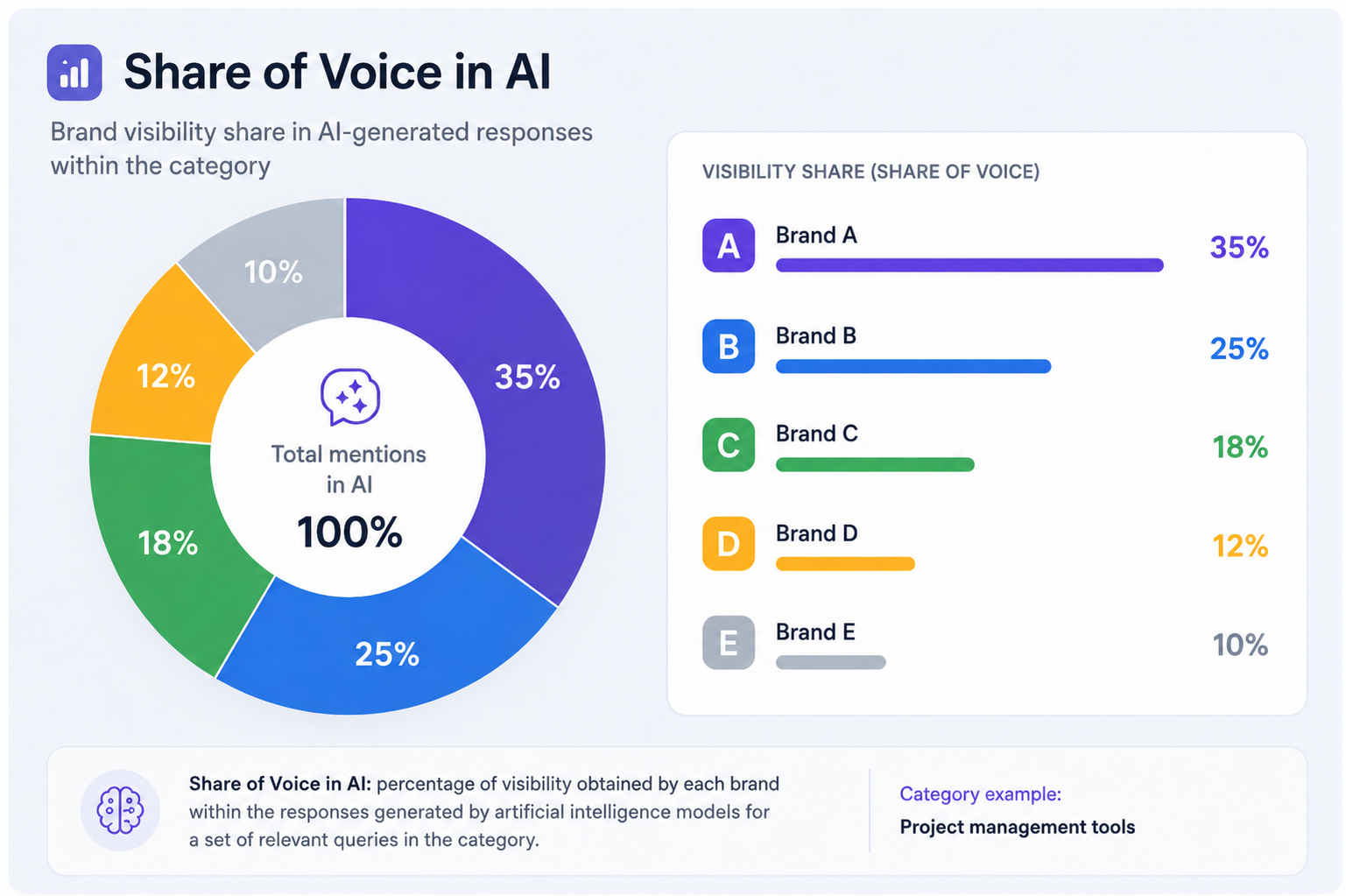
Share of Voice in AI allows measuring which brands carry more weight within generative responses. It is a particularly useful metric for comparing your own visibility against competitors, as AI models rarely talk about a brand in isolation. Typically, they compare, group, recommend, and rank different options.
Brand
Mentions
Visibility Share
Brand A
X
X%
Brand B
X
X%
Brand C
X
X%
This analysis makes it possible to detect who is dominating the conversation in AI and which brands are gaining ground in a specific category. If a competitor appears repeatedly in strategic queries and your brand is barely mentioned, it could be a sign that you need to reinforce topical authority, content, external mentions, or digital reputation.
That’s why Share of Voice complements other AI visibility KPIs very well, as it allows moving from an individual reading to a competitive view.
How AI Interprets Brand Perception
AI BrandPulse 360 does not just stop at measuring visibility, because appearing frequently is not always positive if the way AI describes the brand is not aligned with its actual positioning. Therefore, the platform also analyzes brand perception.
AI models can associate a company with attributes such as innovation, trust, prestige, quality, price, specialization, proximity, support, or experience. The problem arises when those associations do not reflect what the brand wants to convey or when the models offer a description that is too generic, outdated, or incomplete.
For example, a company might want to position itself as a premium and strategic solution, but AI might describe it primarily as an affordable option. Another brand might invest in innovation only to find that models barely mention that attribute when speaking about it.
This analysis helps detect mismatches between the identity a brand wants to build and the perception that LLMs are transmitting to users.
Brand Sentiment in AI
Sentiment analysis allows understanding whether AI-generated responses convey a positive, neutral, or negative perception of a brand. Not all mentions carry the same value, which is why it is important to analyze the tone with which a company appears inside each response.
A brand might appear positively when discussing innovation but receive a more neutral rating when the query focuses on price, support, or customer experience. That contextual difference is crucial because AI reputation is not built uniformly; instead, it changes depending on the question the user asks.
The goal is not to just settle for a “positive,” “neutral,” or “negative” label, but to understand what is driving that perception and how it can be addressed through content, authority, communication, and external sources. This is why measuring reputation in AI and LLMs is becoming an important part of brand strategy.
What Sources AI Uses to Build a Brand’s Image
AI does not build a brand’s perception solely from its corporate website. Generative models can rely on media outlets, specialized blogs, knowledge bases, studies, comparisons, social media, public documentation, institutions, directories, reviews, or third-party pages.
AIBrandpulse360 helps identify which sources are influencing how AI represents a brand. This allows knowing whether models are using updated sources, if relevant media outlets appear, if the information reinforces the desired positioning, or if old content is still conditioning the perception.
This point is particularly important because many companies believe they control their narrative solely with their website, when in reality AI builds reputation from a much broader ecosystem. The corporate website matters, but it is not the only voice that models take into account.
Monitoring in ChatGPT, Gemini, Claude, and Google AI Overviews
Not all AI systems respond the same way. ChatGPT might describe a brand one way, Gemini might rely on other sources, Claude might provide a more contextual response, and Google AI Overviews might integrate the brand within an experience closer to a traditional search engine.
That is why AIBrandpulse360 allows comparing a brand’s presence across different generative systems, such as ChatGPT, Gemini, Claude, Perplexity, Google AI Overviews, and Google AI Mode. This comparison helps detect whether a brand is well-represented in one environment but has room for improvement in another.
For example, a company might appear quite strongly in ChatGPT but have little visibility in Google AI Overviews. In that case, it might be necessary to review the content strategy, indexable sources, topical authority, or presence in external media.
How to Use This Data to Improve GEO Positioning
Measuring AI presence only makes sense if that data is turned into decisions. The true value of AIBrandpulse360 lies in transforming the diagnosis into actions to improve GEO positioning.
When a brand knows where it appears, how it appears, and what sources influence its representation, it can make much more accurate decisions. It can reinforce content, correct messaging, improve topical authority, and work on external mentions that help AI models better understand its value proposition.
Some practical uses of this data are:
Create content that is better aligned with users’ actual questions.
Reinforce strategic pages regarding products, services, or categories.
Improve presence on relevant external sources.
Correct negative or outdated associations.
Detect competitors that are gaining more visibility in AI.
Work on brand attributes that models are not accurately capturing.
Optimizing for AI is not about manipulating responses, but about making the brand clearer, more consistent, and more verifiable across its entire digital ecosystem.
So, What Does AIBrandpulse360 Actually Measure?
AIBrandpulse360 measures how a brand exists within artificial intelligence. It analyzes whether it appears, how frequently it does so, what prominence it receives, which competitors accompany it, what perception it conveys, what sentiment it generates, and which sources are building that image.
In an environment where more and more users query AI directly before making decisions, these metrics allow understanding a dimension of visibility that traditional SEO does not completely cover. The future of digital visibility is not played out solely in search results, but also in generative responses.
Therefore, brands need to know if AI recognizes them, understands them, and recommends them at the right times.
Frequently Asked Questions About What AIBrandpulse360 Measures
Are ChatGPT Responses the Same for All Users?
Not always. Responses can vary depending on the query, context, model version, and available sources, so it is best to analyze many queries before drawing conclusions.
Can a Brand Rank Well on Google and Be Invisible to AI?
Yes. A brand can have good SEO rankings and still not appear prominently in ChatGPT, Gemini, or Google AI Overviews, because search engine visibility and AI visibility do not work exactly the same way.
Which Sectors Are Most Impacted by AI Visibility?
Sectors where users compare options before deciding are usually especially affected, such as technology, software, healthcare, education, finance, tourism, legal, B2B, retail, and professional services.
Do LLMs Always Use the Same Sources?
No. Sources can vary depending on the model, type of query, and available information; that is why it is important to analyze which ones appear recurrently and which ones influence brand perception the most.
Does AI Visibility Influence Purchase Decisions?
Yes. When a user asks an AI for recommendations, comparisons, or alternatives, brands that appear with more prominence have a better chance of entering the consideration phase.
What Is the Difference Between a Mention and a Recommendation in AI?
A mention means the brand appears within the response, while a recommendation implies that the AI presents it as a relevant, prominent, or particularly suitable option for a specific need.
Can a Wrong Perception That AI Has About a Brand Be Corrected?
Yes, although it is usually not immediate. It is necessary to work on proprietary content, external mentions, topical authority, digital reputation, and reliable sources that help reinforce a more accurate image.
How Does AI Affect International Brand Management?
AI can represent a brand differently depending on the language, country, and available sources in each market, which is why international brands should analyze their presence by region, language, and cultural context.
Does AI Monitoring Replace SEO Tools?
No. AI monitoring complements SEO, as SEO tools are still necessary to analyze rankings, searches, and traffic, while AI monitoring allows understanding how the brand appears within generative responses.
What Role Will AI Visibility Play in the Coming Years?
AI visibility will become increasingly important because users are incorporating generative assistants into their search, comparison, and decision-making processes. Brands that start measuring this presence earlier will have a greater capacity to influence the digital conversation.
Últimos artículos
Sep 11, 2026
Digital PR for GEO: how to earn mentions that strengthen your brand in AI
Sep 09, 2026
E-E-A-T in the AI era: how to demonstrate real expertise
Sep 08, 2026
Structured data and GEO: does Schema help you appear in AI generated answers?
Sep 04, 2026
7 myths about GEO and AI Search that Google has already debunked
Sep 02, 2026
llms.txt: what it is, what it is used for, and what Google says about its use
Sep 01, 2026
Google Preferred Sources: how to make your website a preferred source
ANALYZE YOUR AI VISIBILITY
Ready to boost your brand’s visibility
in AI?
Discover how your brand appears across ChatGPT, Gemini, Perplexity, and other AI environments, and turn it into a competitive advantage.



 Sep 11, 2026


