
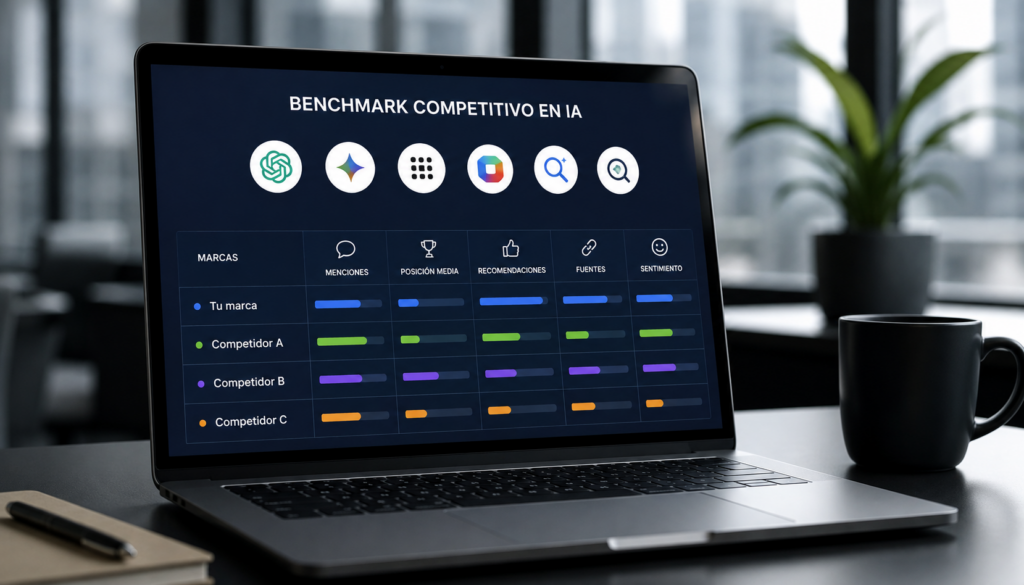
Your brand may appear in ChatGPT, Gemini, or Perplexity and still be losing visibility to your competitors.
Knowing that your company has been mentioned is not enough. To understand its true position, you need to compare how often it appears, where it ranks, how AI models describe it, and when it is recommended over other options.
That is the purpose of an AI competitive benchmark.
What Is an AI Competitive Benchmark?
An AI competitive benchmark compares your brand’s presence with that of your competitors across responses generated by systems such as ChatGPT, Gemini, Perplexity, Copilot, and Google AI Overviews.
The analysis helps answer questions such as:
- Which brands appear most frequently?
- Which brands typically rank at the top?
- Which companies receive direct recommendations?
- Which topics and user needs are associated with each brand?
- Which positive or negative attributes does AI assign to them?
- Which sources support the responses?
This type of analysis is part of an AI visibility strategy because it evaluates a company’s position within a competitive landscape rather than measuring it in isolation.
AI Benchmarking vs. Traditional Competitive Analysis
Traditional competitive analysis focuses on organic traffic, keywords, backlinks, social media, pricing, and product features.
AI benchmarking adds a different dimension: how generative AI models interpret, present, and recommend brands.
A company may have more traffic and stronger Google rankings yet appear less frequently in ChatGPT’s responses. Likewise, it may be well known within its industry but still not be associated with a specific use case.
For this reason, the two approaches complement each other. SEO measures visibility in search engines, while generative benchmarking reveals which brands occupy space within AI-generated responses.
Why a Single Manual Query Is Not Enough
Asking ChatGPT once which companies are the best in your industry can provide an initial indication, but it is not enough to draw reliable conclusions.
Responses may vary depending on:
- How the prompt is written.
- The AI model being used.
- The language and location.
- The conversation context.
- The date of the query.
- The available sources.
In addition, users ask different questions throughout their buying journey. Some seek general information, while others compare alternatives, evaluate pricing, or request a specific recommendation.
To obtain meaningful results, it is necessary to analyze a structured set of prompts and apply the same conditions to every brand being evaluated.
How to Conduct an AI Competitive Benchmark
1. Select Your Competitors
Start with three to five companies.
Include direct competitors, a market leader, and an emerging brand that is gaining visibility. It is also useful to track companies that appear spontaneously in AI responses, even if you do not initially consider them competitors.
AI can associate your category with alternative solutions or new players that may not yet appear in your traditional competitive analysis.
2. Define the Topics You Want to Analyze
Do not limit the study to queries that include your brand name.
Unbranded queries help determine whether a company appears when users have not yet selected a provider. They are especially useful for analyzing organic discovery.
Topics can be organized around:
- Problems the product solves.
- Use cases.
- Industries or customer types.
- Features.
- Integrations.
- Comparisons.
- Alternatives.
- Pricing.
- Implementation.
- Security.
- Reputation.
This segmentation helps identify specific strengths. A competitor may dominate the overall category, while your brand leads in a specific niche or for a particular customer need.
3. Create Prompts for Different Intentions
The query set should represent different stages of the buying journey.
You can include questions such as:
- “What solutions exist to solve X?”
- “What are the best tools for X?”
- “Compare the leading providers of X.”
- “What alternatives exist to brand X?”
- “What solution would you recommend for a company in this industry?”
Combine branded and unbranded prompts. Branded prompts help analyze perception, accuracy, and comparisons. Unbranded prompts show whether the company appears organically.
4. Analyze Multiple AI Engines
Not all platforms use the same sources or generate responses in the same way.
A brand may have strong visibility in Perplexity and be almost invisible in Gemini. Therefore, results should be separated by platform before calculating an overall metric.
When comparing AI engines, review:
- Frequency of appearance.
- Position within the response.
- Recommended brands.
- Arguments used.
- Cited sources.
- Differences in perception.
You can explore this topic further by looking at how ChatGPT, Gemini, and Perplexity influence visibility.
5. Maintain a Consistent Methodology
To ensure valid comparisons, always use the same prompts, models, languages, locations, and classification criteria.
It is also important to record the date of each query and save the complete responses.
AI visibility is dynamic. A repeatable methodology helps distinguish between sustained improvement and temporary variations in model responses.
Key Metrics to Compare AI Presence
| Metric | What It Measures |
| Share of Voice | Percentage of mentions attributed to each brand. |
| Presence Rate | Percentage of prompts where the company appears. |
| Average Position | The position the brand occupies within lists and recommendations. |
| Recommendation Rate | How frequently AI recommends the brand. |
| Brand Perception | Positive, negative, or neutral attributes associated with the brand. |
| Semantic Authority | Topics and use cases associated with the company. |
| Cited Sources | Domains that support or influence AI responses. |
How to Interpret the Results
The benchmark should become an action plan, not just a ranking.
The competitor appears more frequently
This may indicate broader topic coverage, greater presence in external sources, or a stronger association with the category.
Before creating new content, identify which queries give them an advantage. Losing visibility in informational questions is not the same as losing visibility in prompts closer to a purchase decision.
You appear, but in lower positions
This means the brand is part of the competitive landscape, but it is not perceived as a leading reference.
Review which signals differentiate the companies positioned above you: reviews, comparisons, case studies, documentation, external mentions, or a clearer value proposition.
You are mentioned, but not recommended
In this case, there is awareness but not preference.
Analyze which arguments AI uses to recommend other providers. The gap may be caused by a lack of differentiation, evidence, or third-party validation.
Your brand is described in generic terms
An imprecise description may indicate that your positioning is not sufficiently established.
To address this, communicate the attributes that differentiate the company consistently and support them with verifiable information.
An unexpected competitor appears
Do not dismiss it immediately.
Analyze which queries they appear in, what needs they solve, and which sources associate them with your category. It may be a new player, an indirect alternative, or a sign that the market is evolving.
Common Mistakes
One of the most common mistakes is measuring only the number of mentions. A company may appear frequently while receiving an unfavorable perception.
It is also problematic to work with too few prompts, change conditions between queries, or only use questions that include the brand name.
Another mistake is assigning the same value to every query. A comparison or purchase-related question usually has greater commercial importance than a purely informational search.
Finally, a benchmark should not be performed only once. AI brand monitoring makes it possible to track changes, identify new competitors, and verify whether implemented actions are generating consistent results.
Can It Be Done Manually?
Yes. An initial approach can be carried out using a spreadsheet, a limited selection of competitors, and a set of prompts.
The manual process helps understand the methodology, but it becomes difficult to manage as the following increase:
- AI engines.
- Competitors.
- Countries and languages.
- Number of prompts.
- Repetitions.
- Sources.
- Historical results.
For larger-scale projects, an AI visibility tool makes it possible to collect responses, compare companies, and track the evolution of metrics systematically.
How AIBrandpulse360 Helps
AIBrandpulse360 allows companies to analyze how they appear across different generative AI engines and compare their presence with their main competitors.
The platform helps analyze:
- Frequency of appearance.
- Share of Voice.
- Position within responses.
- Recommendations.
- Perception and attributes.
- Semantic authority.
- Sources used.
- Differences between AI engines.
- Evolution over time.
Beyond showing who has greater visibility, it helps identify which topics have gaps and what actions can help reduce them.
You can learn more about what AIBrandpulse360 measures.
Conclusion
AI visibility should not be analyzed in isolation.
Appearing in ChatGPT or Gemini may seem like a positive result, but it is not enough if your competitors appear more frequently, occupy better positions, and receive clearer recommendations.
An AI competitive benchmark helps answer three questions:
- Which brands currently dominate the category?
- In which topics, queries, and AI engines are you losing visibility?
- What actions can help reduce that gap?
The key is to compare the same questions under consistent conditions and analyze not only mentions, but also position, perception, recommendations, and sources.
With AIBrandpulse360, you can monitor brands in LLMs, compare your Share of Voice, and identify opportunities to improve your positioning.
Contact AIBrandpulse360 and discover which competitors are gaining visibility in your category.
Frequently Asked Questions
How many prompts do I need to obtain useful results?
For an initial measurement, 20 to 40 well-selected prompts are usually enough. The sample should cover different use cases, customer profiles, and search intents.
Is it worth repeating the same query?
Yes. The same question can generate different responses. Repeating prompts helps determine whether a brand’s presence is consistent or only occasional.
Should I use prompts that include my brand name?
Yes, but not exclusively. Branded queries help analyze perception and accuracy, while unbranded queries measure organic discovery.
How do I compare companies of different sizes?
Segment results by market, product, industry, or customer type. A smaller company may have less overall presence while dominating a niche with high commercial value.
What should I do if AI displays incorrect information?
Document the error, check which platforms show it, and review the sources that may be causing it. Then update your website, external profiles, and company documentation.
Should all prompts have the same weight?
Not necessarily. Queries related to comparisons, alternatives, and recommendations usually have greater commercial value than purely informational questions.
How do I know if an improvement is due to my actions?
Maintain a consistent group of prompts and compare results before and after implementing changes. Monitor the evolution of presence, position, recommendations, and perception.
Can visibility increase without website traffic growing?
Yes. Some users obtain information directly from generated responses and do not visit the website. That is why mentions, recommendations, and branded searches should also be measured.

 Aug 19, 2026


