
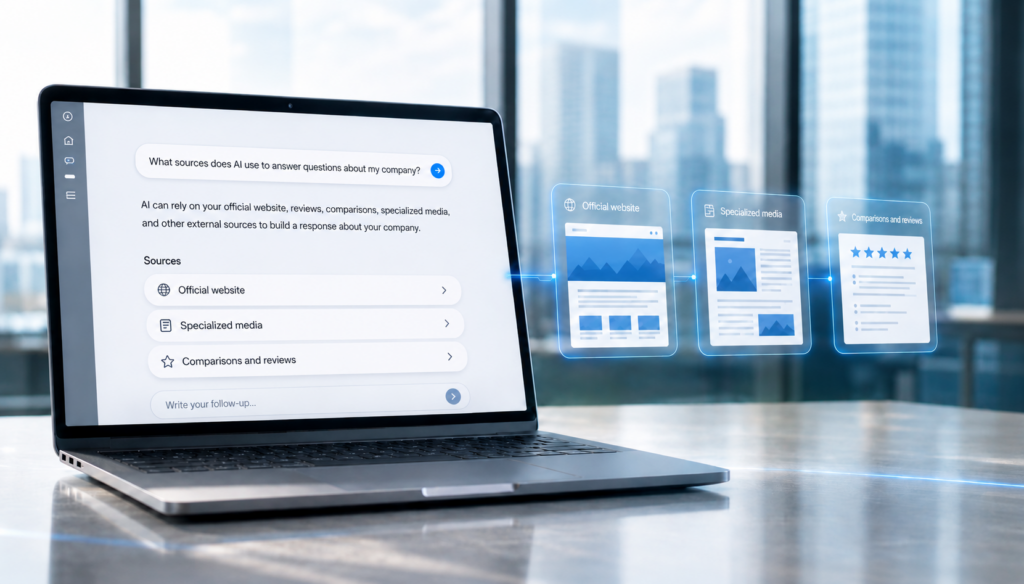
Imagine that a potential customer asks ChatGPT: “Is this company trustworthy?” The AI responds within seconds. It summarizes what your business does, highlights your strengths, perhaps compares you with alternatives and creates a first impression of your brand.
The user reads the response and forms an opinion.
But there is one crucial thing you do not know: which sources the AI used to answer questions about your company.
The response may rely on your official website. Or it may use an outdated directory, a comparison in which you rank below your competitors, an old review, an external article or a page that no longer accurately represents what you do.
This is the new challenge of digital visibility: it is no longer enough to know whether your company appears on Google. You also need to understand how it appears in artificial intelligence and which sources are shaping that response.
AI Is Already Talking About Your Company, Even If You Are Not Measuring It
Users are changing the way they search for information. It is becoming increasingly common to ask AI tools directly before visiting a website, reading a comparison or contacting a company.
Questions like these are already part of the decision-making process:
“Which company would you recommend for this service?”
“What alternatives are there to this brand?”
“Is this company trustworthy?”
“Which companies stand out in this sector?”
“What do users think about this company?”
“What is the best solution to this problem?”
In all these searches, AI can mention brands, rank them, compare them, summarize their benefits and convey a positive, neutral or negative perception.
OpenAI explains that ChatGPT Search provides answers with links to relevant web sources, while Google states that its AI features in Search, such as AI Overviews and AI Mode, can include website content within generative experiences for users.
This means that AI does more than simply provide answers. It also acts as an interpretive layer between your company and the market.
And when that interpretive layer is based on incomplete, outdated or unfavorable sources, the image users receive may differ from what your brand actually wants to communicate.
The Problem Is Not Just Appearing in AI, but Which Sources You Appear With
Many companies start by asking: “Does my brand appear in ChatGPT?” It is a good first question, but it is not enough.
The more important question is:
Which sources does AI use when talking about my company?
Because appearing does not always mean being represented accurately.
Your company may appear in an AI-generated response, but with outdated information. It may be mentioned, but not recommended. It may be included in a comparison, but ranked behind competitors that are explained more clearly. It may be described using external sources you do not control. Or it may appear with attributes that no longer reflect your current positioning.
That is why measuring AI presence is not just about checking whether a brand appears or not. It also involves analyzing the quality of that presence: what the AI says, which sources appear, what tone it uses, which competitors it mentions and what narrative it is building.
This approach is directly connected to GEO and LLMO positioning, a discipline focused on improving how brands are understood, cited and recommended by generative models.
What Types of Sources Might AI Be Using About Your Company?
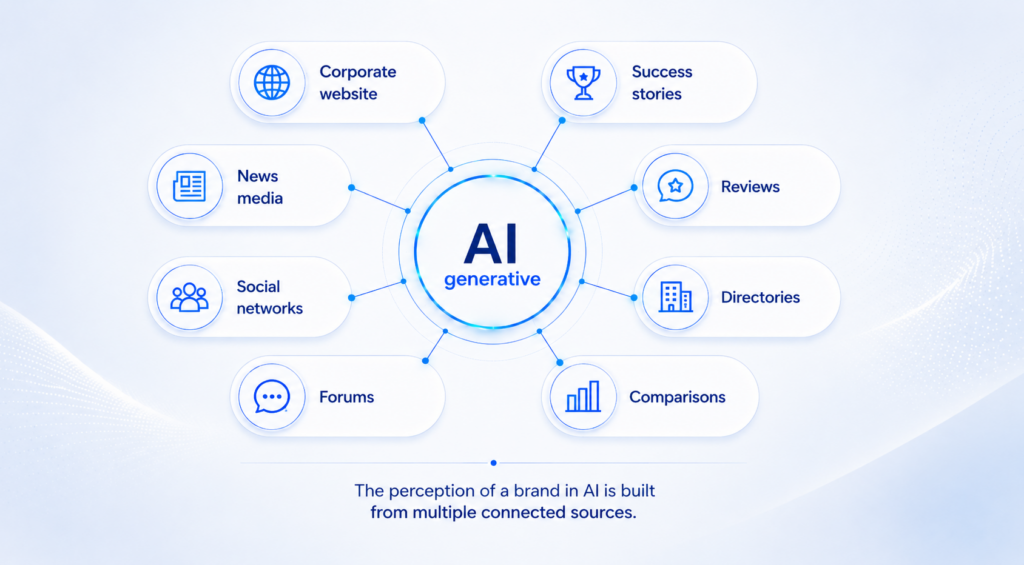
When an AI responds about a company, it may rely on different types of information. Some sources are visible because they appear as links. Others are not always shown explicitly, but they can still influence the response.
The most common sources include:
the company’s official website,
product or service pages,
corporate blogs,
success stories,
press releases,
news media,
industry rankings,
business directories,
tool comparison pages,
user reviews,
forums,
marketplaces,
social media profiles,
public documentation,
and third-party content.
The key point is that not all these sources have the same value for your brand.
If the AI uses your official website, an up-to-date success story and a well-structured guide published by your company, it will probably have more context to explain accurately what you do. However, if the response relies on a generic directory, an outdated description or a comparison in which your competitors have greater visibility, the resulting perception may be different.
That is why it is so important to know whether LLMs use your strategic sources or third-party sources to talk about your brand.
Why You Cannot Determine It Through a Manual Search
A simple way to start is by opening ChatGPT, Gemini, Copilot, Perplexity or Google and asking about your company. The problem is that a single query does not provide a reliable picture.
The response may vary depending on the model, language, country, time of the query, type of prompt or user intent. In addition, not all systems display sources in the same way.
In some cases, you will see links. In others, the AI will provide a response without visible citations. In other cases, it may cite a specific source, while the response is influenced by a broader set of signals.
Google recommends that website owners follow SEO best practices and ensure their content is accessible and crawlable in order to appear in generative Search experiences, but this does not replace the need to measure what actually happens when models respond about a brand.
That is why manual testing can be useful as an initial indicator, but not as a monitoring system.
To truly understand which sources AI uses when talking about your company, you need to analyze multiple responses, models, prompts and competitors.
AIBrandpulse360: The Tool for Identifying Which Sources AI Uses About Your Company
AIBrandpulse360 is a tool designed to measure and analyze brand presence in artificial intelligence.
One of its key functions is to help identify which sources are associated with AI-generated responses about a company, brand or its competitors.
This makes it possible to answer questions that many companies have previously been unable to address clearly:
Which sources appear when AI talks about my company?
Which of my own pages is it using or citing?
Which external sources are influencing brand perception?
Which content appears when AI recommends my competitors?
Which models mention my company and which do not?
Which sources repeatedly appear in comparative responses?
What information should be strengthened, updated or corrected?
The difference is significant: AIBrandpulse360 does not simply check whether a brand appears in AI. It enables companies to analyze where the information AI uses to talk about the brand comes from.
This makes the tool particularly useful for marketing, communications, reputation, sales, product and market intelligence teams that need to understand how generative models are representing their company.
From “What AI Says” to “Why It Says It”
Most audits begin with a superficial question: “What does ChatGPT say about my company?”
But the truly useful analysis begins afterwards:
Why does it say that?
Which sources are behind it?
Is that information up to date?
Does the narrative come from our website or from third parties?
Does AI associate us with the right attributes?
Are our competitors better supported by external sources?
This is where AIBrandpulse360 delivers value as a diagnostic tool. It helps connect the generated response with the sources, mentions and signals that may be influencing brand visibility.
For example, a company may discover that AI mentions it in branded queries, but not in category queries. Or that it appears when users ask about the company directly, but disappears when they search for “the best solutions for…”. It may also detect that a competitor appears more frequently because it is better represented in the media, comparison pages or authoritative content.
This information makes it possible to move from intuition to action.
What You Can Discover by Analyzing the Sources AI Uses
Identifying sources is not simply about creating an inventory of links. It helps you understand how your company’s reputation is being shaped within generative models.
Through source analysis, you may discover, for example, that AI is using an outdated description of your company. Or that your commercial pages are not appearing as references. Or that an external comparison carries more weight than your own content. Or that competitors have greater visibility because they are present in sources more closely connected to the category.
You can also identify opportunities.
If a source appears repeatedly in AI-generated responses about your sector, it may be a strategic space where your brand should be present. If a type of owned content appears in some models but not in others, it may need a clearer structure, stronger semantic clarity or greater external authority. If AI does not mention your brand in recommendation queries, you may be missing content focused on purchase intent, comparisons or use cases.
That is why source measurement should be connected to a broader strategy for reputation in AI and LLMs.
How to Use AIBrandpulse360 to Improve Your AI Presence
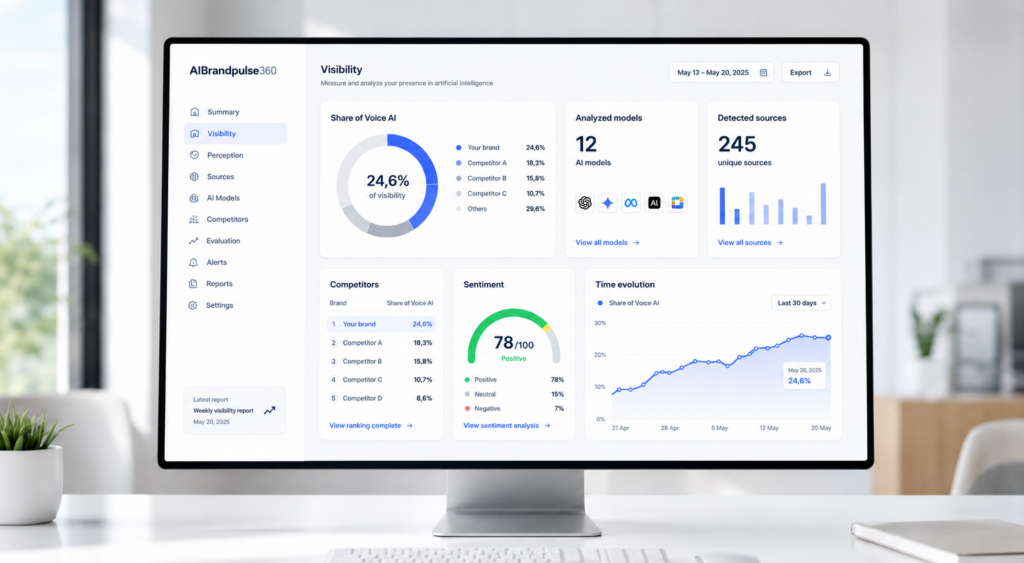
The value of knowing which sources AI uses lies in turning that information into concrete decisions.
With AIBrandpulse360, you can analyze your brand’s presence in AI-generated responses and identify which areas need improvement. The tool helps you assess visibility, mentions, competitors, perception, sentiment and associated sources.
Based on this diagnosis, a company can make decisions such as:
updating pages that AI is using with outdated information,
creating content for questions where the brand does not appear,
strengthening strategic pages that should serve as primary sources,
improving the semantic clarity of services and products,
building external mentions in media outlets or industry-specific platforms,
correcting inconsistent information in third-party sources,
and comparing brand presence against competitors across different models.
This approach also makes it possible to work with new indicators. It is no longer only about SEO rankings or organic traffic, but also about metrics such as AI share of voice, mention frequency, average position, sentiment, presence by model and the most frequently cited sources. These indicators form part of the new AI visibility KPIs.
Which Sources Should You Want AI to Use About Your Company?
It is not about AI using just any source. It is about AI using sources that accurately represent your brand.
Ideally, models should find a balanced combination of owned sources and authoritative external sources.
The most important owned sources include service pages, product pages, success stories, proprietary studies, documentation, FAQs, comparison pages, methodology pages and educational content that clearly explains what the company does and why it is relevant.
The most useful external sources include specialized media, industry reports, interviews, reliable rankings, partner mentions, high-quality reviews and relevant comparisons.
The key is not simply to be present. The key is for the sources that appear to reinforce the right narrative.
If you want your company to be perceived as a specialist, innovative, trustworthy or a leader in its category, the sources AI uses should support that perception.
AI Visibility Is Not Managed Once: It Must Be Monitored
AI-generated responses change. Models change, sources change, competitors change and the information available online changes.
A company may improve its presence in one model and lose visibility in another. It may appear in an informational query, but not in a comparison. It may be mentioned as an option, but not as the main recommendation.
That is why identifying which sources AI uses should not be treated as a one-off audit. It should form part of an ongoing monitoring system.
AIBrandpulse360 enables brands to approach this monitoring through a dedicated framework: measuring presence, identifying sources, analyzing perception and comparing performance over time against competitors.
This type of analysis is connected to the growing need to monitor brands across LLMs and understand how ChatGPT, Gemini, Perplexity, Copilot and other models influence the way users discover companies.
Knowing the Sources Is the First Step Towards Controlling the Narrative
AI can already answer questions about your company before a user visits your website. It can explain who you are, compare you with alternatives, summarize opinions and either recommend your brand or leave it out of a selection.
If you do not know which sources it uses to do so, you are leaving part of your reputation in the hands of content you may not control.
That is why the question “how can I find out which sources AI uses to answer questions about my company?” is not just a technical issue. It is a strategic one.
You need to know whether AI is using your owned sources, whether it relies on third parties, whether your competitors are better supported and whether the information circulating about your brand is helping or harming your positioning.
AIBrandpulse360 is a tool designed to answer that question. It enables you to identify the sources associated with AI-generated responses, analyze how your company appears across different models and detect opportunities to improve your visibility, reputation and presence in generative environments.
In traditional search, brands competed for rankings. In AI-powered search, they also compete to be understood, cited and recommended accurately.
And to achieve that, the first step is to understand which sources AI is using to talk about your brand.

 Sep 11, 2026


