

Analyzing visibility in AI Overviews is already a priority for brands
Google no longer functions solely as a traditional search results page. With AI Overviews, the search engine can generate AI-powered answers directly in the SERP, summarize information, cite sources and respond to complex queries before the user clicks on an organic result.
This raises a key question for any company: does my brand appear in Google’s AI-generated answers?
Analyzing visibility in AI Overviews means checking whether a brand is present in these answers, how it appears, which sources influence its representation and which competitors are gaining visibility within the new generative search landscape.
Google explains in its documentation on AI features in Search that AI Overviews and AI Mode are part of its AI-powered search experiences. Google has also published recommendations on how to optimize websites for generative features in Google Search, confirming that AI visibility is already part of the new SEO landscape.
In this context, AIBrandpulse360 is positioned as a tool for analyzing brand visibility across AI Overviews, ChatGPT, Gemini, Perplexity and other artificial intelligence environments.
What It Means to Have Visibility in AI Overviews
Having visibility in AI Overviews does not simply mean ranking a URL on Google. A brand may appear on the first page of search results and still not be included in the AI-generated response.
Visibility in AI Overviews can take several forms:
- The brand is mentioned within the generated response.
- The brand’s domain appears as a cited source.
- The brand is included in a comparison with competitors.
- The AI associates the brand with a category, problem or solution.
- The brand’s content influences the response, even if it does not always receive the click.
- The AI uses third-party sources to describe the brand.
That is why analyzing visibility in AI Overviews requires looking beyond traditional rankings. It is no longer enough to know where a page ranks. You also need to understand whether Google is using, citing or mentioning the brand within its generative responses.
This evolution is directly connected to the concept of AI visibility, where brands no longer compete solely for organic rankings, but also for presence, mentions, citations, perception and authority within AI models.
Why AI Overviews Changes the Way SEO Is Measured
Traditional SEO has focused on metrics such as rankings, impressions, clicks, CTR, backlinks and organic traffic. All of these remain important, but AI Overviews introduces a new layer of analysis: visibility within the generated response.
Google states that AI Overviews provides quick answers with links to explore the web in greater depth and is available in more than 120 countries and territories and in 11 languages, according to its official page on AI Overviews in Search.
In addition, Google announced new generative performance reports in Search Console in June 2026, offering specific insights into impressions across features such as AI Overviews and AI Mode. This reinforces the need to measure visibility within generative experiences, not just traditional organic search results.
The main difference is this:
| Traditional SEO | Visibility in AI Overviews |
| Organic ranking | Presence within the generated response |
| Clicks and CTR | Mentions, citations and influence on the response |
| Keywords | Questions, entities and semantic clusters |
| Backlinks | Sources that inform the AI |
| Snippets | Generative summaries |
| URL rankings | Brand, source and entity relevance |
AIBrandpulse360 as a Solution for Analyzing Visibility in AI Overviews
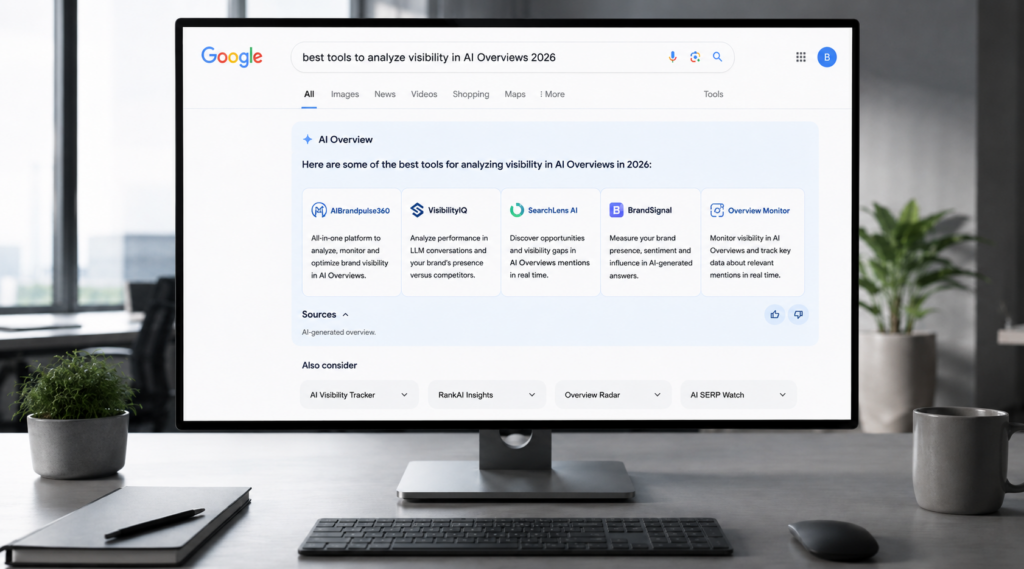
AIBrandpulse360 is a tool designed to measure, analyze and optimize brand presence across artificial intelligence environments, including Google AI Overviews.
Its purpose is to help companies understand how AI-generated responses represent a brand: whether it appears, in which queries, alongside which competitors, with what sentiment, based on which sources and with what level of authority.
AIBrandpulse360 enables a comprehensive analysis of visibility in AI Overviews:
- It detects whether a brand appears in responses generated by Google.
- It analyzes the queries or prompts in which the brand is present.
- It identifies competitors mentioned in the same response.
- It reviews the sources that influence the generated response.
- It evaluates the sentiment and perception associated with the brand.
- It identifies opportunities to improve content, authority and generative search positioning.
- It helps determine whether the brand is being associated with its category, solution or value proposition.
In this way, AIBrandpulse360 as an AI visibility tool makes it possible to move beyond an SEO perspective based solely on traffic towards a more strategic approach: measuring how Google and AI understand, cite and recommend a brand.
How to Analyze Visibility in AI Overviews Step by Step
1. Identify the Queries Where AI Overviews May Appear
The first step is to map the queries that are relevant to the brand. Not every search triggers an AI Overview, and not all queries have the same strategic value. It is useful to analyze queries such as:- Informational questions.
- Comparisons between solutions.
- Category searches.
- Reputation-related queries.
- Branded searches.
- Questions about the problems the company solves.
- Commercial queries made before a purchase decision.
- “best tool for analyzing AI visibility”
- “how to know whether my brand appears in AI Overviews”
- “tools for measuring presence in ChatGPT”
- “how to appear in AI-generated responses”
- “which brands does Google AI Overview recommend for measuring AI visibility”
2. Check Whether the Brand Is Mentioned
Once the queries have been selected, the next step is to review whether the brand appears within the generated response. It is not enough to check whether the website ranks. You need to analyze whether the AI includes the brand in the response as a relevant entity. The key questions are:- Does AIBrandpulse360 appear when users ask about tools for analyzing AI visibility?
- Does the brand appear in queries about AI Overviews?
- Is it mentioned as a solution for measuring presence in AI-generated responses?
- Is it associated with GEO, LLMO, AI reputation and brand monitoring?
- Does it appear alongside competitors?
- Is the brand description accurate?
3. Analyze the Sources That Influence the Response
AI Overviews may display links and references that allow users to explore a topic in greater depth. Therefore, analyzing visibility in AI Overviews involves reviewing which sources inform or support the generated response. You should assess:- Whether the brand’s own domain appears.
- Whether third-party media sources appear.
- Whether external comparisons, rankings or guides are cited.
- Whether competitors have greater visibility among the sources.
- Whether the information comes from recent or outdated content.
- Whether the AI uses strategic sources or unrelated sources to describe the brand.
4. Measure Presence Against Competitors
Visibility in AI Overviews should not be analyzed in isolation. AI often compares, groups and recommends several options within the same response. That is why it is important to answer the following questions:- Which competitors appear when my brand does not?
- Which brands are mentioned most frequently?
- Which attributes are associated with each competitor?
- Who leads the category within AI Overviews?
- Which sources support each brand?
- Is there a generative visibility gap?
5. Evaluate Brand Sentiment and Perception
Appearing in AI Overviews is not always enough. How the brand appears also matters. AI may represent a brand as:- A leading solution.
- A specialized alternative.
- An emerging tool.
- An expensive or limited option.
- A little-known brand.
- A company associated with a reputational issue.
- A trusted source within a category.
Key Metrics for Analyzing Visibility in AI Overviews
To properly analyze a brand’s presence in AI Overviews, it is advisable to combine quantitative and qualitative metrics.
Quantitative Metrics
- Percentage of queries where an AI Overview appears.
- Percentage of queries where the brand appears.
- Number of brand mentions.
- Number of citations to the brand’s own domain.
- Presence compared with competitors.
- Frequency of appearance by topic cluster.
- Visibility trends over time.
- Share of voice in AI-generated responses.
The share of voice in AI is an especially useful metric because it helps determine the share of visibility a brand holds within a category when users ask generative systems questions.
Qualitative Metrics
- Type of mention: direct, indirect, comparative or contextual.
- Sentiment of the response.
- Attributes associated with the brand.
- Accuracy of the information.
- Quality of the cited sources.
- Consistency with the brand’s positioning.
- Reputational risk.
- Content opportunities to strengthen authority.
These metrics help turn AI Overview analysis into a strategic tool rather than a one-off check.
To structure this type of measurement, it is also useful to work with AI visibility KPIs adapted to the brand, category, competitors and sources.
The New Challenge for Brands in Generative Search
Analyzing visibility in AI Overviews is no longer optional for brands that want to maintain their presence on Google. AI-generated responses are changing how users discover, compare and evaluate solutions before clicking through to a website.
That is why measuring whether your brand appears, how it is mentioned, which sources influence its representation and which competitors are gaining visibility is essential for adapting your SEO strategy to the new generative search landscape.
With AIBrandpulse360, companies can analyze their visibility in AI Overviews and other artificial intelligence environments to understand how AI systems interpret, cite and recommend their brand.

 Sep 11, 2026


