
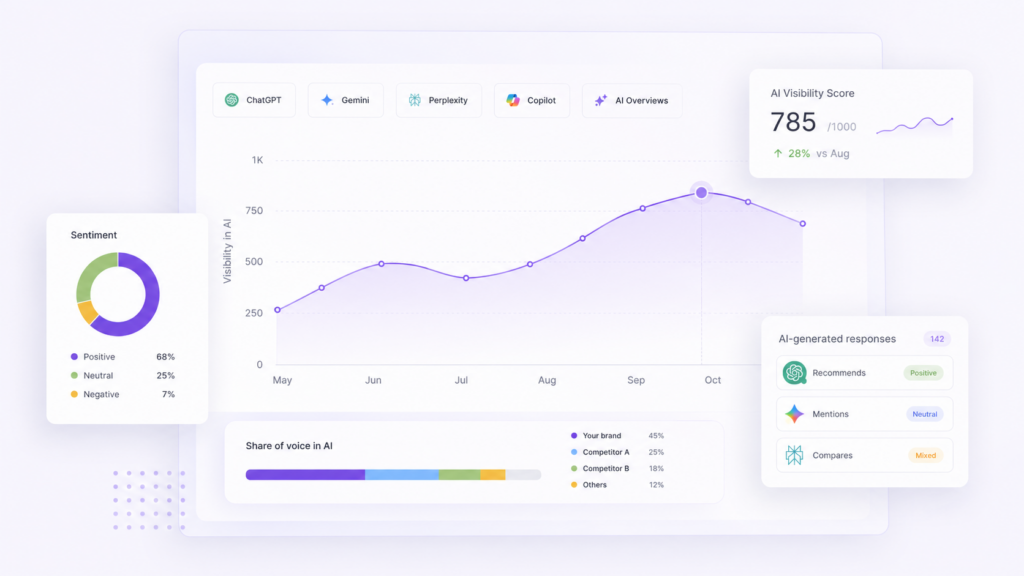
- How the brand is mentioned.
- What tone it appears with.
- Which competitors appear alongside it.
- Which sources AI uses.
- Whether the information is accurate, up to date and favourable.
- What opportunities exist to improve its presence.
What Does It Mean to Measure a Brand’s Reputation in AI?
- If AI mentions the brand: it means the brand has presence within the generated response.
- If AI recommends the brand: it indicates that it considers it a relevant option for the user’s query.
- If AI compares the brand: it is positioning it against other competitors in the sector.
- If AI omits the brand: there may be a visibility gap in queries where it should appear.
- If AI associates the brand with certain attributes: those concepts can strengthen or harm its positioning, for example “innovative”, “expensive”, “reliable” or “complex”.
- If AI uses external sources to talk about the brand: part of the perception depends on what third parties say, not only on official information.
- If AI shows errors about the brand: there is a reputational risk, especially if the data is incorrect, outdated or confusing.
Online Reputation and AI Reputation: What Is the Difference?
Traditional online reputation is measured across media, social networks, reviews, forums, Google results and digital mentions.
AI reputation, on the other hand, is measured within generative responses that summarise, combine and interpret information from multiple sources.
The key difference is this:
| Traditional online reputation | Reputation in AI answers |
| The user checks multiple sources | AI summarizes the answer |
| The brand can control part of the journey | AI decides what to show and how to tell it |
| It is measured across search engines, social media and media outlets | It is measured in ChatGPT, Gemini, Perplexity, Copilot or AI Overviews |
| Rankings, reviews and mentions matter | Mentions, sentiment, sources, accuracy and competitive context matter |
This changes the way digital reputation is managed. It is no longer enough to appear on Google or have good reviews: it is also necessary to understand how generative models interpret the brand.
Why It Matters How a Brand Appears in ChatGPT, Gemini or AI Overviews
- “What are the best software brands for monitoring reputation?”
- “Which company do you recommend for analysing AI visibility?”
- “Is this brand reliable?”
- “What alternatives are there to this solution?”
- “What problems do its customers usually have?”
Which Metrics Should You Use to Measure a Brand’s Reputation in AI?
To properly measure a brand’s reputation in AI-generated responses, it is advisable to combine quantitative and qualitative metrics.
Main metrics:
| Metric | What it measures | Example |
| Brand visibility | How many answers the brand appears in | Appears in 35 out of 100 prompts |
| Brand mentions | How often it is cited and in what context | Mentioned in comparative and recommendation-based queries |
| Share of voice in AI | Presence compared to competitors | Brand A 40%, Brand B 25%, Brand C 15% |
| Sentiment | Positive, neutral, negative or mixed tone | “Reliable and comprehensive”, “expensive but powerful” |
| Position in the answer | Where it appears | First recommendation or secondary mention |
| Accuracy | Accuracy of the information | Correct services, prices, products or location |
| Sources used | Which pages influence the answer | Official website, media outlets, directories, comparison sites |
| Reputational risk | Errors, biases or negative associations | Outdated data or confusion with another brand |
| Evolution over time | Month-on-month or quarter-on-quarter changes | Improved sentiment or loss of visibility |
A particularly useful metric is Share of Voice in AI, because it makes it possible to understand whether the brand has more or less presence than its competitors within generative responses.
Practical Measurement Example
Imagine a company analyses 100 prompts related to its sector.
The conclusion would not simply be “the brand appears”. The real interpretation would be:
The brand has a positive perception when it is mentioned, but it appears less often than its main competitors and depends too heavily on external sources to build its narrative.
This type of analysis is what turns measurement into real SEO, content, digital PR and reputation decisions.
How to Create a Methodology to Measure Brand Reputation in AI
Step 1: define the platforms to be analysed
Ideally, several tools should be reviewed, because each one may provide different responses.- ChatGPT.
- Gemini.
- Perplexity.
- Copilot.
- Google AI Overviews.
- Other answer engines relevant to the sector.
Step 2: create a list of prompts by intent
Not all prompts are useful for measuring the same thing. The recommended approach is to group them by search intent.Step 3: analyse branded and non-branded prompts
To measure reputation properly, it is necessary to combine two types of questions.
Branded prompts
These help you understand what AI says when the user already knows the company.
- “What do you think of [brand]?”
- “Is [brand] reliable?”
- “What advantages does [brand] offer?”
- “What are the problems with [brand]?”
- “What reputation does [brand] have?”
Non-branded prompts
These help you understand whether the company appears when the user does not know it yet.
- “What are the best brands in [category]?”
- “Which company do you recommend for [need]?”
- “What is the best solution for [problem]?”
- “Which brands stand out in [sector]?”
This part is key to measuring real presence. It is not just about checking whether AI responds well when asked directly about the brand, but about knowing whether it recommends it spontaneously.
Step 4: record the responses in a matrix
For the analysis to be useful, each response must be recorded in a structured way.
How to Interpret the Results
Appearing in AI-generated responses does not always mean having a good reputation. Visibility must be interpreted alongside sentiment, position and the competitive context.
That is why measuring mentions alone is not enough. It is also necessary to analyse tone, information quality, sources used and evolution over time.
How to Improve a Brand’s Reputation in AI-Generated Responses
1. Update the brand’s official information
The brand’s own website remains a key source. It is worth reviewing:- Homepage.
- Services or products.
- About us page.
- Frequently asked questions.
- Success stories.
- Contact.
- Category pages.
- Structured data.
- Social profiles and public descriptions.
2. Create useful content that is easy for AI to interpret
Generative models tend to rely on clear, complete and well-structured content. That is why the brand should create:- Practical guides.
- Comparisons.
- Definitions.
- Use cases.
- Frequently asked questions.
- Sector studies.
- Explanatory content about real user problems.
3. Strengthen reliable external sources
AI does not only look at what a brand says about itself. It also interprets what other sources say. That is why it is useful to work on mentions in:- Specialised media.
- Relevant directories.
- Sector comparisons.
- Studies and rankings.
- Verified reviews.
- Interviews.
- Market reports.
- Customer case studies.
4. Correct errors and inconsistent data
One of the major risks of AI is that it can repeat old, incomplete or incorrect information. Some common examples include:When these issues are detected, the original source should be corrected whenever possible.
5. Monitor competitors and content gaps
AI reputation should always be analysed in a competitive context. It is not enough to know whether the brand appears: it is also necessary to know who appears more often, who appears first and which attributes each competitor receives. AIBrandpulse360 helps detect opportunities such as:- Prompts where a competitor appears and the brand does not.
- Queries where the brand appears in a secondary position.
- Positive attributes associated with other players.
- Sources that cite competitors, but not the brand.
- Topics where owned content or external authority is lacking.
Common Mistakes When Measuring AI Reputation
Measuring a brand’s reputation in AI requires a clear method. These are some common mistakes:
It is also advisable to define AI visibility KPIs so that monitoring is comparable and does not remain a one-off review.

 Sep 11, 2026


