
The new SEO battleground: gaining visibility in artificial intelligence responses
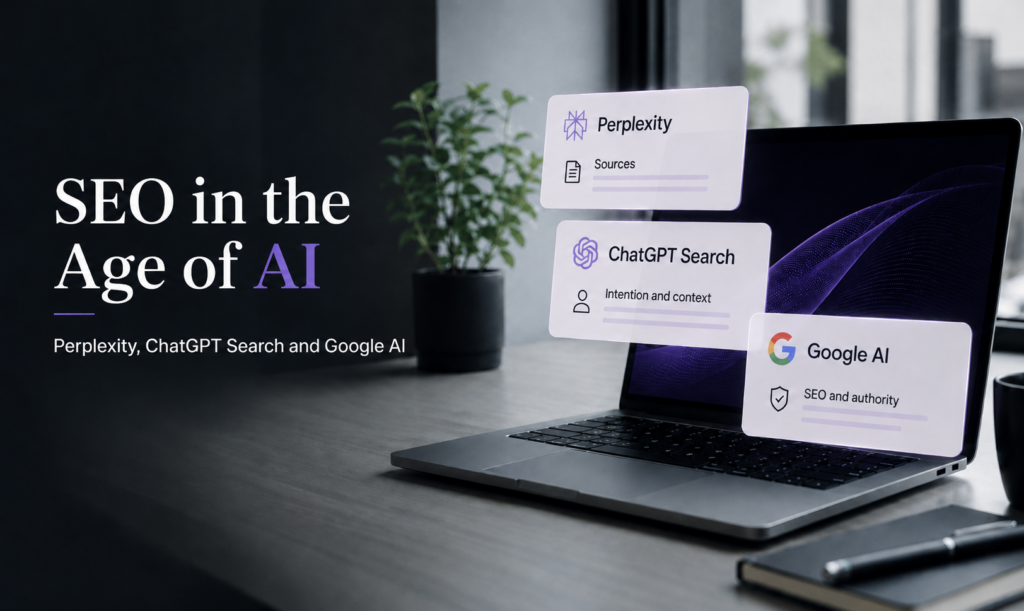
Users no longer rely solely on traditional search engines to find information. More and more people are using artificial intelligence tools such as Perplexity, ChatGPT Search and Google AI to discover brands, compare solutions, answer questions and make purchasing decisions.
This shift is creating a new landscape for businesses: appearing in a list of search results is no longer enough. Brands now need to be included in the responses generated by artificial intelligence.
The new question for brands is: “What does AI respond when a potential customer searches for a solution like the one we offer?”
Optimisation for generative engines, also known as GEO positioning, emerged precisely from this need: to help brands increase their visibility within artificial intelligence systems.
Traditional SEO vs SEO for artificial intelligence engines
Although traditional SEO remains essential, the emergence of AI-powered search engines is changing how digital visibility is measured.
The objective is no longer simply to achieve a strong position on Google, but to ensure that a brand is understood, considered relevant and recommended by artificial intelligence models.
Traditional SEO:
- Ranking web pages.
- Optimising keywords.
- Generating organic traffic.
- Measuring rankings and positions.
SEO for AI engines:
- Appearing in generated responses.
- Addressing complex search intents.
- Building authority and digital influence.
- Measuring mentions, recommendations and brand perception.
In this new context, AI visibility becomes a key metric for understanding whether a brand is present in the responses that influence user decisions.
SEO for Perplexity: the importance of being a trusted source

Perplexity operates as an AI-powered search engine that combines generated responses with references to different sources.
Its main objective is to provide useful, verifiable and contextualised information. For this reason, brands that want to appear in its responses should focus on creating content that conveys authority and trust.
Structured, easy-to-interpret content
Artificial intelligence systems need to understand the available information quickly.
That is why content with a clear structure is more likely to be used as a source:
- Descriptive headings.
- Direct answers.
- Lists and comparisons.
- Specific data.
- Explanations that are easy to extract.
Well-organised content helps both users and AI models identify the most relevant information without forcing the system to interpret confusing or poorly structured text.
Authority, references and trust
Artificial intelligence analyses different signals to determine which sources are reliable.
The most important factors include:
- Demonstrable expertise.
- Clearly identified authors.
- External mentions.
- High-quality references.
- Digital reputation.
The goal is not simply to publish more content, but to build a digital presence that demonstrates genuine knowledge of a subject. In this area, strengthening reputation in AI helps reinforce how models interpret a brand’s authority and reliability.
The importance of up-to-date information
AI engines need relevant, current information.
Updating older content, adding new data and maintaining consistent digital communications helps increase the chances of being used as a source.
SEO for ChatGPT Search: optimising for intelligent answers

ChatGPT Search introduces a new way of finding information online. Instead of displaying only a list of pages, artificial intelligence interprets the user’s intent and generates a response tailored to the context.
For this reason, SEO for ChatGPT Search requires thinking beyond traditional keywords.
Search intent is more important than the keyword
Search behaviour is evolving.
Previously, a user might search for:
“AI marketing software”
Today, they might ask:
“What is the best artificial intelligence tool for a small marketing team?”
Brands need to create content that answers complete questions and addresses real needs. That is why working on positioning in ChatGPT involves understanding how users formulate their questions and how the model interprets information.
Build topical authority
AI models need to identify which companies and sources have expertise in a specific area.
An effective strategy requires:
- Creating specialised content.
- Covering different aspects of the same topic.
- Demonstrating expertise.
- Maintaining consistency across all digital channels.
Create content designed for AI models
Content that is easier to interpret usually includes:
- Frequently asked questions.
- Comparisons.
- Clear definitions.
- Practical examples.
- Brief, direct answers.
Clarity is becoming an increasingly important SEO factor, especially when dealing with models that analyse context, connect concepts and generate responses from multiple sources.
SEO for Google AI: the evolution of traditional search
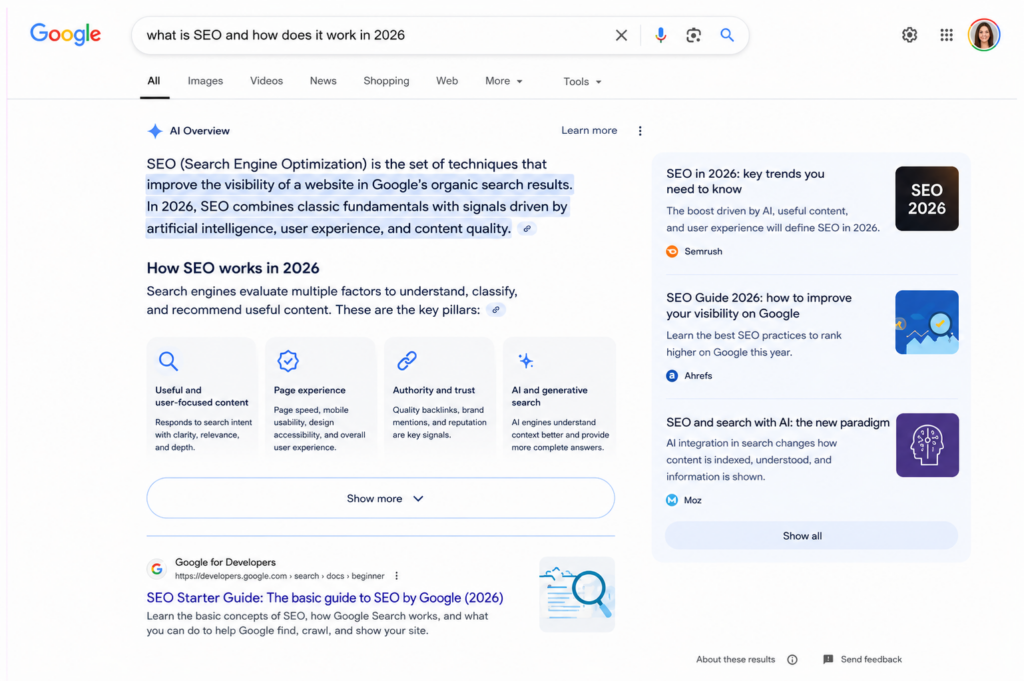
Google is integrating artificial intelligence into the search experience through new features such as AI Overviews. Although the way results are presented is changing, many traditional SEO principles remain essential.
The role of helpful content and experience
Google continues to prioritise content created for users, with original, useful and reliable information. The creator’s experience, the site’s authority and trustworthiness remain important factors for gaining visibility.
The importance of online authority
Google’s models use multiple signals to assess the relevance of a source. These include:
- Content quality.
- Domain authority.
- Relevant links.
- Digital reputation.
- Demonstrated experience.
The difference is that these factors now influence not only traditional rankings, but also the possibility of appearing within AI-generated responses.
How to adapt to AI Overviews
To increase the chances of appearing in AI-generated responses, brands should create content that is:
- Well structured.
- Easy to understand.
- Focused on real questions.
- Based on specific, useful information.
Understanding how Google AI Overviews works is essential for adapting the content strategy to this new way of presenting results on Google.
Key differences between Perplexity, ChatGPT Search and Google AI
Each platform uses artificial intelligence differently, so the SEO strategy must be adapted to each environment.
| Platform | What it prioritises | What the brand needs |
| Perplexity | Verifiable sources, citations and up-to-date content | Clear, reliable content supported by references |
| ChatGPT Search | Context, intent and comprehensive answers | Specialised content that addresses specific needs |
| Google AI | Traditional SEO combined with artificial intelligence | Authority, experience, useful content and a clear structure |
Taken together, these differences show that the shift from SEO to GEO is not about replacing traditional SEO, but expanding it to compete within AI-generated responses as well.
How to measure your brand’s visibility in AI engines with AIBrandPulse360
AIBrandPulse360 helps companies analyse how they appear in AI-generated responses, which competitors are gaining visibility and which factors influence a brand’s digital perception.
The platform makes it possible to monitor a company’s presence across the new AI search ecosystem by analysing mentions, recommendations, sources used and changes in visibility over time.
While traditional SEO measures rankings and organic traffic, the new generation of SEO needs to answer a different question: “Is artificial intelligence recommending my brand?”
With an AI visibility tool, marketing teams can turn AI visibility into a measurable, data-driven strategy. In addition, monitoring brands across LLMs makes it possible to understand whether a company appears, how it is mentioned and which competitors it is compared with within AI-generated responses.
The future of SEO: from ranking pages to being recommended by AI
Perplexity, ChatGPT Search and Google AI are changing the way users discover information. SEO is not disappearing, but it is evolving.
Brands no longer need to compete only to appear in search results. They must also work to be understood, cited and recommended by artificial intelligence systems.
The next competitive advantage will be ensuring that AI considers a brand to be a relevant, trustworthy and recommendable source.

 Sep 11, 2026


