
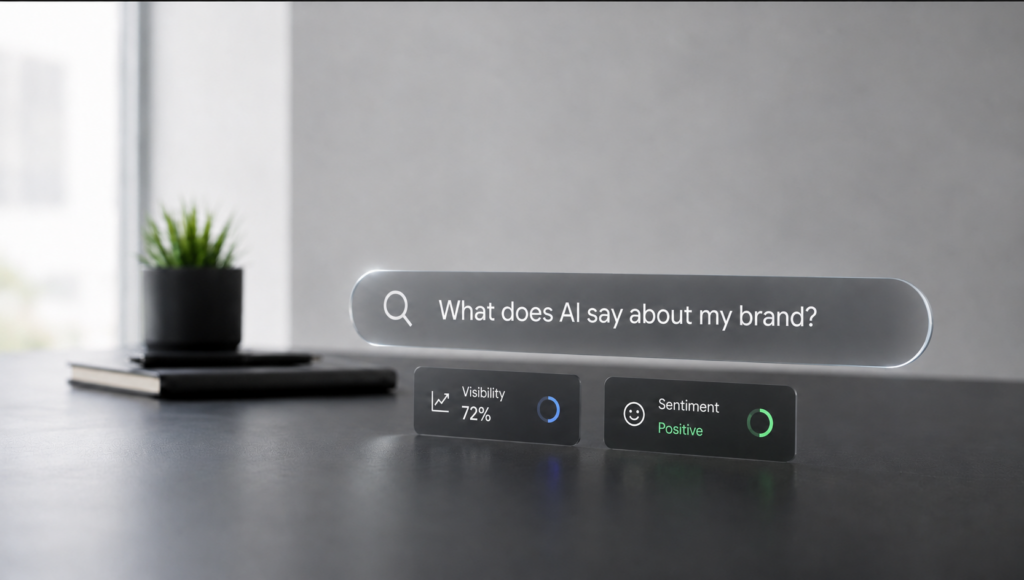
What is brand monitoring in ChatGPT?
Brand monitoring in ChatGPT consists of analysing how a brand appears within ChatGPT-generated responses: whether it is mentioned, how it is described, which competitors it is compared with, which sources influence the response and what perception it conveys to the user.
Until now, brand monitoring mainly focused on Google, social media, digital media outlets, reviews, forums and opinion platforms. However, search behaviour is changing. More and more users are asking AI systems directly to discover solutions, compare alternatives, validate decisions or understand which brands are relevant within a category.
This turns ChatGPT into a new space for discovery, comparison and decision-making. That is why brand monitoring can no longer be limited to understanding what is being said about a brand in search engines or on social media. It is also necessary to understand what ChatGPT responds when a user asks about your industry, your products, your competitors or the solutions you offer.
In this context, AIBrandpulse360 helps analyse the visibility, reputation and presence of brands in ChatGPT and other artificial intelligence environments.
Why monitoring your brand in ChatGPT is important
ChatGPT can influence how a brand is perceived before the user visits a website, reads a review or contacts a sales team. If someone asks about tools, providers, services or solutions within a category, the AI’s response can shape which brands they consider relevant.
This represents an important shift: brands are no longer competing only for rankings, clicks or media mentions. They are also competing to appear in conversational responses generated by AI.
Brand monitoring in ChatGPT makes it possible to answer questions such as:
- Does my brand appear when someone asks about solutions in my category?
- Does ChatGPT accurately describe what my company does?
- Which competitors appear alongside my brand?
- Which attributes does AI associate with my brand?
- Which sources does ChatGPT use to build its response?
- Is the resulting perception positive, neutral or negative?
- Is my brand being recommended, omitted or misrepresented?
In its introduction to ChatGPT Search, OpenAI explains that search in ChatGPT combines a natural language interface with access to up-to-date information from the web. For brands, this introduces a new layer of visibility: it is no longer enough to appear in search engines; it is also important to appear in the responses an AI assistant provides to users.
To explore this new reality in greater depth, you can read AIBrandpulse360’s guide on how to find out whether your brand appears or is recommended in AI-generated responses.
Brand monitoring in ChatGPT vs. traditional brand monitoring
Traditional brand monitoring analyses mentions across media outlets, social media, search results, reviews, forums and opinion platforms. Brand monitoring in ChatGPT adds a new layer: how AI interprets a brand.
The difference is key:
| Traditional brand monitoring | Brand monitoring in ChatGPT |
| Mentions in media and social networks | Mentions within AI-generated responses |
| Keyword tracking | Tracking prompts and conversational queries |
| Visible public reputation | Perception synthesised by language models |
| SEO rankings | Presence in responses, recommendations and comparisons |
| Sentiment analysis of published content | Sentiment analysis of generated responses |
| Share of voice across digital channels | Share of voice in AI environments |
Traditional monitoring is still necessary, but it is no longer enough. A brand may have a strong reputation on Google and social media, yet appear rarely, inaccurately or incompletely in ChatGPT.
That is why concepts such as AI brand monitoring, brand visibility in ChatGPT and the need to monitor brands across LLMs are becoming an essential part of digital visibility strategies.
What a brand monitoring strategy in ChatGPT should analyse
To monitor a brand correctly in ChatGPT, it is not enough to ask a one-off question and review a single response. A methodology is needed that covers different types of queries, contexts, competitors and metrics.
1. Brand presence
The first question is simple: does the brand appear in ChatGPT?
However, this presence must be analysed across different scenarios:
- Direct brand searches.
- Category searches.
- Comparative queries.
- Questions about the problems the brand solves.
- Recommendations for tools or providers.
- Reputation-related queries.
- Commercial-intent questions.
For example, a brand should analyse whether it appears in queries such as:
- “tools for brand monitoring in ChatGPT”
- “how to find out what ChatGPT says about my brand”
- “best tools for monitoring brands in AI”
- “how to measure brand visibility in ChatGPT”
- “solutions for reputation management in artificial intelligence”
This analysis makes it possible to determine whether ChatGPT recognises the brand as a relevant entity within its category or whether it is prioritising competitors instead.
2. Mentions and recommendations
Not all appearances have the same value. A brand may simply be mentioned, but it may also be recommended, compared or presented as a leading solution.
Brand monitoring in ChatGPT should distinguish between:
- Direct mention.
- Indirect mention.
- Explicit recommendation.
- Inclusion in a list of solutions.
- Comparison with competitors.
- Appearance as a source or reference.
- Absence from queries where it should appear.
This distinction is important because a secondary mention of a brand by ChatGPT does not have the same impact as presenting it as a relevant alternative within a category.
To analyse this dimension, it is useful to rely on a ChatGPT visibility tracker that can detect mentions, appearance frequency and changes over time.
3. Sentiment and perception
Brand monitoring in ChatGPT should not only measure whether a brand appears, but how it appears.
AI may describe a brand as:
- A leader.
- Innovative.
- Specialised.
- Expensive.
- Complex.
- Relatively unknown.
- Relevant to a specific category.
- An alternative to other competitors.
That is why the analysis should include sentiment and perception. A brand may have visibility while still being associated with attributes that do not align with its positioning.
AIBrandpulse360 makes it possible to analyse this layer of perception and understand whether AI is accurately representing a brand’s value proposition. This approach is connected to reputation in AI and LLMs, where the key is not only to appear, but to appear with the right narrative.
4. Competitors in ChatGPT
One of the most important parts of brand monitoring in ChatGPT is analysing which competitors appear when users ask about a category.
It is not enough to know whether your brand appears. You also need to know:
- Which competitors appear most frequently.
- Which prompts they appear in when your brand does not.
- Which attributes are associated with each competitor.
- Which brands are recommended as the main solution.
- Which sources support each brand.
- What share of presence each competitor holds.
This analysis helps identify a generative visibility gap. If your competitors appear frequently and your brand does not, AI may be displacing your presence at a key stage of the decision-making process.
To explore this further, you can review how to compare your brand with competitors in ChatGPT, Gemini, Claude and Perplexity.
5. Sources ChatGPT uses to talk about your brand
ChatGPT can generate responses based on the model’s knowledge and, when search is used, incorporate information from the web. OpenAI states that ChatGPT Search can provide responses with links to relevant sources, making the public content ecosystem increasingly important for brand visibility in AI.
That is why an essential part of brand monitoring in ChatGPT is analysing the sources that influence the response.
You should review:
- Whether ChatGPT uses the brand’s own sources.
- Whether it cites external media outlets.
- Whether it relies on third-party comparisons.
- Whether it uses up-to-date content.
- Whether the sources describe the brand accurately.
- Whether competitors have greater visibility across strategic sources.
This connects to a critical question: do LLMs use your strategic sources or third-party sources to talk about your brand?
If ChatGPT builds its response from incomplete, outdated or unfavourable sources, the resulting perception may not reflect the brand’s true positioning.
Key metrics for brand monitoring in ChatGPT
A strong brand monitoring strategy in ChatGPT should combine quantitative and qualitative metrics.
Quantitative metrics
- Percentage of prompts in which the brand appears.
- Number of brand mentions.
- Frequency of appearance by category.
- Share of voice compared with competitors.
- Number of times the brand is recommended.
- Number of responses that include the brand’s own sources.
- Changes in visibility over time.
- Presence by search intent.
AI Share of Voice is especially useful because it helps determine the share of visibility a brand holds within responses generated by AI models.
Qualitative metrics
- Response sentiment.
- Attributes associated with the brand.
- Accuracy of the information.
- Quality of the sources.
- Consistency with the brand’s positioning.
- Reputational risks.
- Level of recommendation.
- Comparison with competitors.
These metrics help move beyond a superficial reading towards a real assessment of visibility, reputation and positioning in ChatGPT. To structure the analysis, it is also useful to work with AI visibility KPIs tailored to the brand, category and competitors.
How to monitor your brand in ChatGPT step by step
1. Create a map of strategic prompts
The first step is to define a set of prompts that reflect how users might search for, compare or evaluate your brand.
These prompts should cover:
- Brand-related questions.
- Category-related questions.
- Comparisons.
- Recommendations.
- User problems.
- Use cases.
- Sales objections.
- Reputation-related queries.
Examples:
- “What do you know about [brand]?”
- “Which tools can be used to monitor a brand in ChatGPT?”
- “Which company would you recommend for analysing visibility in AI?”
- “Compare [brand] with its competitors”
- “Which brands are leaders in AI brand monitoring?”
- “How can I find out whether my company appears in ChatGPT responses?”
This map should be reviewed regularly, as user questions change and the models also evolve.
2. Analyse responses by cluster
Once the prompts have been defined, it is useful to group them into clusters:
- Brand.
- Category.
- Competitors.
- Reputation.
- Product.
- Use cases.
- Purchase decision.
- Sources.
- Comparisons.
This makes it possible to identify the conversational territories in which the brand appears and those in which it is absent.
For example, a company may perform well in branded searches but fail to appear in generic searches such as “tools for brand monitoring in ChatGPT”. This difference reveals a clear generative positioning opportunity.
3. Measure visibility and sentiment
The next step is to measure the frequency of appearance and the quality of the brand’s presence.
It is not enough to record mentions. You also need to analyse whether the response is positive, neutral, negative, incomplete or confusing.
A brand may appear in ChatGPT but be described using outdated information, placed in the wrong category or presented without its differentiating attributes. In that case, the issue is not only visibility, but also perception.
4. Review sources and external signals
Brand monitoring in ChatGPT should also review which public content is helping or harming the brand.
This includes:
- Corporate website.
- Blog.
- Product pages.
- Specialist media outlets.
- Comparison content.
- Directories.
- Studies.
- Reviews.
- Third-party content.
If AI cannot find clear and consistent signals about a brand, it may omit it, describe it in generic terms or prioritise better-documented competitors.
5. Turn analysis into action
The purpose of brand monitoring in ChatGPT is not simply to observe. It is to improve.
After the analysis, the brand should decide which actions to take:
- Create content for prompts in which the brand does not appear.
- Optimise key pages.
- Strengthen entities and categories.
- Improve the authority of owned sources.
- Publish studies or original data.
- Develop comparison content.
- Update brand messaging.
- Correct incomplete or outdated information.
- Improve internal linking.
This approach is directly connected to GEO and LLMO positioning, where the aim is not only to rank in traditional search engines, but also to increase brand presence in AI-generated responses.
Practical example of brand monitoring in ChatGPT
Imagine a SaaS company specialising in AI brand monitoring. When analysing its presence in ChatGPT, it discovers that it appears correctly when users search for it by name, but does not appear in generic prompts such as “best tools for monitoring brands in AI” or “how to measure a brand’s visibility in ChatGPT”.
This result indicates that the brand has a certain level of direct recognition but low category visibility. In other words, ChatGPT may know what the brand is when asked about it directly, but it does not yet consider it a reference when users search for solutions within the market.
Based on this diagnosis, the brand could create specific content for the prompts in which it is absent, strengthen category pages, improve comparison content, build mentions across external sources and update key messaging so that AI can better understand its value proposition.
Common mistakes when monitoring your brand in ChatGPT
When carrying out brand monitoring in ChatGPT, it is important to avoid certain mistakes that may distort the assessment:
| Common mistake | Why it is a problem |
| Asking only one question | A single response does not reflect the brand’s true visibility. Different prompts, contexts and search intents need to be analysed. |
| Measuring mentions only | Appearing does not always mean being well positioned. How the brand is described and the perception it conveys also matter. |
| Not comparing with competitors | Without competitive comparison, it is difficult to know whether the brand is gaining presence, losing visibility or being excluded from key recommendations. |
| Not reviewing sources | If AI relies on outdated, incomplete or unfavourable content, the way the brand is represented may not reflect its actual positioning. |
How to improve a brand’s presence in ChatGPT
Monitoring is the first step. Brands must then use the data to improve their presence in AI-generated responses.
Some key actions include:
Create clear, specialised content
ChatGPT needs clear signals to understand what a brand does. That is why strategic pages should explain the value proposition precisely, with useful, differentiated and up-to-date content.
Strengthen entities and categories
The brand should be connected to its category, use cases, main problems and solutions. This helps AI models interpret it within the right context.
Develop owned and external sources
Publishing content on the corporate website is not enough. What media outlets, comparison sites, studies, directories and third-party sources say about the brand also matters.
Optimise internal linking
Internal linking helps consolidate semantic relationships between content. For example, connecting articles about ChatGPT, reputation in AI, visibility in LLMs, sources, competitors and share of voice helps build a clearer architecture for search engines and AI models.
Measure continuously
ChatGPT responses can change. Sources, models, available data and the way users ask questions all evolve. That is why brand monitoring in ChatGPT should be an ongoing process rather than a one-off review.
Brand monitoring in ChatGPT and GEO: an evolution of SEO
Brand monitoring in ChatGPT is part of a broader evolution in digital positioning: from SEO to GEO. Traditional SEO remains important, but brands now also need to work on how they appear in generative engines, conversational assistants and language models.
This is where concepts such as GEO and LLMO come into play.
GEO, or Generative Engine Optimisation, focuses on improving a brand’s presence within AI-generated responses. LLMO focuses on optimisation for language models, helping systems such as ChatGPT better understand, associate and represent the brand.
In this new environment, the objective is no longer solely to generate traffic. It is also to ensure that AI correctly understands:
- What the brand does.
- Which category it competes in.
- Which problems it solves.
- What sets it apart from its competitors.
- Which sources support it.
- What level of authority it has.
- How it should be represented in a response.
That is why brand monitoring in ChatGPT should be integrated into a broader generative visibility strategy.
AIBrandpulse360 as a solution for brand monitoring in ChatGPT
AIBrandpulse360 is a tool for measuring and analysing brand visibility across artificial intelligence environments, including ChatGPT, AI Overviews, Gemini, Perplexity and other LLMs.
When applied to brand monitoring in ChatGPT, AIBrandpulse360 helps brands understand whether they appear in AI-generated responses, how they are described, which competitors appear alongside them, which sources influence the response and what perception the model conveys about the brand.
The methodology makes it possible to analyse a brand’s presence across different dimensions:
- Visibility in ChatGPT responses.
- Frequency of appearance by prompt or cluster.
- Comparison with competitors.
- Sentiment and perception generated by AI.
- Sources that influence the response.
- Opportunities to improve presence in AI.
- Reputational risks associated with incomplete or inaccurate responses.
In this way, AIBrandpulse360 as an AI visibility tool turns brand monitoring in ChatGPT into a strategic process of measurement, diagnosis and optimisation.
Its approach is not limited to ChatGPT. AIBrandpulse360 also helps analyse brand presence across AI Overviews, Gemini, Perplexity and other generative environments, providing a more complete view of AI visibility.
Conclusion: your brand also needs monitoring in ChatGPT
Brand monitoring in ChatGPT is now an essential part of any digital visibility strategy. Brands not only need to know what appears about them on Google, social media or digital media outlets. They also need to understand how AI responds when users ask about them, their competitors or the solutions available within their category.
ChatGPT can influence perception, comparison and decision-making. That is why monitoring brand presence in this environment makes it possible to identify opportunities, correct incomplete information, analyse competitors and strengthen brand authority in responses generated by artificial intelligence.
With AIBrandpulse360, companies can analyse their visibility across ChatGPT, Gemini, Perplexity, AI Overviews and other AI environments to find out whether their brand appears, how it appears and what opportunities they have to improve their presence in the new generative search ecosystem. Request an AI visibility analysis and discover what artificial intelligence says about your brand.

 Sep 11, 2026


